Photo: Wikipedia
Political ClimatePolitical Climate in Newport News, VA
District shown is the primary district for this city’s centroid. Cities may span multiple districts.
Local Political AnalysisPolitical Analysis of Newport News, VA
Newport News has a Cook PVI of D+18, meaning it leans heavily Democratic compared to the national average, and that tilt has only gotten stronger over the last decade. If you’ve lived here as long as I have, you remember when this was a more balanced place politically—working-class folks from the shipyard and military families kept things pretty center-right. But the last few election cycles have shifted the city solidly blue, and the local government has followed suit with policies that feel more and more like they’re coming from Richmond or D.C. than from the neighborhoods I grew up in.
How it compares
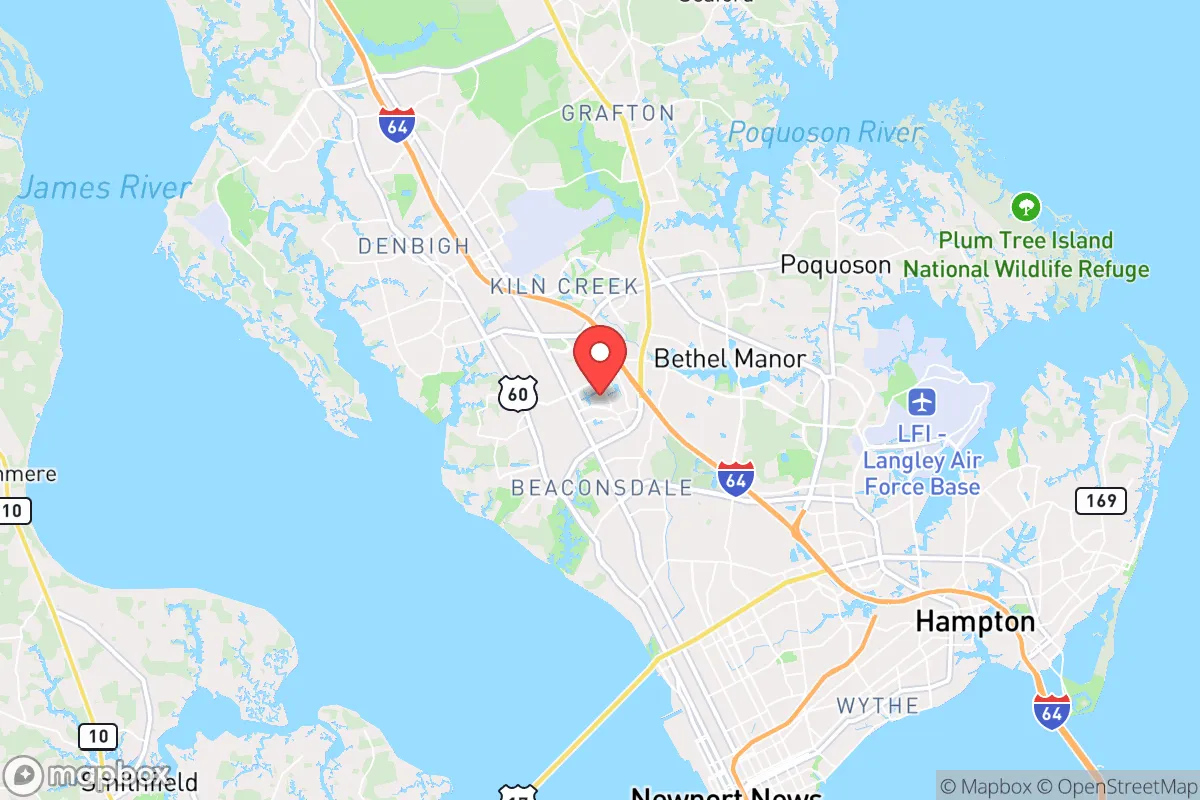
Drive 20 minutes west to York County or Williamsburg, and you’ll find a completely different political vibe—those areas are reliably red, with York County voting Republican by double digits in recent presidential races. Even Hampton, just across the James River, is less progressive than Newport News on paper, though it’s still blue. The real contrast is with Poquoson, a small city to the east that’s one of the most conservative spots in the entire state. What that means is that Newport News is an island of deep-blue politics in a region that’s actually pretty mixed. The city’s D+18 rating puts it in the same league as places like Richmond or Norfolk, but without the same level of progressive activism you’d see in those bigger cities—at least not yet.
What this means for residents
For folks who value personal freedoms and limited government, the trend here is concerning. The city council has been pushing zoning changes that make it easier to build high-density apartments in single-family neighborhoods, which sounds fine on paper but often means less say for homeowners about what goes up next door. There’s also been a steady creep of new regulations on small businesses—things like paid sick leave mandates and stricter permitting that sound good in a press release but hit mom-and-pop shops hard. And the school board has leaned into curriculum changes that prioritize social-emotional learning over core academics, which a lot of parents I know feel is an overreach into how they raise their kids. Property taxes have gone up to fund these priorities, and while services like parks and libraries are decent, you start to wonder if the trade-off is worth it when you see your paycheck shrinking and your neighborhood changing faster than you can keep up.
Culturally, Newport News still has a strong military and shipyard identity—Northrop Grumman is the biggest employer, and you can’t escape the sound of the foghorns or the sight of carriers in the river. That blue-collar backbone used to keep things grounded, but the political class here seems more interested in chasing progressive trends than preserving what made this place work. The city has also leaned into “equity” initiatives that, in practice, mean more bureaucracy and less transparency—like the recent push for a racial equity task force that has more power than most residents realize. If you’re thinking about moving here, just know that the political climate is shifting fast, and it’s not heading in a direction that respects the kind of freedom and local control that used to be a given in this part of Virginia.

State Political ClimatePolitical Climate in Virginia
State Political AnalysisPolitical Environment in the State
Virginia has transformed from a reliably conservative Southern state into a competitive purple battleground, with Democrats now controlling the governorship and both legislative chambers after a decade-long leftward shift. The state voted for Joe Biden by 10 points in 2020, a stark contrast to its Republican lean as recently as 2004, driven largely by explosive growth in the Washington D.C. suburbs and a steady erosion of rural conservative influence. For a conservative considering relocation, Virginia offers a mixed bag: low taxes and strong gun rights on paper, but a policy environment increasingly hostile to traditional values and personal freedoms.
Urban vs. rural divide
The political map of Virginia is a tale of two Virginias. The urban crescent—Northern Virginia (Fairfax, Loudoun, Prince William counties), Richmond, and Hampton Roads (Norfolk, Virginia Beach)—drives the state’s blue lean. Northern Virginia alone accounts for over a third of the state’s population and votes Democratic by margins of 30-40 points, powered by federal employees, tech workers, and a heavily diverse population. Loudoun County, once a conservative stronghold, flipped blue in the 2010s and now routinely delivers 60%+ for Democrats. Meanwhile, rural and exurban areas—Southwest Virginia (Bristol, Roanoke), the Shenandoah Valley (Harrisonburg, Staunton), and Southside (Danville, Martinsville)—vote Republican by similar margins, but their populations are shrinking or stagnant. The Richmond suburbs like Chesterfield and Henrico have become competitive, with Henrico trending blue as younger families move in. The result is a state where a Republican can win statewide only by running up huge margins in rural areas while keeping losses in the suburbs manageable—a formula that failed in 2020 and 2021.
Policy environment
Virginia’s tax burden is moderate compared to the Northeast, with a flat income tax rate of 5.75% and a state sales tax of 5.3% (higher in some localities). Property taxes are set locally and vary widely—Loudoun County averages around 1.2% of assessed value, while rural Grayson County is under 0.6%. The regulatory posture has shifted left under Governor Glenn Youngkin (a Republican) and a Democratic legislature: the state re-joined the Regional Greenhouse Gas Initiative (RGGI) in 2021, raising electricity costs, and passed the Virginia Clean Economy Act, mandating a carbon-free grid by 2050. Education policy is a flashpoint: Youngkin pushed through a model "Parents’ Bill of Rights" in 2022, but Democrats have blocked efforts to expand school choice or charter schools. Healthcare is heavily regulated, with Medicaid expansion under the Affordable Care Act in 2019 covering 400,000 new enrollees. Election laws are relatively secure—voter ID is required, but no-excuse absentee voting and same-day registration were expanded in 2020. For conservatives, the biggest red flag is the state’s willingness to preempt local gun laws: a 2020 law allows localities to ban firearms in government buildings and public parks, a direct infringement on Second Amendment rights.
Trajectory & freedom
Virginia is becoming less free for conservatives by nearly every measure. The 2020 General Assembly, under Democratic control, passed a sweeping gun control package: universal background checks, a "red flag" law (allowing confiscation of firearms without due process), and a one-handgun-per-month limit. Youngkin’s 2021 victory was a backlash, but he has been unable to roll back these laws due to Democratic legislative majorities. On parental rights, Youngkin’s executive order banning "inherently divisive concepts" in schools (critical race theory) was a win, but Democrats have fought it in court. Medical autonomy took a hit with the 2021 repeal of Virginia’s certificate-of-need law for hospitals, which reduced regulatory barriers, but the state also expanded abortion access in 2023, eliminating the 24-hour waiting period and requiring insurance coverage. Property rights are under pressure from aggressive zoning changes in Arlington and Alexandria that upzone single-family neighborhoods for high-density development, often without neighborhood input. The trajectory is clear: without a Republican trifecta, expect more gun restrictions, higher energy costs, and erosion of school choice.
Civil unrest & political movements
Virginia has been a flashpoint for political violence and activism. The 2017 "Unite the Right" rally in Charlottesville left one counter-protester dead and cemented the state’s image as a battleground over Confederate monuments and free speech. Since then, left-wing activist groups like the Virginia Civic Engagement Table and Indivisible have organized massive protests against Republican policies, while conservative groups like the Virginia Citizens Defense League have mobilized for gun rights rallies at the state capitol. Immigration politics are heated: Fairfax County and Prince William County have declared themselves "sanctuary" jurisdictions, refusing to cooperate with ICE detainers, a policy that Youngkin has tried to reverse through executive orders. Election integrity remains a sore spot: the 2020 election saw widespread use of drop boxes and ballot harvesting, and a 2021 audit found no fraud, but many conservatives remain skeptical of the state’s mail-in voting system. The most visible flashpoint for a new resident would be the constant protests at the state capitol in Richmond—gun rights rallies, abortion rights marches, and school board meetings that have turned into shouting matches over critical race theory and LGBTQ curriculum.
Projection
Over the next 5-10 years, Virginia will likely continue its leftward drift, driven by demographic trends that favor Democrats. Northern Virginia is growing faster than the rest of the state, with Loudoun County adding 30,000 residents per year, mostly from out-of-state transplants who lean progressive. The rural population is aging and shrinking, meaning Republicans will need to win by even larger margins in those areas to stay competitive. Youngkin’s 2021 win was an anomaly fueled by a backlash to COVID lockdowns and critical race theory; without a similar national wave, a Republican governor is unlikely in 2025 or 2029. The state legislature is likely to remain under Democratic control, meaning more gun control, higher taxes, and expanded social programs. For a conservative moving in now, expect to see the state become more like Maryland or New Jersey within a decade—high cost of living, strict regulations, and a culture that is increasingly hostile to traditional values.
For a conservative relocating to Virginia, the bottom line is this: you’ll find low taxes and a strong economy, but you’ll be fighting a losing battle on cultural and political issues. If you’re a single professional or a parent, the best bet is to settle in a conservative-leaning exurb like Spotsylvania County or Fredericksburg, where you can still find good schools and a like-minded community, while accepting that the state as a whole will continue to drift left. The freedom you’re looking for is increasingly found in the rural counties, not the state capitol.
* Values derived from national, state, county, city and local statistics and may differ in a specific area. Last updated: 2026-04-19T20:10:22.000Z
Narrative content on this page is AI-generated and may contain mistakes. Verify any details that matter before acting on them.
ReloMaps may earn a commission from affiliate links at no extra cost to you.

