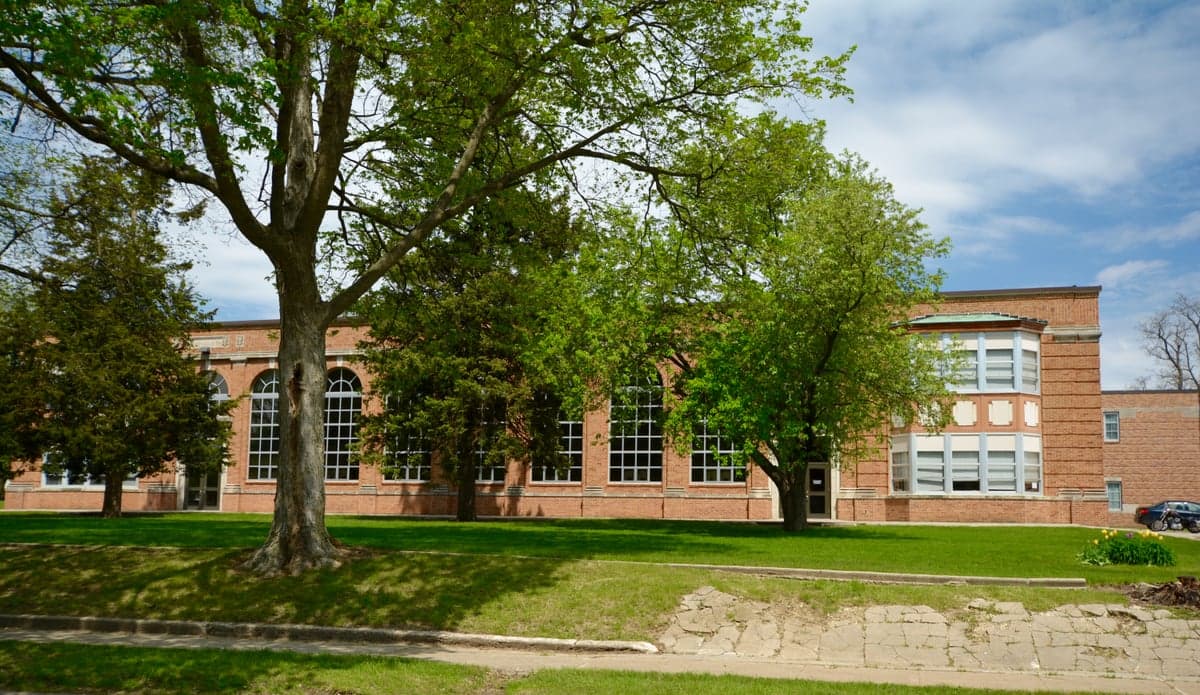
Photo: Wikipedia
Demographics of Newton, IA
Affluence Level in Newton, IA
A middle-class area roughly in line with national averages across income, home values, education, and employment.
People of Newton, IA
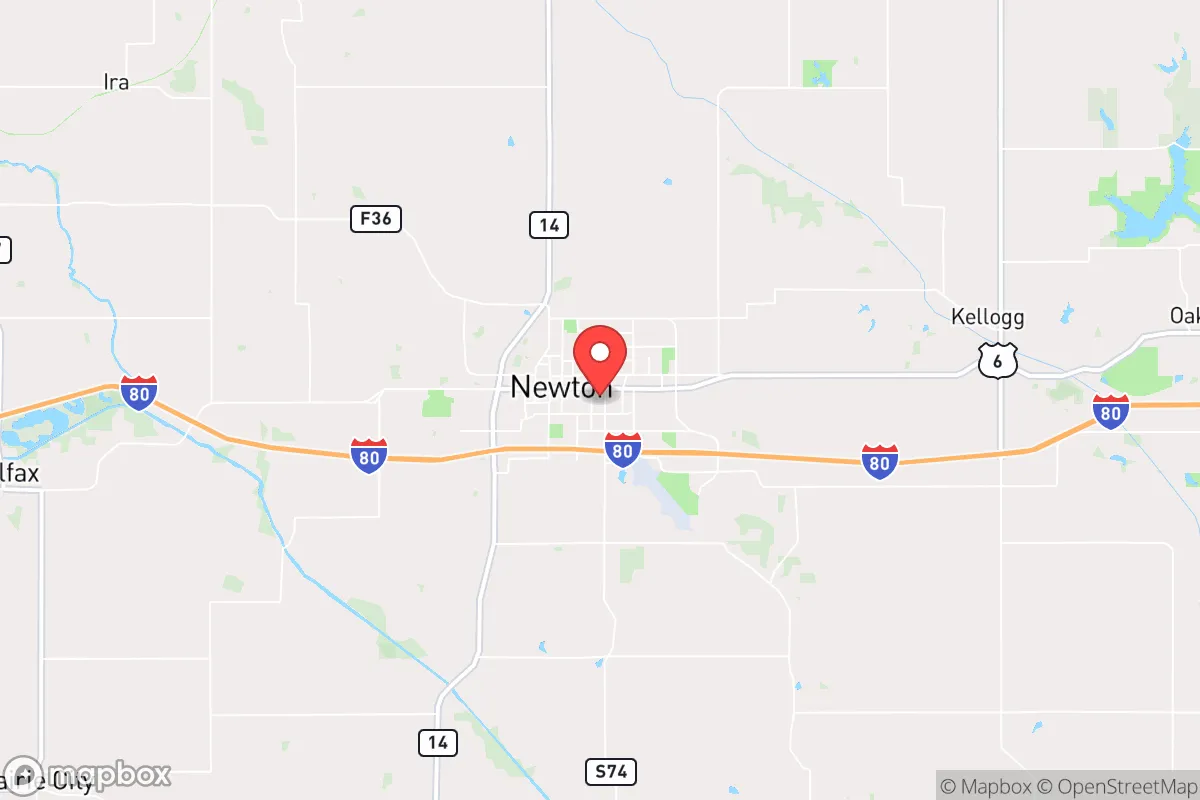
The people of Newton, Iowa, today number roughly 15,700 and form a predominantly white, working- and middle-class community with a strong manufacturing heritage. The city is notably less diverse than the national average, with a foreign-born population of just 3.7% and a Hispanic share of 5.1%, reflecting a population that has remained largely stable in its ethnic composition over recent decades. Distinctive identity markers include a deep-rooted pride in the town’s history as the home of the Maytag Corporation and a growing sense of place as a more affordable, quieter alternative to the Des Moines metro area, located about 30 miles east.
How the city was settled and grew
Newton’s population history begins with its founding in 1846 as a railroad and agricultural service center. The first major wave of settlers were Anglo-American farmers and merchants from Ohio, Indiana, and New York, drawn by the promise of cheap land along the Skunk River and the arrival of the Keokuk & Des Moines Railroad in the 1860s. These early residents built the Downtown Historic District around the courthouse square, establishing a grid of wood-frame homes and brick commercial blocks that still define the city’s core. A second, smaller wave arrived in the late 19th century: German and Irish immigrants who found work in the new coal mines and brickyards east of town, settling in what became known as the East Side near the railroad tracks. The defining population event, however, was the 1893 founding of the Maytag Company. Over the next 60 years, Maytag’s expansion into washing machines drew thousands of workers from rural Iowa and the Midwest, creating a company-town culture that concentrated in the Maytag Addition neighborhood—a planned area of modest bungalows and duplexes built by the company for its employees. By 1960, Newton’s population peaked near 16,000, overwhelmingly white and native-born, with a strong unionized workforce.
Modern era (post-1965)
After the 1965 Hart-Cellar Act, Newton saw virtually no immigration-driven diversification. The foreign-born share remained below 4% through 2020, and the city’s Black population (1.6%) and East/Southeast Asian population (0.1%) are negligible. Instead, the major demographic shift has been domestic: the gradual decline of Maytag, which closed its last Newton plant in 2007, triggered an out-migration of younger workers and a simultaneous in-migration of retirees and commuters seeking lower housing costs. These newer residents have gravitated toward the West Side subdivisions—such as the Sunset Ridge and Prairie View developments—where newer, larger homes on cul-de-sacs appeal to families working in Des Moines or at the remaining industrial employers like TPI Composites (wind turbine blades) and Vermeer Corporation. The Hispanic population, while small at 5.1%, has grown modestly since 2000, concentrated in the South Side around the former Maytag plant and along Highway 14, where several Mexican restaurants and a small grocery have opened. This group is largely composed of second- and third-generation Mexican-American families who moved from larger Iowa cities like Des Moines for affordable housing and manufacturing jobs. The Indian-subcontinent population is effectively zero, and no Arab community is present.
The future
Newton’s population is likely to remain stable or decline slightly over the next 10–20 years, with a slow homogenization rather than tribalization into distinct enclaves. The Hispanic share may rise to 7–8% as families grow, but the city lacks the economic magnets—large universities, refugee resettlement programs, or high-tech corridors—that drive rapid diversification elsewhere. The white population, now 88.6%, will continue to age in place, particularly in the Maytag Addition and Downtown Historic District, where many long-term residents are retirees. Younger families will likely continue to choose the West Side subdivisions, reinforcing a geographic split between older, established neighborhoods and newer, commuter-oriented ones. The college-educated share (18.8%) is low and may edge upward only slowly as remote work attracts a small number of professionals from the Des Moines metro. No significant immigrant community is expected to emerge, barring a major new employer or refugee program.
For someone moving to Newton now, the city offers a stable, predominantly white, working-class community with a strong sense of local history and a modest but growing Hispanic presence. The population is not diversifying rapidly, and the main demographic story is the aging of the Maytag-era cohort and the slow replacement by commuters and retirees. Newton is becoming a quieter, more residential satellite of Des Moines—a place where the past is still visible in the neighborhoods built by a single company, and where the future looks much like the present.

* Values derived from national, state, county, city and local statistics and may differ in a specific area. Last updated: 2026-04-23T00:45:57.000Z
Narrative content on this page is AI-generated and may contain mistakes. Verify any details that matter before acting on them.
ReloMaps may earn a commission from affiliate links at no extra cost to you.

