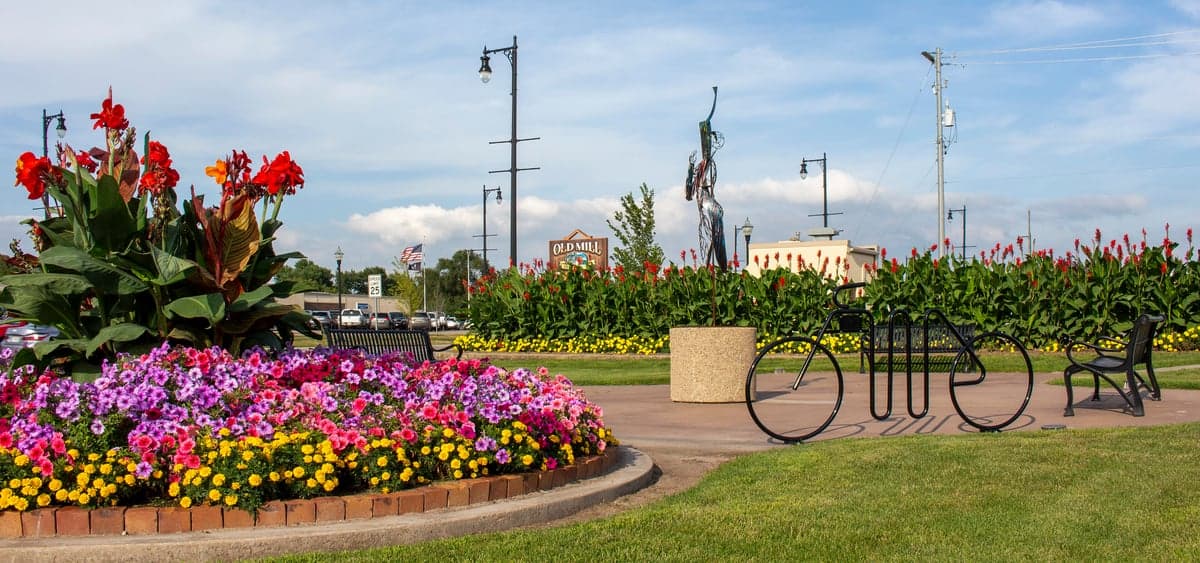
Photo: Wikipedia
Personal Sovereignty in Norfolk, NE
Viable for self-reliance. Generally workable, though some barriers may limit total independence.
What does Personal Sovereignty tell us?
Personal Sovereignty measures your capacity for self-reliance and independence with minimal government friction. Higher scores mean fewer barriers between you and the way you want to live... but it assumes you have the space you need and good neighbors.
What does this tell us?
Personal Sovereignty measures your capacity for self-reliance and independence with minimal government friction. Higher scores mean fewer barriers between you and the way you want to live... but it assumes you have the space you need and good neighbors.
State Policy
Energy independence: Importer (35% of energy produced in-state)
Personal Liberty
Homesteading

Personal Liberty Analysis
Norfolk, Nebraska, offers a personal sovereignty environment that stands out in the Great Plains for its blend of low regulatory friction and a deeply ingrained culture of self-reliance. Unlike coastal or even some Midwestern metro areas where local ordinances increasingly dictate daily life, Norfolk operates under a distinctly hands-off county and state framework that prioritizes individual decision-making over bureaucratic oversight. For the survivalist or prepper, this translates into a place where the default assumption is that you can manage your own affairs—from how you secure your home to how you raise your food—without needing permission slips from a zoning board or a state agency. The key question for anyone considering relocation here isn't whether you can live freely, but whether you're prepared to take on the full responsibility that comes with that freedom.
Tax burden and regulatory posture: How Nebraska compares to high-tax states
Nebraska’s tax structure is a mixed bag that still favors the sovereign individual compared to high-tax states like California, New York, or Illinois. The state imposes a progressive income tax with rates topping out at 6.84% for 2025, which is moderate but not negligible. However, Norfolk residents benefit from Madison County’s relatively low property tax levies—around 1.5% of assessed value, which is below the national average and significantly lower than the 2%+ rates found in many Northeastern or West Coast counties. The real win for personal sovereignty here is the regulatory environment. Nebraska is a right-to-work state, meaning you cannot be forced to join a union as a condition of employment, and the state has no statewide building code for single-family homes in most rural areas. This means that in Norfolk and the surrounding unincorporated areas, you can build a modest home, workshop, or storage structure without the costly permit delays and inspections that plague jurisdictions like Denver or Portland. The state’s sales tax is 5.5%, with Norfolk adding a local option of 1.5%, totaling 7%—manageable and predictable. For the prepper, the absence of a state-level income tax on Social Security benefits (Nebraska exempts them) is a direct boost to financial autonomy in retirement.
Self-defense and gun law specifics: What Norfolk allows that other cities restrict
Nebraska is a constitutional carry state as of 2023, meaning Norfolk residents can carry a concealed firearm without a permit. This is a foundational pillar of personal sovereignty for the survivalist mindset. The state preempts local gun ordinances, so Norfolk cannot enact the kind of magazine bans, assault weapon restrictions, or waiting periods that cities like Seattle or Chicago impose. You can legally own suppressors, short-barreled rifles, and machine guns under federal NFA rules, and the state does not require registration of firearms. Stand-your-ground laws are in effect, with no duty to retreat in any place you are lawfully present. For home defense, this is critical: if someone forcibly enters your residence, you have a legal presumption of reasonable fear of death or great bodily harm. The only notable restriction is that concealed carry is prohibited in certain posted locations like schools and government buildings, but these are standard exceptions. For the prepper, the ability to keep a loaded firearm in your vehicle without a permit (legal under state law) and to defend your property without legal ambiguity is a significant advantage over states with "safe storage" laws or duty-to-retreat doctrines.
Self-reliance and homesteading viability: Lot sizes, zoning, and off-grid feasibility
Norfolk’s zoning and land-use policies are a strong draw for those seeking self-reliance. Within city limits, standard residential lots range from 7,000 to 12,000 square feet, and the city code explicitly allows for backyard chickens, beekeeping, and small-scale vegetable gardens without special permits. For larger homesteading ambitions, the unincorporated areas of Madison County—just a 10-minute drive from downtown Norfolk—offer parcels starting at 1 to 5 acres with minimal zoning restrictions. There is no county-wide ban on rainwater collection, and Nebraska law actually encourages it by exempting rainwater harvesting systems from water rights permitting. Off-grid feasibility is high: the region’s shallow water table (typically 20-40 feet) makes private well drilling affordable, and septic systems are standard for rural properties. Solar panel installation is unrestricted, and net metering is available through Norfolk’s municipal utility, though the buyback rate is lower than retail. For the serious prepper, the ability to own a small acreage, drill a well, install solar, and keep livestock without a parade of inspectors is a tangible expression of sovereignty that is increasingly rare in the United States. The only caveat is that the city does enforce basic nuisance ordinances (noise, junk vehicles), but these are reasonable and rarely used against legitimate homesteading activities.
Personal liberties: Parental rights, medical autonomy, speech, and property
Norfolk sits in a state that has consistently pushed back against federal overreach in several key areas of personal liberty. Nebraska law protects parental rights explicitly, stating that parents have the fundamental right to direct the upbringing, education, and healthcare of their children. This means no state-mandated vaccine requirements for school attendance beyond standard childhood immunizations (which have a broad religious exemption), and no forced curriculum on sexual orientation or gender ideology in K-12 classrooms. Medical autonomy is strong: Nebraska does not have a state-level vaccine passport mandate, and the state’s health department has not imposed lockdown-style business closures since 2021. For the prepper concerned about medical freedom, the state’s Right to Try law allows terminally ill patients access to experimental treatments, and there are no laws prohibiting the purchase of antibiotics or other medications for personal stockpiling (though a prescription is still required from a licensed provider). Free speech is protected under Nebraska’s constitution, which has been interpreted more broadly than the First Amendment in some cases, and Norfolk has no local hate speech ordinances that chill political expression. Property rights are robust: Nebraska is a "Dillon’s Rule" state, meaning local governments only have powers explicitly granted by the state, which limits Norfolk’s ability to impose rent control, short-term rental bans, or restrictive historic preservation overlays. For the landowner, this means you can generally use your property as you see fit, within basic health and safety codes.
In the broader landscape of American personal sovereignty, Norfolk, Nebraska, ranks as a strong but not extreme option. It lacks the total absence of state income tax found in Texas or Florida, and its winters require a serious commitment to self-sufficiency in heating and food storage. However, for the conservative-leaning individual or family who values the ability to keep and bear arms without bureaucratic hurdles, to raise children with minimal state interference, and to pursue a homesteading lifestyle on affordable land, Norfolk offers a balance that few other regions can match. The trade-off is that you are trading the convenience of urban amenities for the quiet freedom of a place where the government largely stays out of your way—and where your sovereignty is limited only by your own preparation and grit.

* Values derived from national, state, county, city and local statistics and may differ in a specific area. Last updated: 2026-04-23T02:30:40.000Z
Narrative content on this page is AI-generated and may contain mistakes. Verify any details that matter before acting on them.
ReloMaps may earn a commission from affiliate links at no extra cost to you.

