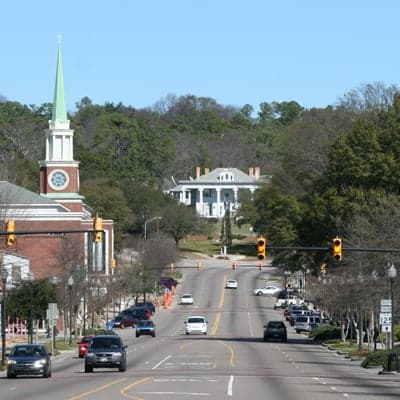
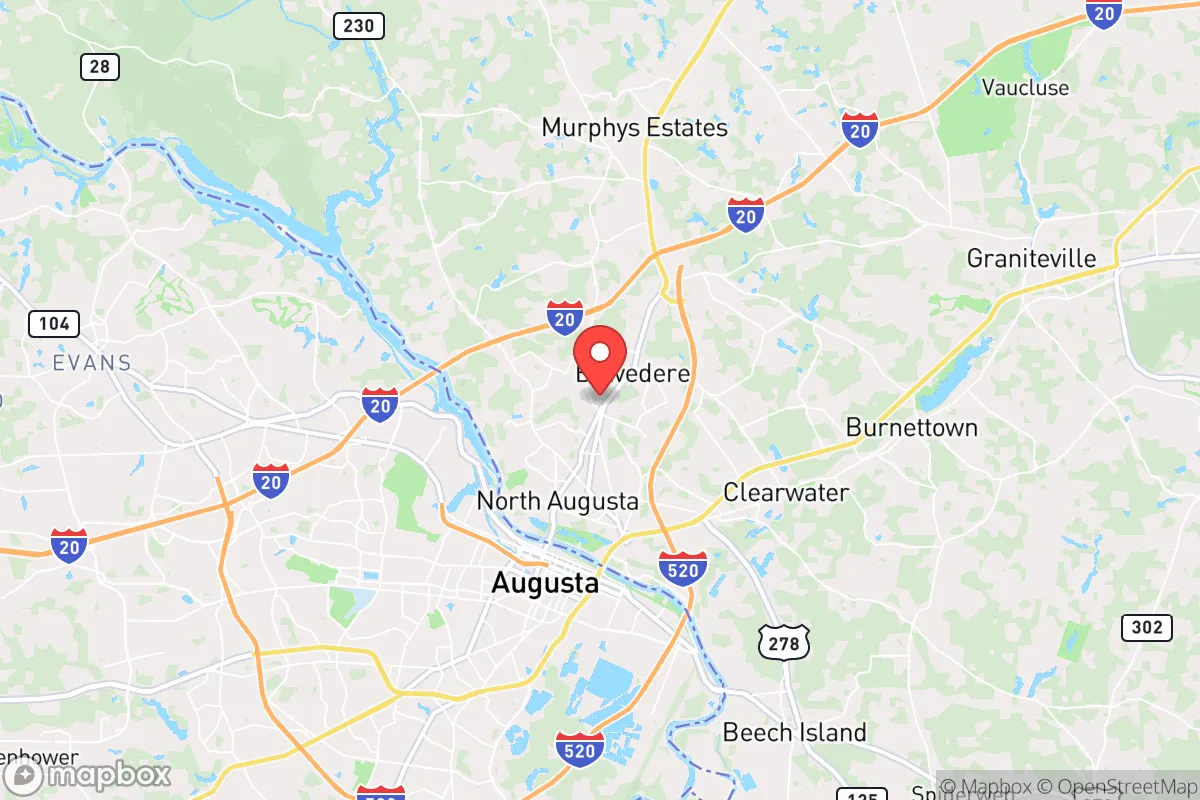
Photo: Wikipedia
Demographics of North Augusta, SC
Affluence Level in North Augusta, SC
A middle-class area roughly in line with national averages across income, home values, education, and employment.
People of North Augusta, SC
The people of North Augusta, South Carolina today number roughly 24,928, forming a predominantly white (74.5%) and politically conservative community with a notably low foreign-born share of just 0.9%. The city’s identity is rooted in its history as a planned railroad suburb of Augusta, Georgia, and its population today is characterized by a mix of long-standing local families, retirees drawn to the Savannah River, and younger professionals commuting across the state line. With 37.9% of adults holding a college degree, the city leans educated and middle-to-upper-middle class, while its small Black (14.4%) and Hispanic (6.5%) populations reflect a slower pace of diversification than nearby metro areas.
How the city was settled and grew
North Augusta was not a colonial-era settlement but a planned community born from the railroad boom of the late 19th century. In 1890, the North Augusta Land Company, backed by Augusta investors, purchased farmland along the Savannah River and laid out a grid of streets intended as a residential escape from Augusta’s crowding and industry. The first wave of residents were white middle-class families—clerks, merchants, and railroad workers—who built modest homes in what is now the Historic District, centered around Georgia Avenue and Martintown Road. By 1900, the town had a few hundred residents, almost entirely native-born whites. A second wave arrived in the 1910s and 1920s as the city incorporated (1906) and the textile industry expanded along the river. The Hammond’s Ferry neighborhood, originally a working-class enclave near the riverfront, housed mill workers and their families, many of whom were white migrants from rural South Carolina and Georgia. Black residents were present from the early 1900s but in very small numbers, concentrated in a small area near Belvedere (an unincorporated community just north of the city limits) and along the railroad tracks in what is now the West Side. The Great Depression and World War II paused growth, but the city’s population remained overwhelmingly white and native-born through the 1950s, hovering around 6,000.
Modern era (post-1965)
The post-1965 period brought two major demographic shifts: suburbanization from Augusta and the slow integration of Black families into the city proper. The 1970s and 1980s saw a surge of white families moving from Augusta’s urban core into North Augusta’s expanding subdivisions, drawn by lower taxes, newer schools, and a perceived safer environment. The Woodhaven subdivision, built in the 1970s off Martintown Road, became a hub for these relocating families, solidifying the city’s white middle-class character. The Hammond’s Ferry area, once working-class, was redeveloped in the 2000s into a master-planned community with higher home prices, attracting professionals and retirees from outside the region. Black residents, who had historically been a small minority (under 5% as late as 1980), grew to 14.4% by 2020, largely through natural increase and some in-migration from Augusta’s Black neighborhoods. This growth concentrated in the West Side and along the Edgefield Road corridor, where older, more affordable housing stock exists. Hispanic and East/Southeast Asian populations remain tiny (6.5% and 0.5% respectively), with most Hispanic residents working in construction or service jobs and living in rental units near the I-20 corridor. The Indian-subcontinent population (0.5%) is almost entirely professionals in healthcare or tech, scattered across newer subdivisions like Hammond’s Ferry rather than forming an ethnic enclave.
The future
North Augusta’s population is likely to continue growing slowly, driven by domestic in-migration from the Northeast and Midwest, attracted by lower cost of living and proximity to Augusta’s medical and military sectors. The city is not homogenizing into a single demographic block but is instead tribalizing into distinct enclaves by income and lifestyle: older, wealthier retirees in Hammond’s Ferry; middle-class families in Woodhaven and the Historic District; and a smaller, more diverse working-class population on the West Side and Edgefield Road. The foreign-born share (0.9%) is so low that immigrant communities are unlikely to grow significantly in the next decade, barring a major shift in local industry. Hispanic and Black populations may increase modestly through natural growth and some spillover from Augusta, but the city will remain predominantly white and native-born. The biggest demographic change may be an aging population, as retirees continue to move in and younger families face housing affordability pressures in the newer developments.
For someone moving to North Augusta now, the city offers a stable, predominantly white, and conservative community with clear neighborhood distinctions. It is not a melting pot but a collection of relatively homogeneous enclaves, each with its own character and price point. The city’s future is one of slow, steady growth, with demographic change coming more from domestic migration than international immigration, making it a predictable choice for those seeking a traditional Southern suburb.

* Values derived from national, state, county, city and local statistics and may differ in a specific area. Last updated: 2026-04-30T03:41:47.000Z
Narrative content on this page is AI-generated and may contain mistakes. Verify any details that matter before acting on them.
ReloMaps may earn a commission from affiliate links at no extra cost to you.

