
Photo: Wikipedia
Personal Sovereignty in North Augusta, SC
Viable for self-reliance. Generally workable, though some barriers may limit total independence.
What does Personal Sovereignty tell us?
Personal Sovereignty measures your capacity for self-reliance and independence with minimal government friction. Higher scores mean fewer barriers between you and the way you want to live... but it assumes you have the space you need and good neighbors.
What does this tell us?
Personal Sovereignty measures your capacity for self-reliance and independence with minimal government friction. Higher scores mean fewer barriers between you and the way you want to live... but it assumes you have the space you need and good neighbors.
State Policy
Energy independence: Importer (25% of energy produced in-state)
Personal Liberty
Homesteading

Personal Liberty Analysis
For the individual or family prioritizing personal sovereignty, North Augusta, South Carolina offers a notably stronger autonomy environment than most of the urbanized Southeast, largely because it sits just across the Savannah River from Augusta, Georgia, but under the far more liberty-friendly legal and tax framework of South Carolina. While no locale is a fortress against federal overreach, this city’s state-level protections on gun rights, property use, and parental authority, combined with a relatively low tax burden and a regulatory culture that still respects private land decisions, make it a serious contender for those seeking to minimize government entanglement in daily life. The key trade-off is proximity to a mid-sized city (Augusta) for employment and services, while living in a state that has consistently pushed back against federal mandates on everything from COVID-era restrictions to firearm preemption.
Tax burden and regulatory posture: how South Carolina compares to neighboring states
South Carolina’s tax structure is a clear advantage for the sovereignty-minded. The state’s income tax is a flat 3% as of 2026 (down from a progressive rate that topped 7% a decade ago), and there is no state-level tax on Social Security benefits. For a single individual or a family, this means more of your labor stays in your pocket, not in Columbia’s coffers. Property taxes in Aiken County, where North Augusta sits, are among the lowest in the state, with an effective rate around 0.5% of assessed value — roughly half of what you’d pay across the river in Richmond County, Georgia. The regulatory posture is similarly restrained: South Carolina is a right-to-work state with no state-level occupational licensing for dozens of trades that require it elsewhere, and the state has no general business license tax for most small operations. Zoning in North Augusta is present but not oppressive; the city’s Unified Development Ordinance allows for accessory dwelling units, home-based businesses, and even limited agricultural uses on residential lots without the kind of bureaucratic gauntlet common in Georgia or the Northeast. For the prepper or homesteader, this means you can legally keep chickens, maintain a substantial garden, and run a small repair or fabrication business from your garage without triggering a code enforcement war.
Self-defense and gun law specifics: what the Second Sanctuary means on the ground
South Carolina is a “Second Amendment Sanctuary” state by legislative resolution, and the practical effect in North Augusta is that local law enforcement does not enforce federal firearms restrictions that conflict with state law. The state has permitless (constitutional) carry for anyone 18 or older who can legally possess a firearm, meaning no government permission slip is needed to carry concealed in most public spaces. Stand-your-ground law is fully codified, with no duty to retreat in any place you have a legal right to be. This is not theoretical: Aiken County’s sheriff has publicly stated he will not enforce any federal “red flag” order or magazine ban, and the county council passed a resolution affirming that position in 2021. For the survivalist, the practical takeaway is that your gun rights are as robust as they get in the continental U.S. — no waiting periods, no state-level background check for private sales, and no restrictions on standard-capacity magazines or common rifle configurations. The only notable limitation is that carrying on school grounds (including public K-12) is prohibited without a special permit, though that permit is available and not unreasonably denied. For a family, this means you can train your children in firearms safety at home without fear of state interference, and you can defend your property with lethal force if necessary, without the legal jeopardy you’d face in states like New York or California.
Self-reliance and homesteading viability: lot sizes, zoning, and off-grid feasibility
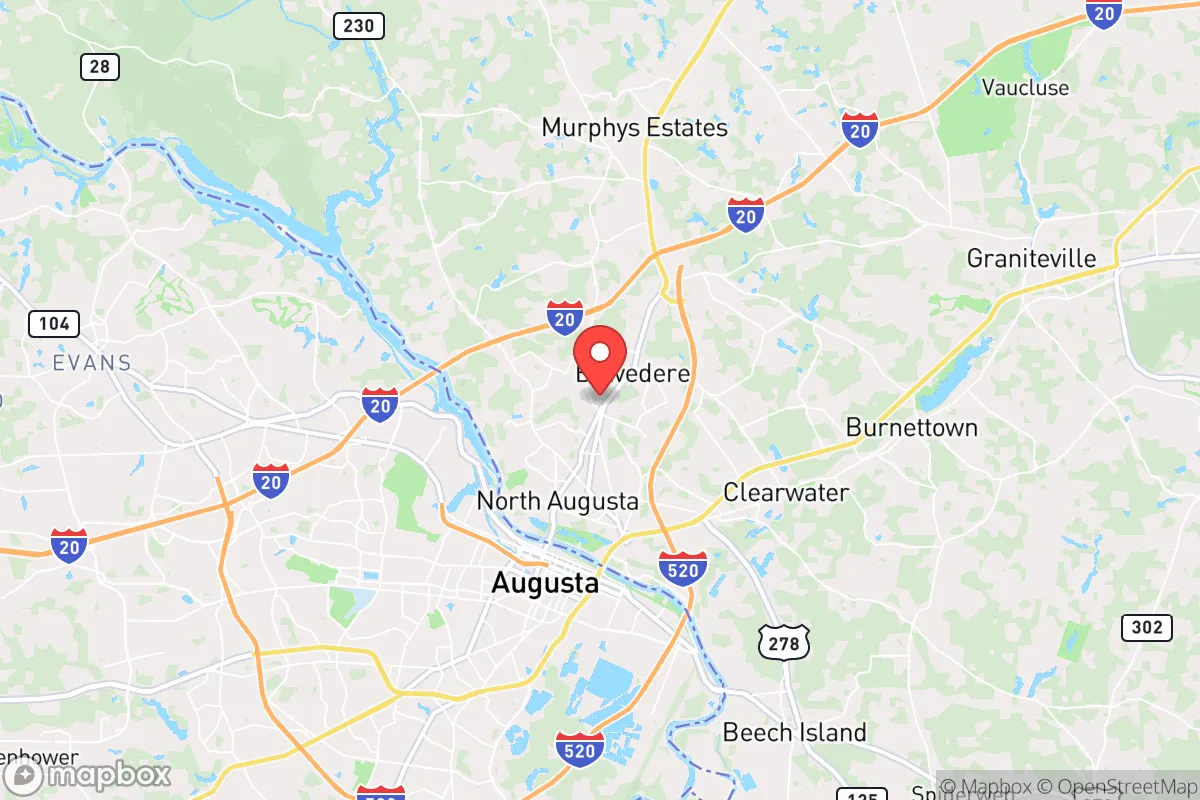
North Augusta’s residential landscape offers a genuine path to self-reliance, especially compared to the cookie-cutter subdivisions of the Atlanta suburbs. Standard residential lots in the city proper range from a quarter-acre to half-acre, but the unincorporated areas of Aiken County just outside city limits — places like Belvedere, Clearwater, and the rural pockets along Highway 421 — offer parcels of 1 to 5 acres at prices well under $20,000 per acre. Zoning in the county is minimal: no county-wide building code for agricultural structures, no permit required for fences under 6 feet, and no restriction on rainwater collection or composting toilets. Off-grid feasibility is high: South Carolina has no state law prohibiting solar panel installation, and net metering is available through Dominion Energy, though the rates are not as favorable as in some western states. Well water is common in rural Aiken County, and septic systems are permitted with a straightforward health department inspection. For the prepper, the critical detail is that Aiken County has no county-level noise ordinance that would restrict generator use or target shooting on your own property, provided you’re outside city limits. The city itself does have noise restrictions (10 p.m. to 7 a.m.), but they are rarely enforced for non-commercial activity. The biggest hurdle for full off-grid living is that the county requires a minimum of 2 acres for a septic system, which effectively sets the floor for true self-sufficiency at that parcel size.
Personal liberties: parental rights, medical autonomy, speech, and property
South Carolina has been a battleground for parental rights, and the results are favorable for families seeking to control their children’s education and medical decisions. The state passed a Parents’ Bill of Rights in 2023 that explicitly affirms the right of parents to direct the upbringing, education, and health care of their minor children, including the right to opt out of any school curriculum or activity without penalty. School boards in Aiken County have been conservative in practice, with no mask mandates or vaccine requirements for students since 2021. Medical autonomy is more mixed: South Carolina has no state-level vaccine mandate for adults, and the state did not adopt any COVID-19 passport system, but it also has not passed the kind of broad medical freedom legislation seen in states like Idaho or Montana. For the survivalist, the key is that you can refuse any medical treatment for yourself or your children without state intervention, and there is no state law requiring emergency contraception or abortion access (abortion is banned after 6 weeks, with limited exceptions). Free speech protections are strong: the state has no hate speech law that criminalizes political or religious expression, and public protests are generally permitted without permits for groups under 50. Property rights are reinforced by South Carolina’s strong eminent domain protections — the state constitution requires “just compensation” and a public use finding that is more restrictive than federal law. For the individualist, this means your land is genuinely yours, and the government has limited tools to take it for private development.
In the broader context of the Southeast, North Augusta offers a sovereignty profile that is stronger than Georgia (which has a state income tax, weaker gun preemption, and more aggressive local zoning) and significantly stronger than any state in the Northeast or West Coast. It is not a libertarian utopia — you still pay property taxes, you still need a building permit for major construction, and the federal government’s reach is inescapable — but for the person who wants to live with minimal state interference in their daily choices about self-defense, family, property, and livelihood, this city and its surrounding county represent one of the better options within a two-hour drive of a major metropolitan area. The trade-off is that you are in the Deep South, with all that implies for climate (hot, humid summers), infrastructure (limited public transit), and cultural homogeneity. But if your priority is maximizing personal sovereignty while maintaining access to jobs, healthcare, and schools, North Augusta deserves a serious look.

* Values derived from national, state, county, city and local statistics and may differ in a specific area. Last updated: 2026-04-30T03:41:47.000Z
Narrative content on this page is AI-generated and may contain mistakes. Verify any details that matter before acting on them.
ReloMaps may earn a commission from affiliate links at no extra cost to you.

