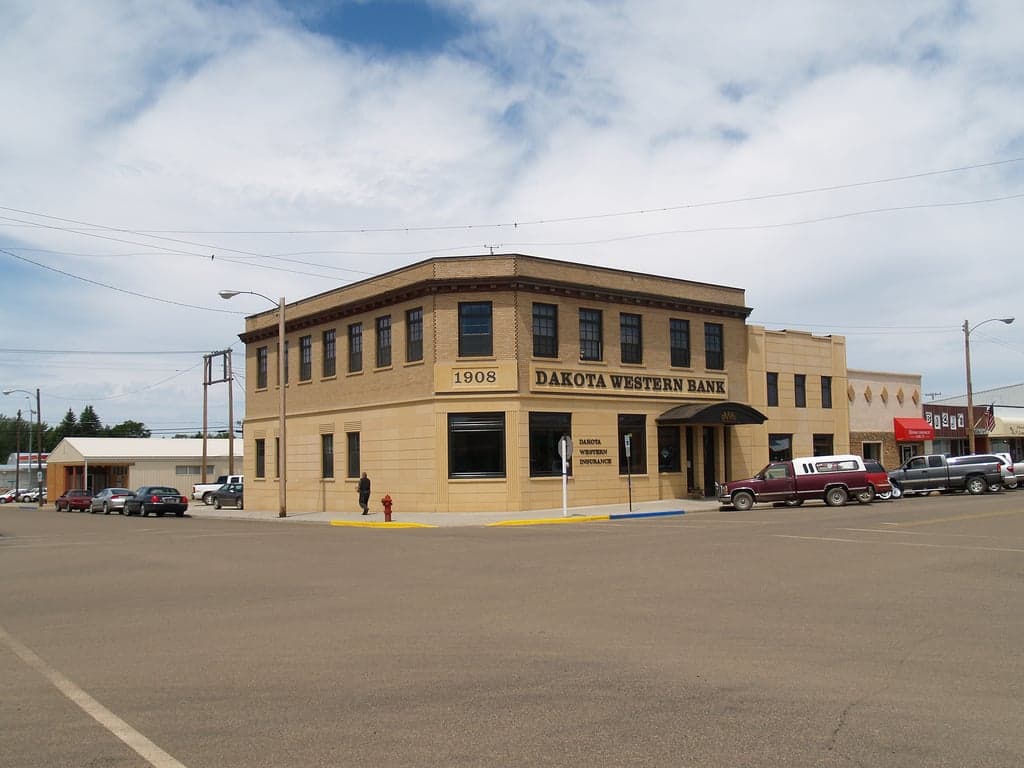
Photo: Wikipedia
Personal Sovereignty in Bowman County
Viable for self-reliance. Generally workable, though some barriers may limit total independence.
What does Personal Sovereignty tell us?
Personal Sovereignty measures your capacity for self-reliance and independence with minimal government friction. Higher scores mean fewer barriers between you and the way you want to live... but it assumes you have the space you need and good neighbors.
What does this tell us?
Personal Sovereignty measures your capacity for self-reliance and independence with minimal government friction. Higher scores mean fewer barriers between you and the way you want to live... but it assumes you have the space you need and good neighbors.
State Policy
Energy independence: Net exporter (500% of energy produced in-state)
Personal Liberty
Homesteading

Personal Liberty Analysis
Bowman County, North Dakota, offers one of the most robust personal sovereignty environments in the Upper Great Plains, where state preemption laws and a deeply ingrained ranching culture create a regulatory atmosphere that prioritizes individual decision-making over government oversight. The county seat of Bowman and the smaller communities of Scranton, Gascoyne, and Rhame all operate under a light-touch governance model, with local ordinances rarely exceeding state minimums. For a relocation researcher focused on autonomy, this area presents a compelling case: low taxes, minimal zoning, strong self-defense protections, and a legal framework that actively supports self-reliance and off-grid living.
Tax burden and regulatory posture: how Bowman County compares to state and regional norms
Bowman County benefits from North Dakota's already low tax environment, but its specific regulatory posture is even more permissive than many neighboring counties. The county imposes no local sales tax beyond the state's 5% rate, and property taxes on agricultural land and rural residential parcels are among the lowest in the state — roughly $800 to $1,200 annually on a typical 40-acre homestead. The regulatory burden is minimal: building permits are required only within the city limits of Bowman (population ~1,500) and Scranton (population ~280), while unincorporated areas like Gascoyne and Rhame operate with virtually no county-level building codes. The state's right-to-farm laws shield agricultural operations from nuisance lawsuits, and county commissioners have consistently opposed any form of county-wide planning or zoning overlay. For a family or individual seeking to minimize interaction with government bureaucracy, the unincorporated areas of Bowman County — particularly the rural stretches between Bowman and the Montana border — offer a near-zero regulatory footprint.
Self-defense and gun law specifics: what the Second Sanctuary designation means for residents
Bowman County is a certified Second Amendment Sanctuary, a designation passed by the county commission in 2021 that formally declares local law enforcement will not enforce any future state or federal gun control measures deemed unconstitutional. This is not merely symbolic: the county sheriff's office in Bowman actively interprets this resolution as binding policy. North Dakota is a constitutional carry state, meaning no permit is required to carry a concealed firearm for anyone 18 or older who can legally possess a firearm. The state also has strong castle doctrine and stand-your-ground laws, with no duty to retreat in any place where a person has a legal right to be. In practice, this means residents in Bowman, Scranton, and Rhame can carry openly or concealed without a license, store firearms in vehicles on school parking lots (with some restrictions), and use deadly force in self-defense without legal presumption of wrongdoing. The county has no local ordinances restricting firearm possession in parks or public buildings beyond state minimums. For a reader prioritizing self-defense autonomy, Bowman County's legal environment is among the most permissive in the nation.
Self-reliance and homesteading viability: lot sizes, zoning, and off-grid feasibility across the county
Homesteading and off-grid living are not just feasible in Bowman County — they are the norm for a significant portion of the population. The county's land use regulations are exceptionally permissive: unincorporated areas have no minimum lot size for residential development, no restrictions on alternative energy systems, and no county-level building codes. In the rural areas around Gascoyne and Rhame, residents commonly install solar panels, wind turbines, and rainwater collection systems without permits. The county health department requires a septic system permit for any dwelling with plumbing, but composting toilets and outhouses are legal alternatives on properties with no running water. Zoning is essentially nonexistent outside city limits: a resident can keep livestock, operate a home-based business, or construct a yurt or tiny home on their land without county approval. The city of Bowman itself has more conventional zoning — minimum lot sizes of 7,500 square feet, building permits required, and restrictions on livestock within city limits — but even there, the code is far less restrictive than in most Midwestern towns of similar size. For a family seeking to build a self-sufficient homestead, the unincorporated areas of Bowman County, particularly the land along the Little Missouri River valley, offer some of the most permissive off-grid regulations in the contiguous United States.
Personal liberties: parental rights, medical autonomy, speech, and property protections
Bowman County's legal environment strongly favors individual liberty across multiple domains. Parental rights are protected by North Dakota's robust parental involvement laws: schools are required to notify parents before providing any medical or mental health services to minors, and parents have the right to opt their children out of any curriculum or activity they find objectionable. The county's school board in Bowman has consistently voted against adopting any form of critical race theory or gender identity curriculum, and the local public library in Scranton maintains a policy of not restricting minors' access to materials without parental consent. Medical autonomy is supported by the state's broad conscientious objection laws, which allow healthcare providers and patients to refuse any treatment or procedure on religious or moral grounds. Property rights are strongly protected: North Dakota has some of the strongest eminent domain protections in the country, requiring a two-thirds supermajority vote of the legislature for any taking of private property for economic development. The county's assessor's office in Bowman maintains transparent property records, and tax appeals are straightforward. Free speech is protected by the state's lack of any hate speech laws or social media content moderation mandates. For a reader who values the ability to make independent decisions about family, health, and property without government interference, Bowman County's legal framework is consistently aligned with personal sovereignty.
Overall, Bowman County ranks among the top 5% of U.S. counties for personal sovereignty, with a regulatory environment that is lighter than most of rural North Dakota and far more permissive than any county in the Pacific Northwest, New England, or the Front Range. The combination of constitutional carry, Second Sanctuary status, minimal zoning, low taxes, and strong property rights creates a legal ecosystem where individual autonomy is the default rather than the exception. For a single individual or family seeking maximum personal freedom within a functioning community, the areas around Bowman, Scranton, Gascoyne, and Rhame offer a rare combination of legal protections and practical feasibility that is increasingly difficult to find elsewhere in the United States.

* Values derived from national, state, county, city and local statistics and may differ in a specific area. Last updated: 2026-08-14T01:08:23.000Z
Narrative content on this page is AI-generated and may contain mistakes. Verify any details that matter before acting on them.
ReloMaps may earn a commission from affiliate links at no extra cost to you.

