Photo: Wikipedia
Demographics of North Liberty, IA
Affluence Level in North Liberty, IA
An upper-middle-class area. Household wealth, education levels, and homeownership run ahead of national benchmarks.
People of North Liberty, IA
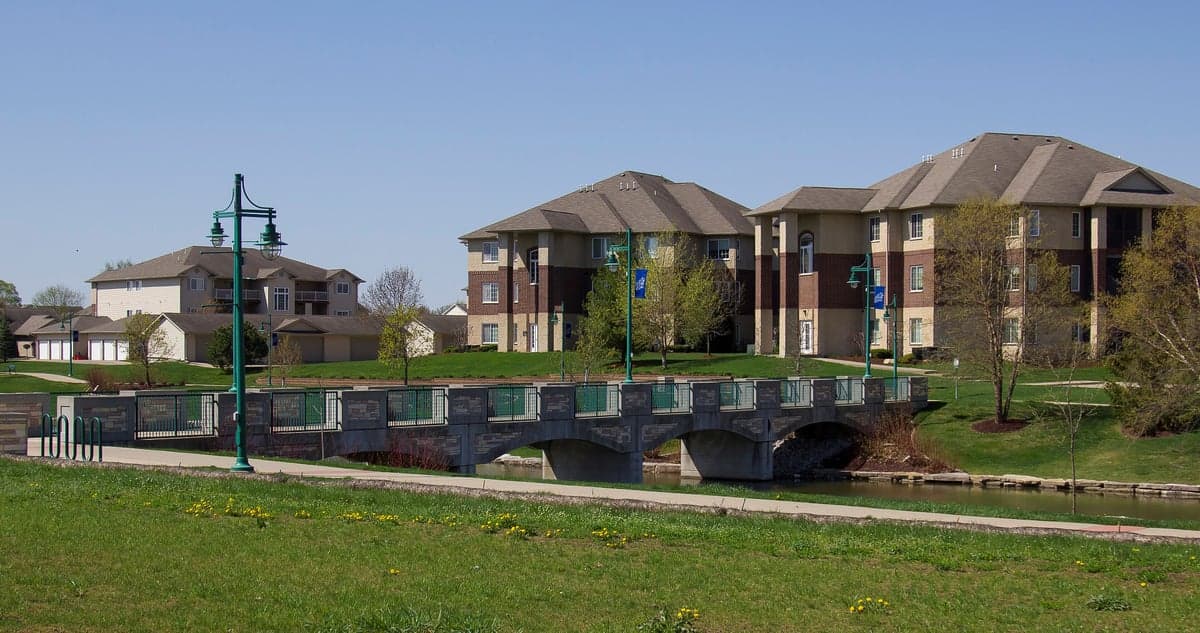
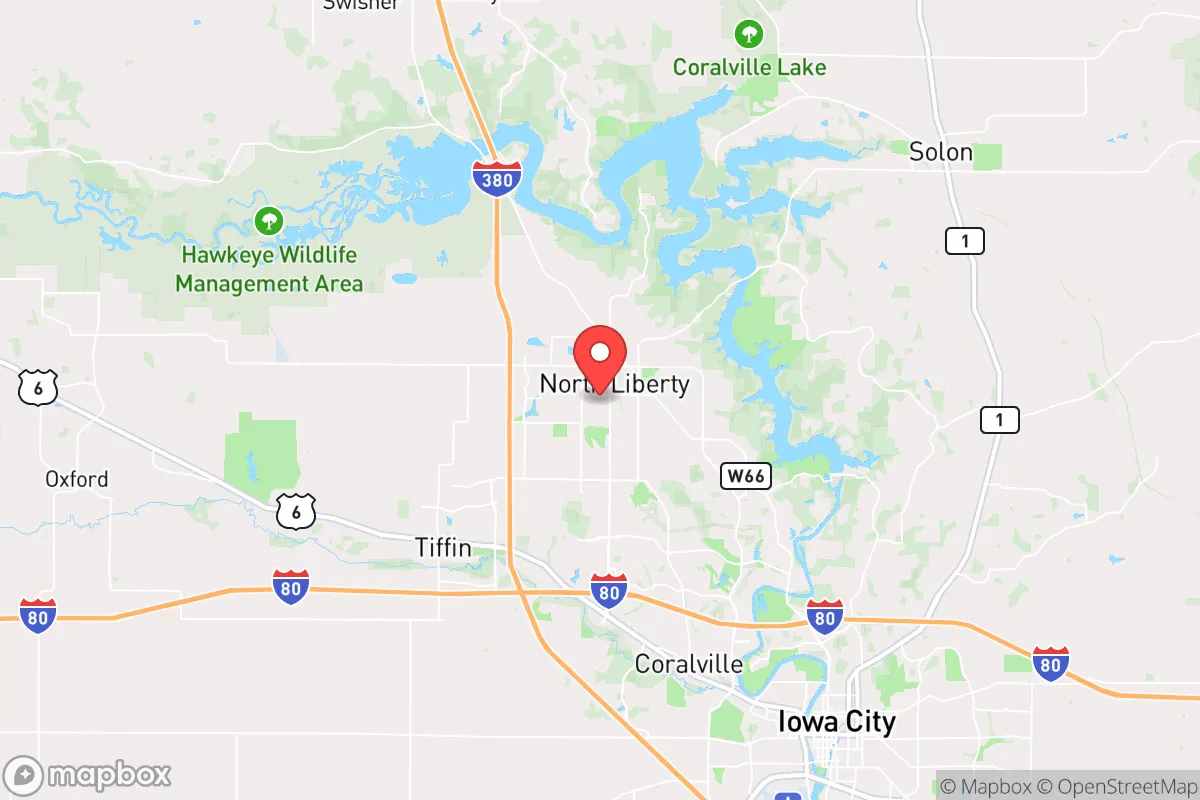
North Liberty, Iowa, is a fast-growing, predominantly white suburb of 20,782 residents that has transformed from a small farming hamlet into a bedroom community for the Iowa City-Cedar Rapids corridor. Its population is notably young and educated, with 53.3% holding a college degree, and it is becoming slightly more diverse than its rural Johnson County neighbors. The city’s identity is shaped by a wave of middle-class families and professionals drawn by new housing developments and proximity to the University of Iowa, creating a community that feels both planned and family-oriented.
How the city was settled and grew
North Liberty’s human history begins in the 1850s, when the Chicago, Rock Island and Pacific Railroad laid tracks through the area, attracting a handful of German and Irish farmers who established the original town plat. These early settlers built homes and small businesses along what is now Main Street, in the area today known as Old Town North Liberty, a historic district centered around Cherry Street and Penn Street. The town remained a tiny agricultural crossroads for nearly a century, with a population that barely topped 200 by 1950. The first significant growth spurt came in the 1960s and 1970s, when the expansion of the University of Iowa and nearby ACT, Inc. drew educated professionals seeking affordable land. These newcomers settled in the North Ridge subdivision, one of the first planned residential areas, built on former cornfields north of the original town core. This wave was almost entirely white, native-born, and middle-class, laying the foundation for the suburb’s modern character.
Modern era (post-1965)
The post-1965 immigration reforms had a modest direct impact on North Liberty, as the city remained overwhelmingly white through the 1990s. The real demographic shift began after 2000, when the city’s population exploded from roughly 5,000 to over 20,000, driven by domestic in-migration from the Midwest and, increasingly, from coastal states. This growth was channeled into large master-planned communities like Liberty Centre and West Lake, which offered new single-family homes and attracted a mix of young families and University of Iowa employees. The foreign-born population, now at 5.4%, is a recent phenomenon. East and Southeast Asian residents (3.3%)—many employed in tech and healthcare roles at the university or at nearby Collins Aerospace—concentrate in the newer developments around Liberty Centre and the Penny Lane area. Indian-subcontinent residents (1.6%) are also present, often in professional roles, and tend to cluster in the same newer subdivisions. The Hispanic population (5.8%) is more dispersed, with families living in both older rental stock near Old Town and in newer apartments along Highway 965. The Black population (4.6%) is small but growing, drawn by employment at the University of Iowa Hospitals and Clinics, and is spread across the city without a distinct ethnic enclave. Notably, North Liberty lacks the historic ethnic neighborhoods of older Iowa cities; its diversity is a product of recent, individual migration rather than chain migration into established communities.
The future
North Liberty’s population is heading toward continued growth and gradual diversification, but it is likely to remain a predominantly white, middle-to-upper-middle-class suburb. The city is not tribalizing into distinct ethnic enclaves; instead, newer residents of all backgrounds are integrating into the same subdivisions and school zones. The East/Southeast Asian and Indian communities are growing steadily but from a small base, and they show signs of assimilation into the broader professional class. The Hispanic population is also growing, driven by service-sector jobs in the broader Iowa City area, but remains a smaller share than in many Midwestern cities. The biggest demographic story is the ongoing influx of white, college-educated families from other parts of Iowa and the Midwest, which reinforces the city’s existing character. Over the next 10–20 years, North Liberty will likely become slightly more diverse, but it will not become a majority-minority city or develop the kind of ethnic enclaves seen in larger metros. The city’s growth will continue to be shaped by its role as a family-oriented suburb, with new developments like Liberty Ridge and North Liberty Station absorbing the next wave of residents.
For a conservative-leaning individual or family moving in now, North Liberty offers a stable, safe, and increasingly diverse community that remains culturally anchored in Midwestern family values. The city is becoming more varied in its population but not fragmented, and its growth is managed through planned development rather than organic urban sprawl. It is a place where newcomers of any background can expect to find a welcoming, if still predominantly white, environment with strong schools and a clear sense of community direction.

* Values derived from national, state, county, city and local statistics and may differ in a specific area. Last updated: 2026-04-29T22:36:34.000Z
Narrative content on this page is AI-generated and may contain mistakes. Verify any details that matter before acting on them.
ReloMaps may earn a commission from affiliate links at no extra cost to you.

