Photo: Wikipedia
Political ClimatePolitical Climate in North Liberty, IA
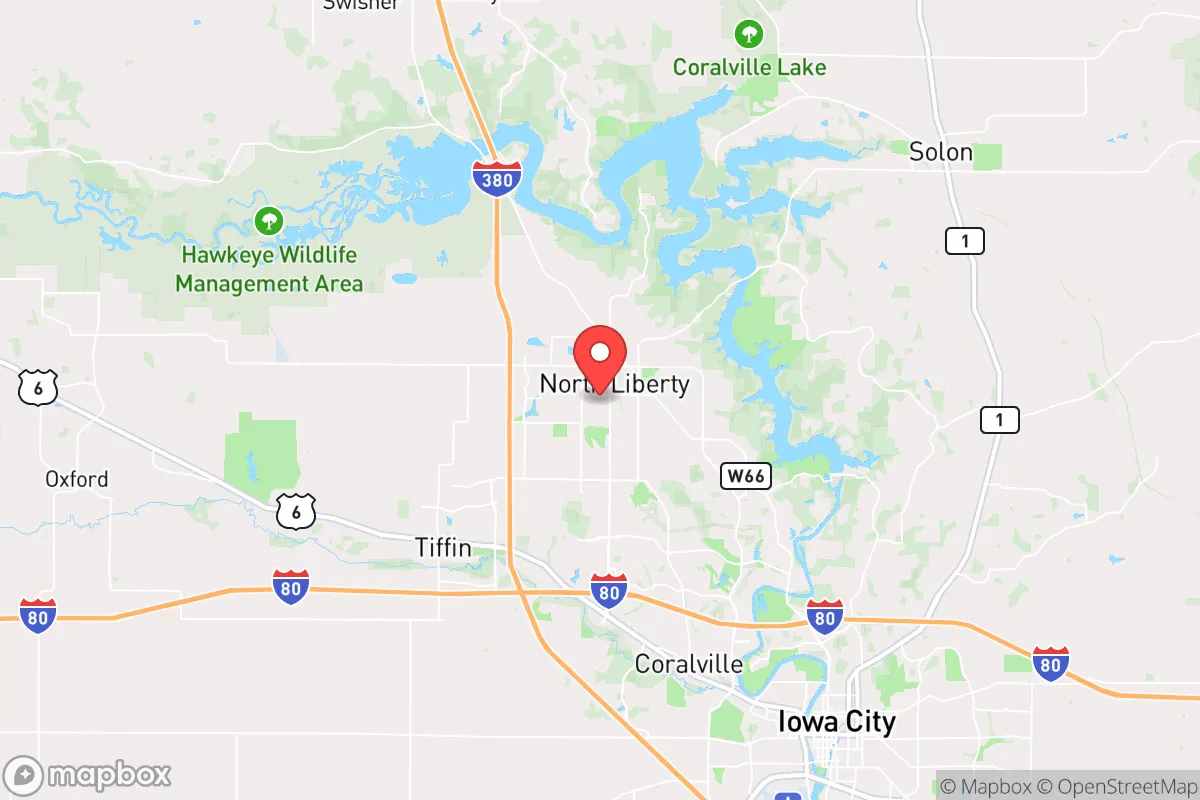
District shown is the primary district for this city’s centroid. Cities may span multiple districts.
Local Political AnalysisPolitical Analysis of North Liberty, IA
North Liberty has always been a bit of a mixed bag politically, but if you look at the numbers, it’s still a solidly conservative-leaning community at its core. The Cook PVI of R+4 tells you the district leans Republican by a modest margin, and that’s been the baseline for a while. But here’s the thing—this town is growing fast, and with that growth comes a slow, creeping shift. You’ve got a lot of young families moving in from Iowa City and Coralville, and they bring a more progressive vibe with them. The local elections are getting tighter, and while the county still votes red, you can feel the ground shifting under your feet. It’s not a blue wave by any stretch, but it’s a steady trickle of left-leaning ideas that weren’t here ten years ago.
How it compares
Drive ten minutes east to Iowa City, and you’re in a completely different world—a deep blue college town where progressive policies are the norm. Coralville and North Liberty sit right in the middle, but North Liberty has historically been the more conservative of the two. Compared to rural Johnson County, which is still pretty red, North Liberty is the suburban buffer zone. The contrast is stark: in Iowa City, you see heavy-handed regulations on housing and business, while North Liberty has kept a lighter touch. But lately, you’re seeing more city council candidates pushing for “equity” initiatives and zoning changes that feel like government overreach. It’s not full-blown yet, but the pattern is there—more rules, more oversight, less freedom for property owners and small businesses. If you’re coming from a place like Tiffin or Solon, you’ll notice North Liberty is starting to feel a little more like Coralville every year.
What this means for residents
For folks who value personal freedoms and limited government, the trend is concerning. The biggest red flag is the push for stricter rental regulations and development mandates. Some council members are floating ideas like inclusionary zoning—basically telling property owners what they can charge or build. That’s a direct hit on your right to use your land as you see fit. The school board is another battleground; there’s been pressure to adopt more progressive curriculum materials, and parents are having to stay vigilant to keep local control. On the flip side, the tax burden here is still lower than in Iowa City, and the county sheriff’s office hasn’t gone soft on crime. But if you’re a long-time resident, you can feel the bureaucracy creeping in. The local government is getting bigger, and with it comes more rules that chip away at the independence that made this area attractive in the first place.
Culturally, North Liberty still has a strong sense of community—neighborhood block parties, youth sports, and a general “mind your own business” attitude. But the policy distinctions are starting to show. The city has resisted some of the more aggressive climate mandates seen in Iowa City, and the gun laws remain friendly to responsible owners. The real test will be the next few election cycles. If the progressive newcomers organize and vote, you could see a shift in the city council that brings more government overreach. For now, it’s a place where you can still live your life without too much interference, but you’ve got to keep an eye on the ballot box. The long-term trajectory depends on whether the conservative base stays engaged or gets complacent.

State Political ClimatePolitical Climate in Iowa
State Political AnalysisPolitical Environment in the State
Iowa has long been a reliably Republican state in presidential elections, but it’s not the deep-red monolith outsiders often assume. The state voted for Donald Trump by roughly 8 points in 2020 and 9 points in 2024, a consistent but not overwhelming margin. Over the past 20 years, the GOP has solidified its grip on state government, holding the governorship, both legislative chambers, and a majority of congressional seats since 2016. However, the state’s political identity is more nuanced than the top-line numbers suggest, with a sharp urban-rural split and a recent history of competitive statewide races that keep things interesting.
Urban vs. rural divide
The political map of Iowa is a textbook case of the urban-rural divide. The state’s two major metros — Des Moines and Iowa City — lean reliably Democratic, while the vast rural and small-town expanse votes heavily Republican. Des Moines and its suburbs, particularly Polk County, have become a Democratic stronghold, delivering margins of 15-20 points for Biden and Harris. Iowa City, home to the University of Iowa, is even more liberal, with Johnson County routinely voting 30+ points Democratic. In contrast, rural counties like Sioux, Lyon, and Plymouth in the northwest routinely vote 70-80% Republican. The real battlegrounds are the “collar counties” around Des Moines — Dallas and Warren — which have trended rightward as suburban voters shift toward the GOP on cultural and economic issues. A notable flip in 2024 was Dubuque County, a historically Democratic stronghold in the northeast, which voted for Trump after backing Biden in 2020, signaling a broader working-class realignment.
Policy environment
Iowa’s policy environment has shifted decisively conservative over the past decade. The state has a flat income tax rate of 3.8% (down from a top rate of 8.98% in 2018), with a scheduled phase-down to 3.5% by 2027. Property taxes are relatively low, with a median effective rate of 1.4%, though they vary by county. The regulatory posture is business-friendly, with no state-level minimum wage above the federal $7.25 and a right-to-work law on the books. Education policy has been a flashpoint: in 2023, Governor Kim Reynolds signed a universal school choice law allowing any family to use state funds for private school tuition, a major win for parental rights advocates. Healthcare is more mixed — Iowa expanded Medicaid under the Affordable Care Act in 2014, but the state has also imposed work requirements for able-bodied adults. Election laws tightened in 2021 with a law reducing early voting days, requiring voter ID, and banning private funding of election offices. For a conservative-leaning family, the tax and education policies are clear draws, though the Medicaid expansion may give pause to those wary of government healthcare programs.
Trajectory & freedom
Iowa is becoming more free in several key areas, particularly gun rights and parental rights. In 2021, the state passed constitutional carry, allowing permitless carry of firearms for anyone 21 or older. That same year, a law banned mask mandates in schools and prohibited school districts from requiring COVID-19 vaccines. In 2023, the “Parental Rights in Education” law required schools to notify parents of any changes to a student’s mental or physical health, and banned instruction on gender identity and sexual orientation through sixth grade — a direct counter to progressive school policies seen in blue states. Property rights are strong, with no state-level rent control and a relatively low property tax burden. On the flip side, the state’s medical marijuana program remains highly restrictive, limited to low-THC oils for specific conditions, and recreational cannabis is illegal. For a conservative moving in, the trajectory is positive: the state is actively rolling back government overreach in education and self-defense, while keeping taxes low and regulations light.
Civil unrest & political movements
Iowa has seen relatively little civil unrest compared to coastal states, but there have been notable flashpoints. In 2020, protests in Des Moines and Iowa City over George Floyd’s death turned into small-scale riots, with property damage and arrests, but they were quickly contained. The state has been a battleground over immigration politics: in 2024, Governor Reynolds signed a law allowing state law enforcement to arrest and detain undocumented immigrants, directly challenging federal authority — a move that energized conservative base voters. Election integrity controversies have been minimal, though the 2021 voting law was criticized by Democrats as voter suppression. On the right, the “Iowa Freedom Rallies” have become annual events drawing national conservative speakers, while left-wing activism is concentrated around the University of Iowa campus. A new resident would notice the absence of the kind of chronic street-level activism seen in Portland or Seattle, but the political temperature is still high, especially during election cycles.
Projection
Over the next 5-10 years, Iowa is likely to become more Republican at the state level, driven by two demographic trends. First, the state’s rural population is aging and shrinking, but those who remain are becoming more conservative. Second, in-migration from blue states like Illinois and California is accelerating, particularly to suburban Des Moines and smaller cities like Ankeny and Waukee. These newcomers are often fleeing high taxes and progressive policies, and they tend to vote Republican once they arrive. The Democratic strongholds in Des Moines and Iowa City will remain blue, but their influence will be diluted as the state’s overall population shifts rightward. The wildcard is the state’s growing Hispanic population, concentrated in meatpacking towns like Storm Lake and Denison, which could become a swing vote. For now, the trajectory is clear: expect lower taxes, stronger school choice, and continued cultural conservatism. A family moving in now should feel confident that the state will remain a safe bet for traditional values and economic freedom.
Bottom line for a new resident: Iowa offers a rare combination of low taxes, strong parental rights, and constitutional carry, all in a state that is actively pushing back against federal overreach. The urban-rural divide means you’ll find a like-minded community in most of the state, especially outside of Des Moines and Iowa City. If you’re looking for a place where the government respects your freedom to raise your kids, defend your home, and keep more of what you earn, Iowa is a solid choice — and it’s only getting better.
* Values derived from national, state, county, city and local statistics and may differ in a specific area. Last updated: 2026-04-29T22:36:34.000Z
Narrative content on this page is AI-generated and may contain mistakes. Verify any details that matter before acting on them.
ReloMaps may earn a commission from affiliate links at no extra cost to you.

