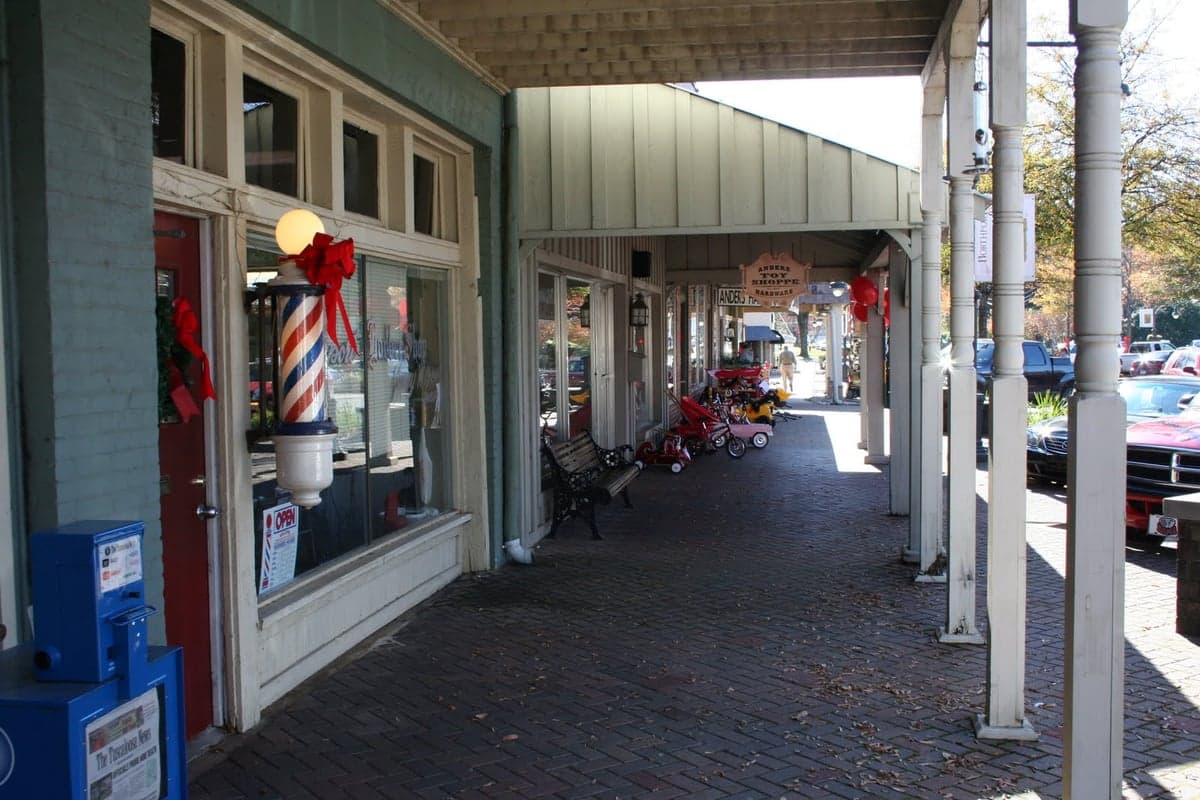
Photo: Wikipedia
Demographics of Northport, AL
Affluence Level in Northport, AL
A middle-class area roughly in line with national averages across income, home values, education, and employment.
People of Northport, AL
The people of Northport, Alabama, today number 30,991, forming a predominantly White (66.2%) and Black (26.4%) community with a small but growing Hispanic presence (5.0%) and a very limited foreign-born population (3.1%). The city retains a distinctly Southern, family-oriented character, with a college-educated rate of 37.1% that reflects its role as a residential and commercial hub for the Tuscaloosa metropolitan area. Unlike its larger neighbor across the Black Warrior River, Northport has historically been a quieter, more suburban alternative, attracting families and workers seeking lower density and a slower pace while remaining connected to the University of Alabama’s economic engine.
How the city was settled and grew
Northport’s human history begins in the early 19th century as a river landing and ferry crossing, drawing its first permanent settlers—mostly Anglo-American farmers and merchants from Georgia and the Carolinas—who were attracted by fertile bottomlands along the Black Warrior River and the promise of cotton-based prosperity. By the 1830s, the area known as Kentuck (now a historic neighborhood near the river) became the original nucleus, settled by planters and enslaved African Americans who cleared land and built the early infrastructure. After the Civil War, freed Black families established their own communities, notably in the Rosedale and Booth’s Mill areas, where they built churches, schools, and small farms. The arrival of the railroad in the 1880s spurred a second wave: German and Irish immigrants came as laborers and shopkeepers, settling in what is now Downtown Northport along Main Avenue, while timber and coal industries drew additional White workers from rural Alabama into the Flatwoods neighborhood. By 1900, Northport’s population was roughly 1,200, overwhelmingly native-born White and Black, with no significant Asian or Hispanic presence.
Modern era (post-1965)
The post-1965 period brought gradual demographic change, though Northport remained far less diverse than Tuscaloosa. The Immigration and Nationality Act of 1965 had minimal immediate impact here; the foreign-born share today is just 3.1%, and East/Southeast Asian communities (0.4%) and Indian-subcontinent residents (0.0%) are virtually absent. Instead, the major population shift came from domestic in-migration: White families from rural west Alabama moved to Northport during the 1970s and 1980s suburban boom, drawn by new subdivisions like Lakewood and Indian Creek, which offered affordable homes and good schools. Black residents, who had historically concentrated in Rosedale and Booth’s Mill, began moving into previously White neighborhoods like Flatwoods and newer developments near Highway 43, though the city remains residentially patterned along racial lines—older, predominantly Black neighborhoods near the river, and newer, predominantly White subdivisions to the north and west. The Hispanic population, which grew from negligible levels in 1990 to 5.0% today, is concentrated in rental apartments and mobile home parks along the McFarland Boulevard corridor, drawn by construction and service jobs tied to the University of Alabama’s expansion.
The future
Northport’s population is projected to continue slow, steady growth—likely reaching 35,000–38,000 by 2040—driven primarily by White domestic in-migration from other parts of Alabama and the Southeast, attracted by lower housing costs and a perceived safer environment than Tuscaloosa. The Hispanic share is expected to rise modestly to 7–8% as families settle and birth rates remain above the White and Black averages, but the foreign-born population will stay below 5% due to limited economic pull for immigrants. The Black population share is likely to hold steady or decline slightly (to 22–24%) as younger Black residents move to larger metros for opportunity, while the White share will remain dominant. The city is not tribalizing into distinct ethnic enclaves—Hispanic residents are dispersing across newer subdivisions rather than clustering—but the older Black neighborhoods (Rosedale, Booth’s Mill) are aging and seeing little new construction, risking population loss. East/Southeast Asian and Indian communities will remain negligible, as Northport lacks the professional job base or ethnic infrastructure to attract them.
For someone moving in now, Northport is becoming a more homogenously White, family-oriented suburb with a stable Black minority and a small but integrated Hispanic population—a place where demographic change is slow and incremental, not disruptive. The city’s identity as a quieter, more conservative alternative to Tuscaloosa is likely to deepen, making it most attractive to those seeking a predictable, low-diversity environment with good schools and easy river access.

* Values derived from national, state, county, city and local statistics and may differ in a specific area. Last updated: 2026-04-19T19:01:50.000Z
Narrative content on this page is AI-generated and may contain mistakes. Verify any details that matter before acting on them.
ReloMaps may earn a commission from affiliate links at no extra cost to you.

