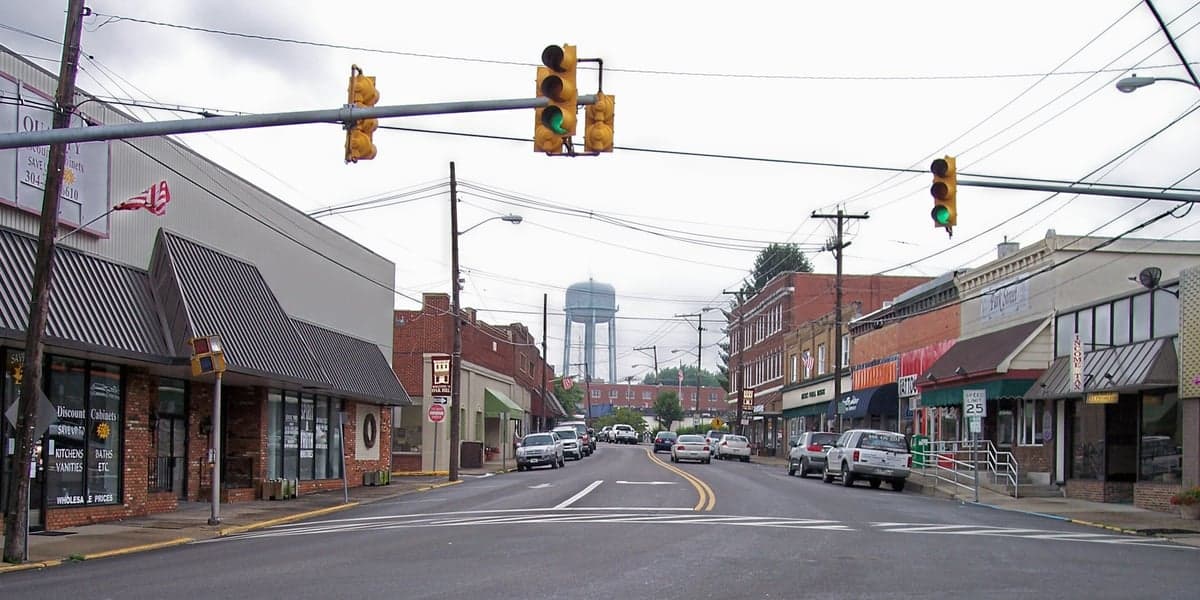
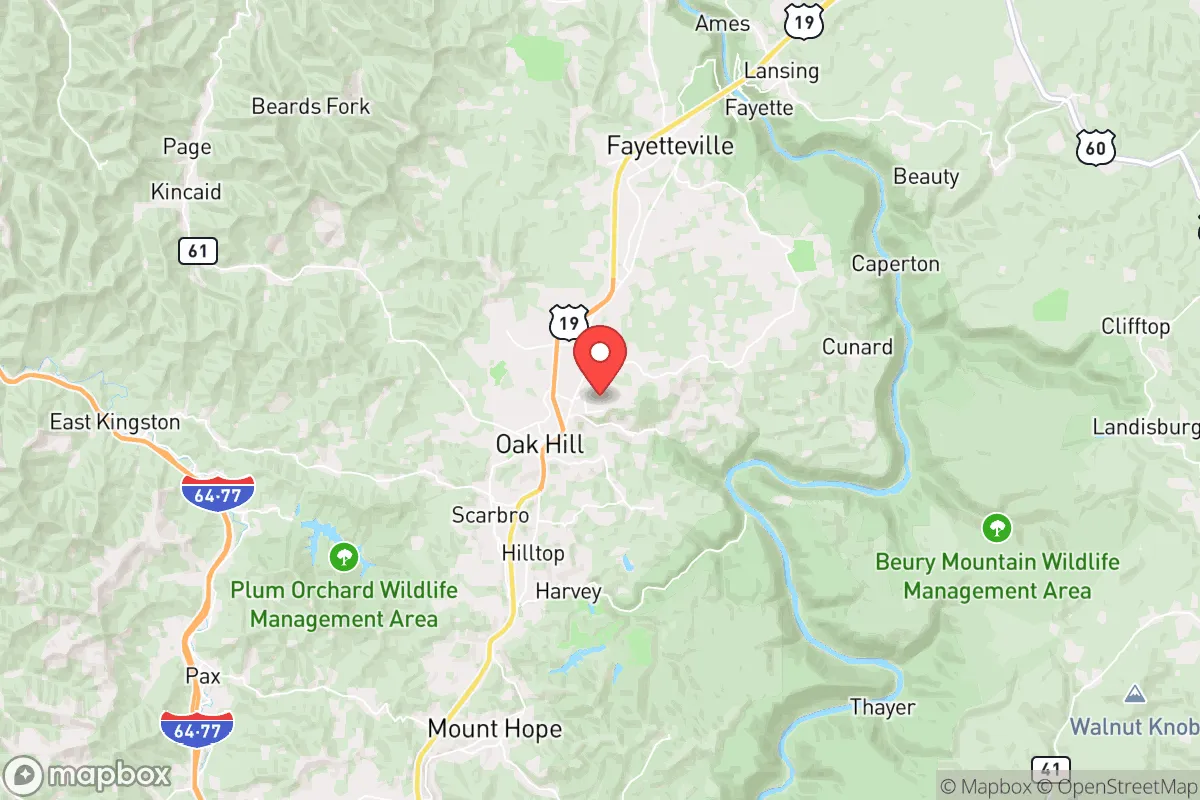
Photo: Wikipedia
Demographics of Oak Hill, WV
Historical data isn't available for Oak Hill, WV. Trends shown are for Fayette County, WV.
Affluence Level in Oak Hill, WV
A below-average socioeconomic profile. Incomes, home values, and educational attainment trail the U.S., with higher poverty and unemployment.
People of Oak Hill, WV
The people of Oak Hill, West Virginia today number 8,057, forming a predominantly white (90.5%) and native-born community with a strikingly low foreign-born share of just 0.4%. With a Black population of 7.1% and negligible Hispanic (0.2%), East/Southeast Asian (0.2%), and Indian subcontinent (0.0%) presence, the city retains a demographic profile rooted in its Appalachian coal-mining heritage. Only 15.4% of adults hold a college degree, reflecting a blue-collar, family-oriented character where multigenerational ties to the land and local industry remain strong.
How the city was settled and grew
Oak Hill’s human history begins not with colonial settlement but with the late-19th-century coal boom that transformed southern West Virginia. The city was formally incorporated in 1905, but its population surged after the Chesapeake and Ohio Railway extended a branch line into the New River Coalfield around 1873. The original white settlers were largely of English, Scots-Irish, and German stock, migrating from older Appalachian counties and, to a lesser extent, directly from the British Isles. They built the earliest neighborhoods—East Oak Hill and Main Street—as compact clusters of company houses and boarding homes near the mines and the rail depot. A second wave arrived between 1910 and 1930, when the coal industry expanded dramatically. This period brought a small but significant Black population—mostly from Virginia and the Carolinas—who settled in the South Oak Hill area, near the tipple and the coke ovens, forming a distinct African American enclave. By 1950, Oak Hill’s population peaked near 5,500, with the mines employing the vast majority of working-age men. The city’s layout—a tight grid of streets climbing the hillsides—still reflects this era, with older homes concentrated in East Oak Hill and South Oak Hill, while newer subdivisions like Hilltop and Meadow Bridge Road emerged later for mine supervisors and merchants.
Modern era (post-1965)
After the 1965 Hart-Cellar Act, Oak Hill experienced virtually no new immigration—the foreign-born share today is 0.4%, essentially unchanged from 1970. The city’s demographic story in the modern era is one of domestic out-migration and gradual racial homogenization. The mechanization of coal mining in the 1970s and 1980s eliminated thousands of jobs, prompting a steady exodus of younger families, especially from the Black community in South Oak Hill. Many African American residents moved to larger cities like Columbus, Ohio, or Charlotte, North Carolina, for work. The white population also shrank but at a slower rate, leaving the Black share to decline from a peak of roughly 12% in 1960 to 7.1% today. The neighborhoods that absorbed the few newcomers—mostly white retirees and remote workers from elsewhere in West Virginia—were the newer subdivisions: Hilltop (built in the 1970s) and Meadow Bridge Road (developed in the 1990s). These areas are almost entirely white and more suburban in character, with larger lots and newer homes. Meanwhile, East Oak Hill and Main Street have aged in place, with many homes now occupied by elderly residents or rented to a transient workforce in the remaining mines and the nearby Fayetteville tourism sector. The city’s Hispanic and Asian populations remain negligible—0.2% each—and are concentrated in no single neighborhood, reflecting their status as isolated individuals rather than established communities.
The future
Oak Hill’s population is likely to continue its slow decline, with the 2020 census showing a drop of roughly 300 residents from 2010. The city is homogenizing rather than tribalizing: the small Black community is aging and not being replaced by younger Black families, while the white population is also shrinking but remains dominant. No immigrant community is growing—the foreign-born share is essentially zero—so the city will remain overwhelmingly native-born and white for the foreseeable future. The only potential for demographic change lies in the broader New River Gorge region’s tourism economy, which could attract a modest number of white-collar remote workers or retirees from outside Appalachia. However, the low college attainment rate (15.4%) and limited housing stock in neighborhoods like Hilltop and Meadow Bridge Road suggest that any such influx will be small and will not fundamentally alter the city’s character. The next 10–20 years will likely see Oak Hill become slightly older, slightly smaller, and even more uniformly white, with the remaining Black population concentrated in South Oak Hill and the white population spread across all neighborhoods.
For someone moving in now, Oak Hill offers a stable, deeply rooted community where family history and local ties matter more than demographic diversity. The city is becoming a quieter, more insular version of its coal-boom past—a place where the population is shrinking but the identity remains firmly Appalachian and working-class. New residents should expect a tight-knit social fabric, limited ethnic variety, and a pace of life shaped by the surrounding mountains and the legacy of coal.

* Values derived from national, state, county, city and local statistics and may differ in a specific area. Last updated: 2026-04-21T15:26:48.000Z
Narrative content on this page is AI-generated and may contain mistakes. Verify any details that matter before acting on them.
ReloMaps may earn a commission from affiliate links at no extra cost to you.

