
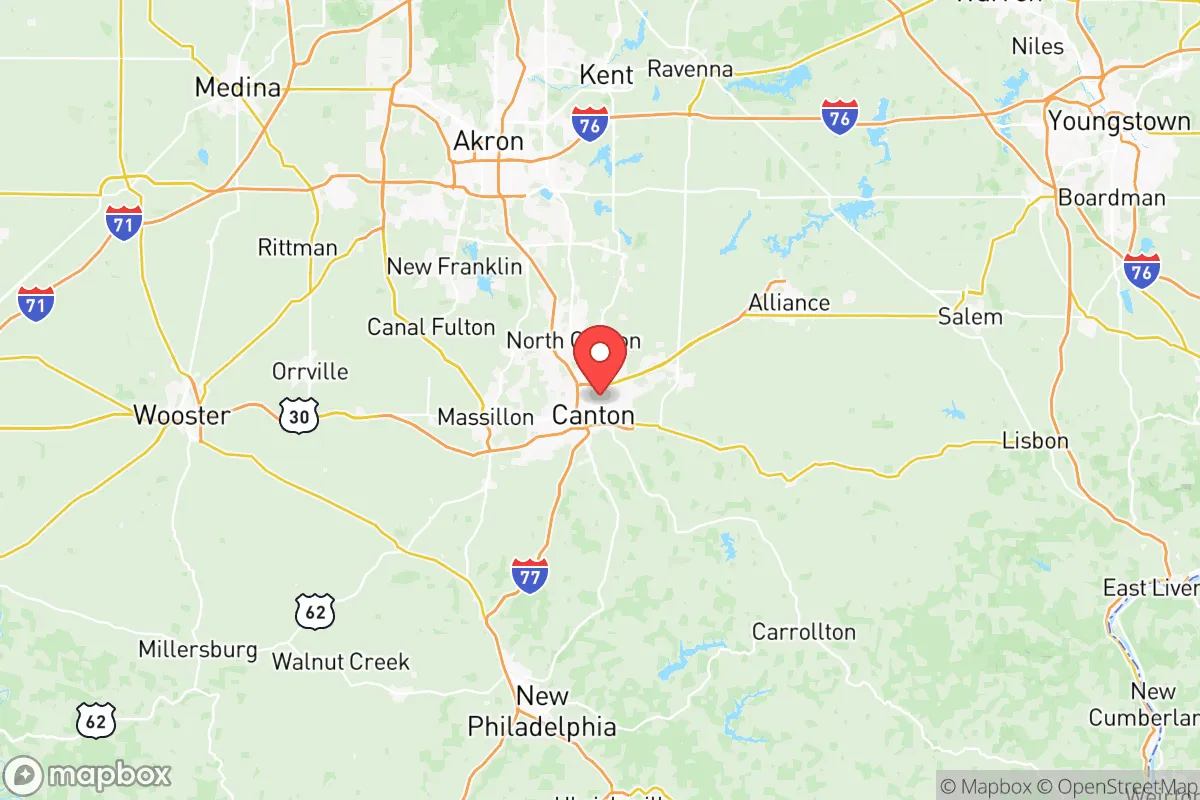
Photo: Wikipedia
Quality of Life in Stark County
A livable area that tracks near national norms for affordability, walkability, and neighborhood health.
What does Quality of Life tell us?
Quality of Life measures an area by evaluating factors like cost of living, nearby amenities, country club access, airport proximity, socioeconomic signals and neighborhood character. For large states, this is a general average — quality of life can vary dramatically between metro areas, suburbs, and rural communities within the same state.
What does this tell us?
Quality of Life measures an area by evaluating factors like cost of living, nearby amenities, country club access, airport proximity, socioeconomic signals and neighborhood character. For large states, this is a general average — quality of life can vary dramatically between metro areas, suburbs, and rural communities within the same state.
Cost of Living
30% below national average
130%
The Real Cost of Living in Stark County for 2026
| Tier | Individual | Family (4) |
|---|---|---|
| Survival | $14k | $26k |
| Comfortable | $35k | $51k |
| Luxury | $112k+ | $173k+ |
| Elite (Top 5%) | $131k+ | $203k+ |
Quality-of-Life Analysis
Stark County offers a broad quality-of-life spectrum, from the urban-suburban energy of its largest city to the quiet, agricultural rhythms of its smallest towns and townships. With a cost of living index of 70 (30% below the national average) and a median home value of $177,700, the county attracts everyone from young professionals seeking affordable city living to families and retirees looking for space and slower pace in communities like Louisville, Hartville, and Minerva. The county's character is defined by this mix: a dense, historic core in Canton, a ring of established suburbs, and a scattering of rural villages where farmland and small-town main streets still dominate.
Largest town(s) & population centers
Canton is the county's anchor and largest city, with a population of roughly 70,000. Daily life here is shaped by its industrial heritage, anchored by the Pro Football Hall of Fame and a revitalizing downtown district. The city offers a range of amenities including the smaller towns lack, including the Canton Palace Theatre, the Canton Museum of Art, and a growing food scene along Market Avenue N. Housing is notably affordable, with many historic homes in neighborhoods like Ridgewood and Market and the median home value of $177,700. The average commute in the county is just under 22 minutes, making it feasible to live in Canton and work in the city or commute to Akron or Cleveland. North Canton, a separate city within the county, offers a more suburban feel with higher home values, strong schools, and the retail corridor along Portage Street NW.
Smaller towns
Beyond the main population centers, Stark County is dotted with distinct smaller communities. Louisville is a family-oriented town with a well-regarded school system and a compact historic downtown. Hartville is known for its massive Hartville Marketplace and Flea Market, a regional draw that anchors local daily life. Minerva with a small-town feel. Minerva, straddling the county's eastern edge, has a more rural, self-contained character with a historic square and a strong sense of local identity. East Canton and and Waynesburg are smaller villages where daily life revolves around local churches, community events, and proximity to farmland. The county's unincorporated areas, such as those in Nimishillen Township and Pike Township, offer true rural living with larger lots, agricultural zoning, and minimal traffic.
Cost range
The cost of living across the county varies noticeably by location and housing stock. At the lower end, parts of Canton and some rural townships offer homes well below the county median, with some fixer-uppers available for under $100,000. Median rent countywide is just $877, making it one of the more affordable rental markets in Northeast Ohio. At the higher end, North Canton and Jackson Township command premium prices, with many homes in the $300,000 to $500,000 range, particularly in newer subdivisions near the Belden Village area. Plain Township and Lake Township also sit above the county average, offering larger lots and newer construction. The lifestyle range is equally broad: a renter in downtown Canton might walk to a brewery and a museum, while a family on a five-acre lot in Paris Township might drive 20 minutes to the nearest grocery store. The county's 21.8-minute average commute reflects this spread, as rural residents trade longer drives to jobs in Canton, Akron, or the industrial corridors along I-77 and US-30.
Stark County works best for people who want affordable housing and variety. Young professionals and young professionals and young professionals and empty nesters who value walkable urban amenities at a low cost will find Canton's historic neighborhoods and downtown revival appealing. Families seeking strong schools and suburban safety gravitate toward North Canton, Jackson Township, or Louisville. Those who prioritize space, privacy, and a slower pace will feel at home in the county's rural townships and villages like Minerva or Waynesburg. The county's real strength is that it offers all three options within a short drive, allowing residents to choose their pace without leaving the region.

Crime in Stark County
Generally safer than 56% of comparable U.S. locations.
Violent CrimeViolent Crime Analysis
Property CrimeProperty Crime Analysis
Crime Analysis
Stark County, Ohio, presents a mixed safety picture that varies significantly by jurisdiction. The county’s overall violent crime rate of 257.1 per 100,000 residents sits slightly below the national average but above the statewide Ohio rate, while its property crime rate of 1,326.2 per 100,000 is notably higher than both state and national benchmarks. The most significant safety concerns are concentrated in the county’s urban core, particularly in Canton, while several surrounding communities report substantially lower crime rates and a markedly different day-to-day experience for residents.
Crime in context
Stark County’s violent crime rate of 257.1 per 100,000 is approximately 26% lower than the U.S. national average of roughly 380 per 100,000, but it is about 10% higher than Ohio’s statewide rate of approximately 230 per 100,000. Property crime in the county, at 1,326.2 per 100,000, exceeds both the national average (around 1,950 per 100,000) and the Ohio average (roughly 1,700 per 100,000), indicating that theft, burglary, and motor vehicle theft are more prevalent here than in many other parts of the state. These figures, however, mask stark internal disparities. Canton, the county seat and largest city, drives a disproportionate share of the county’s crime, with violent crime rates often exceeding 600 per 100,000 and property crime rates well above 3,000 per 100,000. By contrast, communities like Jackson Township, North Canton, and Plain Township report violent crime rates closer to 100–150 per 100,000, and property crime rates under 1,000 per 100,000, making them significantly safer than the county average.
What residents experience
For residents in the safer suburbs, daily life involves minimal exposure to violent crime. Property crime, particularly theft from vehicles and package theft, remains a common nuisance in commercial corridors like those along Belden Village Street in Jackson Township and around the Strip District in North Canton. In Canton proper, residents report higher rates of aggravated assault, robbery, and burglary, especially in neighborhoods east of downtown and near the Stark County Courthouse area. The Stark County Prosecutor’s Office, under a Republican-led administration, has maintained a generally tough-on-crime posture, but the Canton Municipal Court and Stark County Common Pleas Court have seen increasing criticism from residents for what they perceive as lenient sentencing and progressive diversion programs that prioritize rehabilitation over incarceration. Critics argue that such approaches, while well-intentioned, have contributed to a revolving-door effect for repeat property offenders and have eroded public confidence in the justice system’s ability to protect victims. This is a particular concern in Canton, where the city’s liberal-leaning city council has pushed for criminal justice reforms that some residents believe have emboldened offenders.
Neighborhood-level variation
The most dramatic safety divide in Stark County is between the urban core and the outer-ring suburbs. Massillon, the county’s second-largest city, reports violent crime rates around 350 per 100,000—higher than the county average but still well below Canton’s. Alliance, in the county’s northeast corner, has a violent crime rate near 400 per 100,000, driven largely by drug-related offenses and domestic violence. For families and professionals seeking the lowest crime rates, Hartville, Louisville, and Canal Fulton consistently report violent crime rates under 100 per 100,000 and property crime rates below 800 per 100,000. These communities benefit from smaller police departments with higher officer-to-resident ratios and more conservative judicial approaches in their local mayor’s courts. Prospective residents should carefully evaluate not just county-level statistics but the specific jurisdiction they are considering, as the difference in safety between a Canton neighborhood and a Jackson Township subdivision can be as stark as the difference between a high-crime urban area and a low-crime rural community.
* Values derived from national, state, county, city and local statistics and may differ in a specific area. Last updated: 2026-05-14T19:45:17.000Z
Narrative content on this page is AI-generated and may contain mistakes. Verify any details that matter before acting on them.
ReloMaps may earn a commission from affiliate links at no extra cost to you.

