
Photo: Wikipedia
Strategic Assessment of Stark County
Meaningful friction. Expect exposure to either population pressure, blast zones, or natural disaster risk. Consider buying a retreat property.
What does the Strategic Assessment tell us?
Our Strategic Assessment grades tactical survivability of an area. Major population centers, military targets, fallout zones, natural disasters, and border exposure all drive risk — lower exposure means a more defensible position in a crisis.
This is heavily inspired by Joel Skousen's Strategic Relocation book. Highly recommended you checkout the book ($)What does this tell us?
Our Strategic Assessment grades tactical survivability of an area. Major population centers, military targets, fallout zones, natural disasters, and border exposure all drive risk — lower exposure means a more defensible position in a crisis.
This is heavily inspired by Joel Skousen's Strategic Relocation book. Highly recommended you checkout the book ($)Strategic Pillars

Key Distances
Strategic Assessment Analysis
Stark County, Ohio, presents a complex strategic picture for the conservative relocator seeking a balance between economic opportunity and physical security. While its location in the industrial heartland offers a degree of economic resilience, its proximity to major population centers and critical infrastructure introduces significant vulnerabilities that must be weighed carefully. This analysis assesses Stark County’s viability as a relocation destination for those prioritizing preparedness, self-reliance, and a buffer from the cascading failures of urban centers.
Geographic position and natural advantages for long-term security
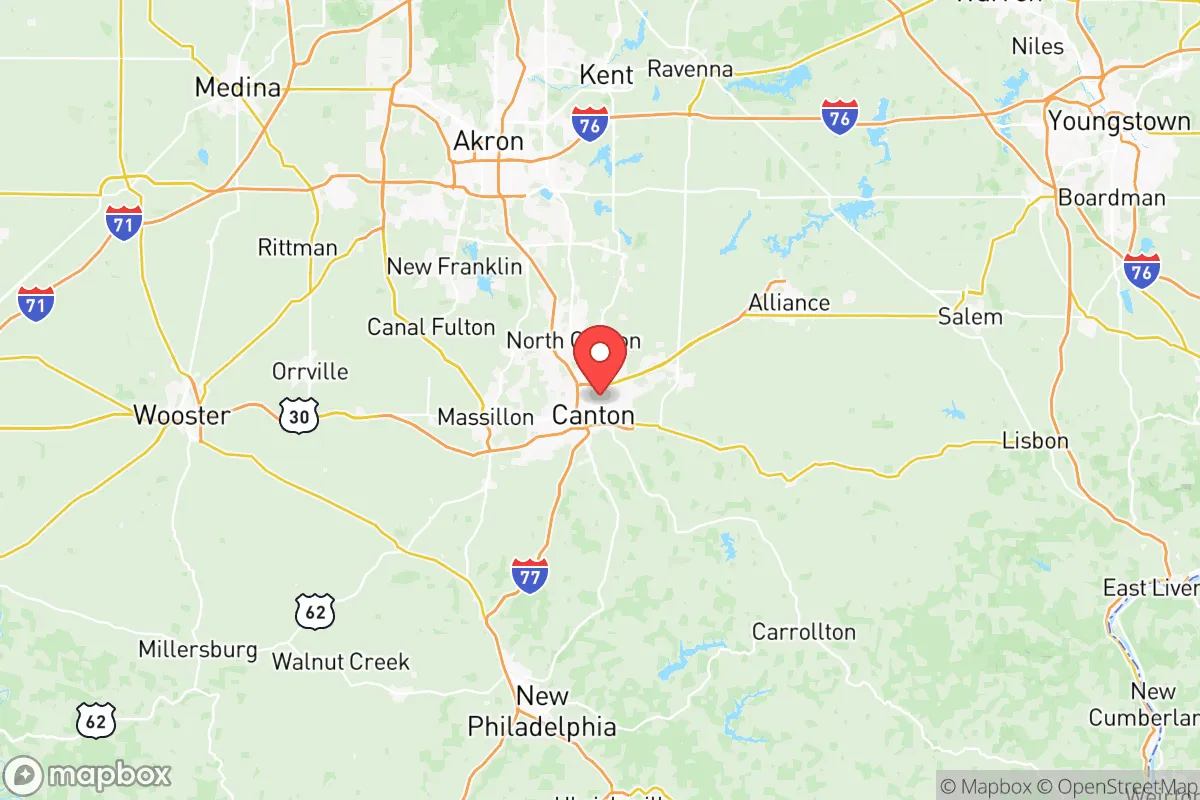
Stark County sits in a sweet spot of the Midwest, roughly 50 miles south of Lake Erie and 20 miles west of the Pennsylvania border. The county seat, Canton, is the largest city, but the region is defined by a network of smaller towns and rural townships like Massillon, Alliance, and Louisville. This decentralized layout is a strategic advantage. A relocator can live in a low-density township like Washington Township or Pike Township and still be within a 20-minute drive of Canton’s hospitals and supply chains. The land is rolling and fertile, part of the Appalachian foothills, offering decent soil for small-scale agriculture. The Tuscarawas River cuts through the county, providing a surface water source, and the underlying glacial aquifers offer reliable groundwater for wells. The climate is four-season, with cold winters that naturally reduce population density and activity during the most vulnerable months. The absence of major fault lines, hurricane zones, or wildfire corridors means the primary natural threats are winter storms and occasional tornadoes—manageable with proper preparation. For a relocator, the ability to heat with wood, draw water from a well, and grow food on a few acres is not a romantic notion; it is a practical reality here.Risks, exposures, and proximity to fallout-relevant landmarks
This is where Stark County’s strategic picture gets complicated. The county is sandwiched between two major population and industrial corridors. To the north, the Cleveland-Akron metroplex is less than an hour away, with its concentration of refineries, chemical plants, and the Cleveland Hopkins International Airport. To the south and east, the Pittsburgh-Youngstown corridor brings its own industrial weight, including the massive Shell petrochemical plant in Beaver County, PA, just 40 miles from Stark County’s eastern border. Within the county itself, the primary concern is the TimkenSteel plant in Canton, a specialty steel mill that produces high-grade alloys for defense and aerospace. While not a nuclear target, it is a strategic industrial asset that could attract attention during a conflict or civil unrest. The county also hosts the Akron-Canton Airport, a regional hub that could become a chokepoint or a target. For the prepper, the proximity to I-77 and I-76 is a double-edged sword. These highways provide excellent supply routes but they also serve as evacuation routes for millions of people from Cleveland and Akron, turning Stark County into a potential funnel zone during a mass movement during a crisis. The county’s location within the Ohio River Valley also means that any contamination event at the Perry Nuclear Power Plant, 60 miles to the northeast, or the Beaver Valley Nuclear Plant, 50 miles to the east, could affect air and water quality depending on wind patterns. The risk is not existential, but it is real and requires a plan for air filtration and water storage.Practical resilience for a relocator: food, water, energy, and defensibility
For the individual or family looking to establish a resilient homestead, Stark County offers a workable foundation. The agricultural base is strong, with Amish and Mennonite communities in the surrounding counties of Holmes and Wayne providing a network of local food production, animal husbandry, and traditional skills. A relocator can tap into this network for livestock, seed stock, and knowledge transfer. The county has a robust network of farm supply stores, feed mills, and equipment dealers, meaning the supply chain for self-sufficiency is local. Water is generally accessible. Most rural properties can support a drilled well at depths of 50 to 150 feet, with yields adequate for a household and small garden. The county’s water table is not under the same stress as the arid West. For energy, so long-term drought is less of a concern. Energy resilience is more challenging. The grid is reliable in normal times, but winter storms have caused multi-day outages in recent years. Natural gas is widely available in the region, thanks to the Utica Shale play, and many homes already use gas for heating and cooking. A relocator should prioritize a backup generator or solar array with battery storage. Wood heat is viable, as the county is still has significant forest cover, and a cord of hardwood can be sourced locally for a few hundred dollars. Defensibility is a mixed bag. The terrain is not mountainous, but the rolling hills and wooded lots provide natural screening. The key is to avoid the main corridors and choose a property with a single access point, good sightlines, and a buffer of at least 10 acres. The county’s law enforcement presence is adequate but not overwhelming. The Stark County Sheriff’s Office covers the unincorporated areas, and response times in rural townships can be 20 minutes or more. This is not a place for a lone wolf, but for a family willing to build relationships with neighbors and participate in the local community, the security profile is acceptable.The overall strategic picture for a conservative relocator
Stark County is not a survivalist paradise, but it is a realistic option for the relocator who wants to stay connected to the economy while building a buffer from urban collapse. The county’s manufacturing base, anchored by companies like TimkenSteel, Diebold Nixdorf, and the Cleveland Clinic’s Mercy Medical Center, provides stable employment that does not require a commute into a major city. The cost of living in a township like Plain Township or Lake Township, you can have a job in a trade, work remotely, or run a small business without being dependent on the chaos of the federal government or the coastal economies. The political machines. The political climate is conservative, with Stark County voting Republican in every presidential election since 2008, and the culture reflects that—gun ownership is common, church attendance is high, and the general attitude is self-reliance. The downsides are real: the proximity to Cleveland and Pittsburgh means that a major event in either city will spill over into Stark County. The refugee flow of refugees, the strain on medical resources, and the potential for supply chain disruptions are all factors that require a plan. But for the relocator who is willing to dig a well, stock a pantry, and get to know their neighbors, Stark County offers a defensible position with a solid economic base. It is not a retreat, it is a redoubt.
* Values derived from national, state, county, city and local statistics and may differ in a specific area. Last updated: 2026-05-14T19:45:17.000Z
Narrative content on this page is AI-generated and may contain mistakes. Verify any details that matter before acting on them.
ReloMaps may earn a commission from affiliate links at no extra cost to you.

