Photo: Wikipedia
Demographics of Orleans, VT
Affluence Level in Orleans, VT
A below-average socioeconomic profile. Incomes, home values, and educational attainment trail the U.S., with higher poverty and unemployment.
People of Orleans, VT
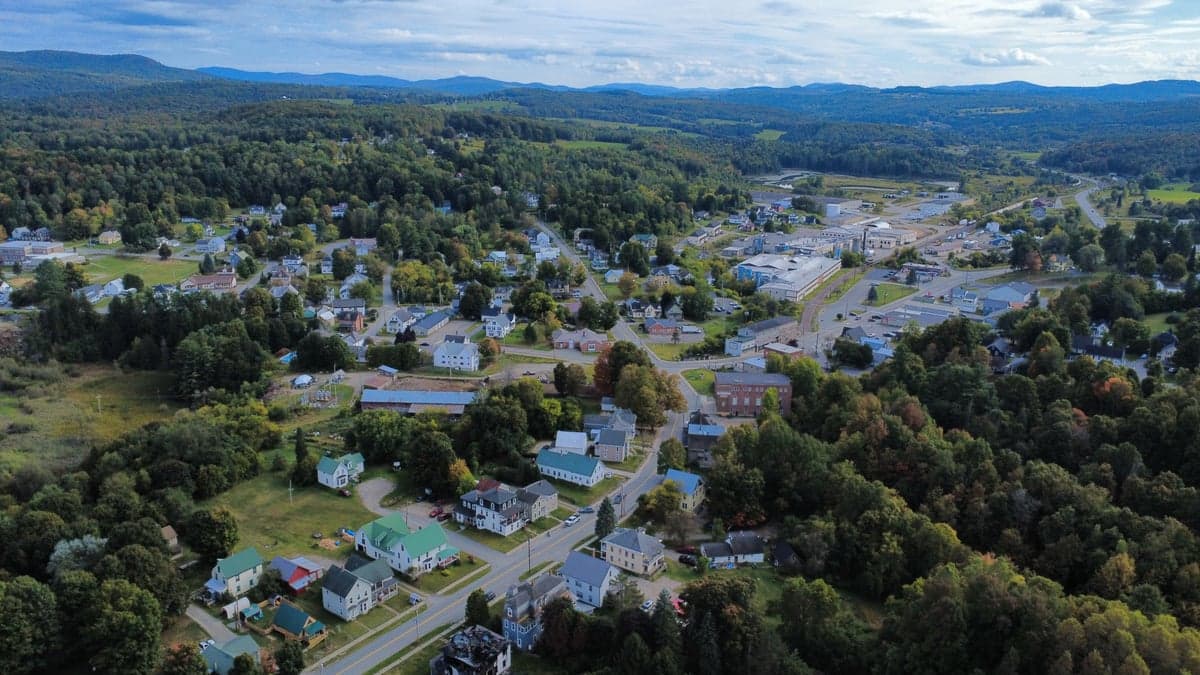
Orleans, Vermont, is a small, tightly-knit community of 848 residents where nearly 96% of the population is white and the foreign-born share stands at 0.0%. The city’s character is defined by its working-class roots, a strong sense of local independence, and a demographic profile that has remained remarkably stable for decades. With a college attainment rate of 28.1%, Orleans is a place where family ties and practical trades often matter more than academic credentials, and where the population is slowly aging in place rather than being reshaped by new arrivals.
How the city was settled and grew
Orleans was chartered in 1793, but its real growth began in the mid-19th century when the railroad arrived, connecting the town to markets in Boston and Montreal. The original settlers were primarily Yankee farmers from southern New England, drawn by land grants in the fertile valley of the Barton River. By the 1850s, a wave of French-Canadian immigrants crossed the border from Quebec, seeking work in the region’s sawmills, gristmills, and the growing granite industry. These families settled in what is now known as the South End neighborhood, near the river and the rail depot, building modest clapboard homes and founding St. Theresa’s Catholic Church. A smaller wave of Irish immigrants arrived around the same time, concentrating in the West Side district along Main Street, where they worked as laborers on the railroad and in local foundries. By 1900, the population had swelled to over 1,500, with a distinct Franco-American identity that still echoes in local surnames and the annual Orleans County Fair.
Modern era (post-1965)
After the 1965 Hart-Cellar Act, Orleans saw virtually no immigration — the foreign-born population remains at 0.0% today. Instead, the post-1965 period was marked by domestic out-migration as the region’s manufacturing base declined. The closure of the Orleans Furniture Company in the 1970s and the gradual shrinkage of the granite industry led younger residents to leave for Burlington or out of state. The population dropped from a peak of roughly 1,200 in 1960 to 848 by 2020. The Downtown Core along Main Street lost several storefronts, while the East Side neighborhood, once home to mill workers, saw homes converted to seasonal rentals. The Hispanic population, now at 1.9%, is a very recent and small addition, mostly families working in the region’s dairy farms and maple sugaring operations, settling in scattered rental units rather than a distinct enclave. The Black population (0.7%) and East/Southeast Asian population (0.0%) are negligible, and there is no Indian-subcontinent community. The city’s racial homogeneity has actually intensified since 2000, as the small non-white populations that existed have either aged out or moved away.
The future
Orleans is not homogenizing — it has been homogeneous for generations — but it is slowly tribalizing along age and income lines. The Lake Region area, near the shores of Lake Memphremagog, is attracting a small number of out-of-state retirees and second-home buyers, driving up property values and creating a subtle divide between year-round locals and seasonal residents. Meanwhile, the South End remains the heart of the working-class Franco-American community, but its population is aging, with few young families moving in. The immigrant communities that are reshaping other parts of Vermont — such as the Somali and Nepali populations in Burlington — have not reached Orleans and show no signs of doing so. The foreign-born share will likely remain near zero for the foreseeable future. The next 10-20 years will probably see a continued slow decline in population, with the city becoming older, whiter, and more economically stratified between lakefront property owners and long-term residents on fixed incomes.
For someone moving in now, Orleans offers a stable, predictable community where neighbors know each other and change comes slowly. It is not a place of demographic dynamism or cultural diversity, but rather a quiet, rural town where the population is aging in place and the biggest shifts are economic, not ethnic. A conservative-leaning individual or family will find a community that values self-reliance, local tradition, and a slower pace of life — but should also expect limited job opportunities, a shrinking school-age population, and a social fabric that is more insular than welcoming to outsiders.

* Values derived from national, state, county, city and local statistics and may differ in a specific area. Last updated: 2026-04-19T08:47:47.000Z
Narrative content on this page is AI-generated and may contain mistakes. Verify any details that matter before acting on them.
ReloMaps may earn a commission from affiliate links at no extra cost to you.

