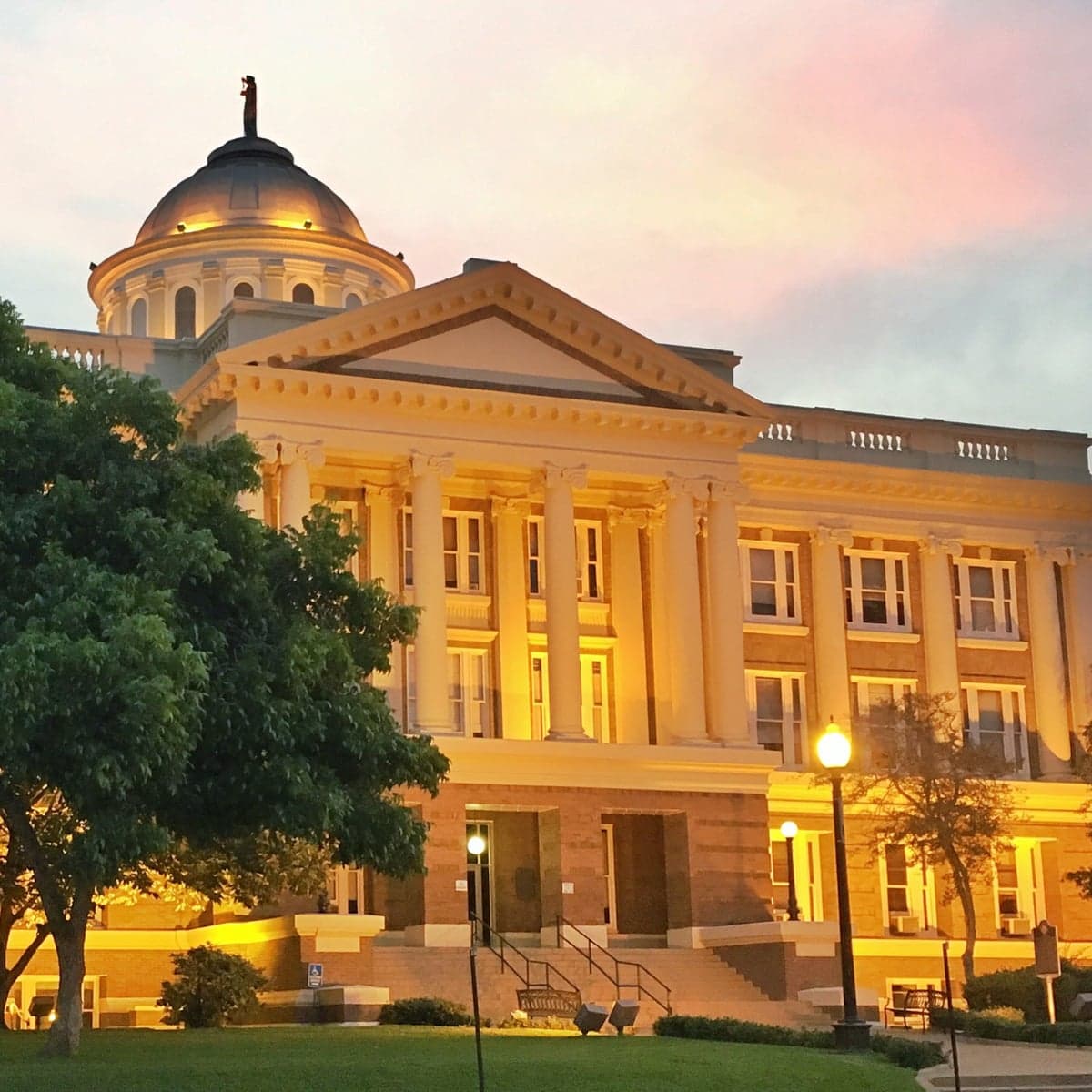
Photo: Wikipedia
Demographics of Palestine, TX
Affluence Level in Palestine, TX
A below-average socioeconomic profile. Incomes, home values, and educational attainment trail the U.S., with higher poverty and unemployment.
People of Palestine, TX
The people of Palestine, Texas, today form a working-class, deeply rooted community of roughly 18,900 residents where no single racial or ethnic group holds a majority. White residents make up 45.1% of the population, Black residents 27.3%, and Hispanic residents 24.4%, creating a tri-ethnic character uncommon in East Texas. The city’s foreign-born share is low at 4.7%, and only 16.3% of adults hold a college degree, reflecting a population shaped by local industry and agriculture rather than by professional migration. Distinct neighborhoods — the historic North Side, the South Side, and the West Side — still echo the settlement patterns of the 19th and 20th centuries.
How the city was settled and grew
Palestine was founded in 1846 as the seat of Anderson County, drawing its first white settlers from the Deep South — primarily Alabama, Mississippi, and Tennessee — who came for cotton land grants and established plantations. Enslaved African Americans were brought to work those plantations, and after Emancipation many remained, forming the nucleus of the North Side neighborhood, which became the city’s historic Black community. The arrival of the International–Great Northern Railroad in the 1870s spurred a second wave: Irish and German laborers built the rail yards and settled in the West Side near the depot, while white merchants and professionals clustered around the courthouse square in what is now the Downtown Historic District. A third wave followed the 1930s oil boom in the nearby East Texas Oil Field, bringing white and Black workers from across the region. Hispanic settlement was minimal before 1950; the South Side began to grow only in the 1960s as Mexican-American families moved in for agricultural and railroad work.
Modern era (post-1965)
After the 1965 Hart-Cellar Act, Palestine saw little new foreign immigration — the foreign-born share remains under 5% — but domestic migration reshaped the city. African Americans from rural Anderson County consolidated into the North Side and adjacent Forest Hills subdivision, while white families gradually moved to newer subdivisions on the West Side and along Loop 256. Hispanic growth accelerated after 1990, with families settling in the South Side and in mobile-home parks near the industrial corridor. The result is a city that remains residentially segregated by neighborhood: the North Side is over 80% Black, the South Side over 60% Hispanic, and the West Side over 70% white. The Asian population is negligible at 0.1% (East/Southeast Asian) and the Indian-subcontinent population is 0.0%, so Palestine has not experienced the Asian immigration common in larger Texas cities. The low college-attainment rate (16.3%) reflects the dominance of blue-collar employment in manufacturing, warehousing, and the nearby prison system.
The future
Palestine’s population is projected to remain stable or grow slowly, with the Hispanic share likely rising to 30–35% by 2040 through higher birth rates and continued in-migration from South Texas. The Black and white shares will edge downward proportionally, but the city is not homogenizing — neighborhoods are likely to stay ethnically distinct rather than blending into a single melting pot. The foreign-born share will probably stay below 6% because the local economy (dominated by a Tyson Foods plant, a Walmart distribution center, and the Texas Department of Criminal Justice) does not attract high-skill immigrants. The Indian and East/Southeast Asian communities will remain tiny. For a conservative-leaning newcomer, this means moving into a place where neighborhood choice largely determines social environment: the West Side offers predominantly white, church-oriented suburban life; the South Side is heavily Hispanic and family-oriented; the North Side is historically Black with strong community institutions. Political culture across all groups leans conservative, with Anderson County voting +39 points Republican in 2024.
Palestine is becoming a more Hispanic, still working-class small city where racial lines remain visible but daily life is cooperative and neighborly. For someone moving in now, the key is to choose a neighborhood that matches their preferences — the city’s character is less about a unified identity and more about three distinct communities sharing a single tax base. The low cost of living and conservative social values are consistent draws, but economic opportunity is limited for those without a trade or a willingness to commute to Tyler or Houston.

* Values derived from national, state, county, city and local statistics and may differ in a specific area. Last updated: 2026-05-14T20:57:47.000Z
Narrative content on this page is AI-generated and may contain mistakes. Verify any details that matter before acting on them.
ReloMaps may earn a commission from affiliate links at no extra cost to you.

