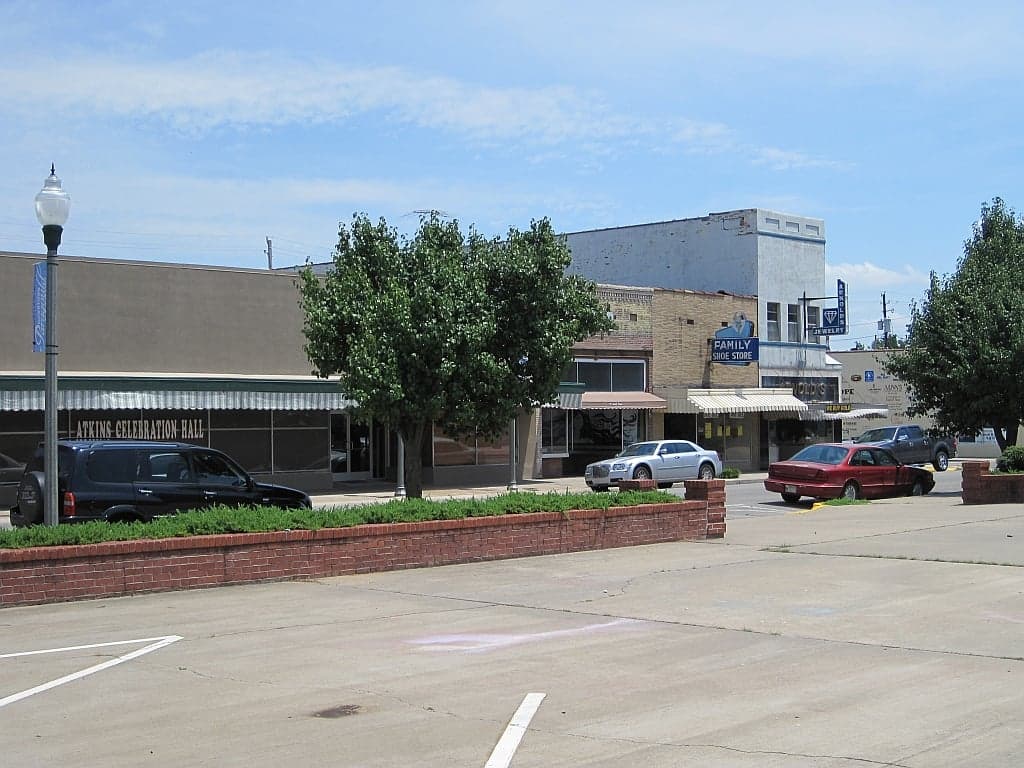
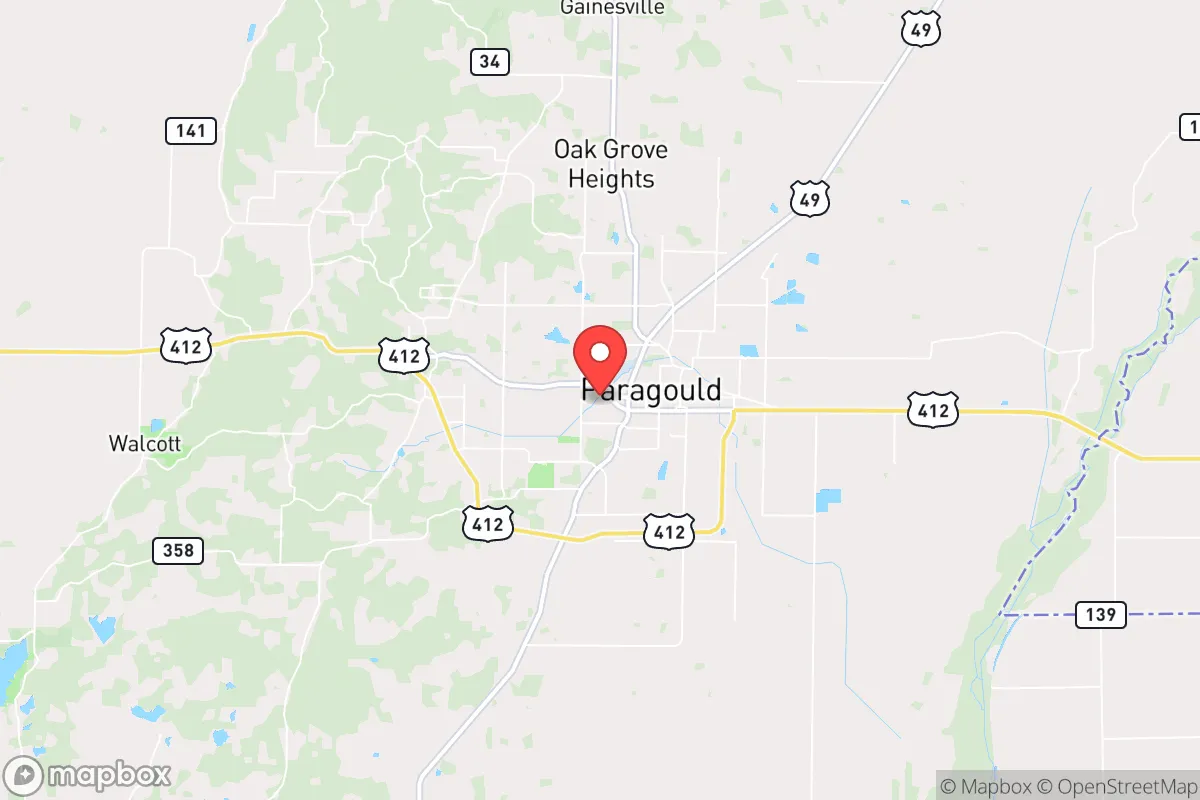
Photo: Wikipedia
Demographics of Paragould, AR
Affluence Level in Paragould, AR
A below-average socioeconomic profile. Incomes, home values, and educational attainment trail the U.S., with higher poverty and unemployment.
People of Paragould, AR
The people of Paragould, Arkansas today number 29,940, forming a predominantly white (86.4%) community with a very small foreign-born population (0.9%). The city is notably less diverse than the national average, with a Hispanic share of 5.0%, a Black population of 3.4%, and tiny East/Southeast Asian (0.2%) and Indian subcontinent (0.3%) communities. Paragould’s identity remains rooted in its railroad and timber heritage, with a blue-collar character reflected in its low college attainment rate of 16.3% and a population density of roughly 1,200 people per square mile.
How the city was settled and grew
Paragould was founded in 1883 as a railroad junction town, named after a merger of two railroad magnates—J.W. Paramore and Jay Gould—whose competing lines met here. The original population was drawn by the timber industry and the promise of rail work. The first wave of settlers were white migrants from the Upper South, primarily Tennessee and Kentucky, who arrived via the St. Louis, Iron Mountain and Southern Railway. These early residents built homes in the Original Townsite (the grid around today’s Courthouse Square) and the West Side neighborhood, where modest frame houses still stand. By 1900, the population had reached about 3,000, with a small Black community forming in the South Side area near the railroad tracks, working as laborers and domestic servants. A second wave came during the 1920s timber boom, when the Missouri Pacific Railroad expanded operations, drawing additional white workers from the Ozarks and a handful of Italian immigrants who settled in the North End near the rail yards. The city grew steadily through the mid-20th century, reaching 10,000 by 1950, with the East Side developing as a post-war subdivision for returning veterans and their families.
Modern era (post-1965)
After the 1965 Hart-Cellar Act, Paragould saw virtually no new immigration—its foreign-born share remains under 1% today. The post-1965 era instead brought domestic in-migration from rural Greene County and neighboring Missouri counties, as small farms consolidated and people moved into town for manufacturing jobs. The Hillcrest neighborhood, developed in the 1970s and 1980s, absorbed many of these white working-class families, while the South Side saw a modest increase in its Black population, which grew from about 2% in 1970 to 3.4% today. The Hispanic population, now 5.0%, began arriving in the 1990s, drawn by poultry processing plants (such as the nearby Tyson Foods facility) and construction work. These families concentrated in the West Side and along Highway 49, where several Spanish-language churches and tiendas have opened. The East/Southeast Asian population (0.2%) is negligible, consisting of a few families employed in healthcare or academia, while the Indian subcontinent population (0.3%) is almost entirely composed of professionals at the local hospital or the Arkansas State University campus in Jonesboro, 25 miles south. No distinct ethnic enclaves exist for these groups; they are scattered across the city.
The future
Paragould’s population is projected to grow slowly, reaching roughly 32,000 by 2035, driven by natural increase and continued domestic in-migration from surrounding rural areas. The city is not homogenizing into a single identity but rather tribalizing along economic lines: the Hillcrest and East Side neighborhoods are becoming more solidly middle-class and white, while the West Side is emerging as a working-class Hispanic corridor. The Black population is plateauing, with no significant new arrivals expected. The tiny Asian and Indian populations are likely to remain static, as Paragould lacks the professional job base or university presence to attract them in numbers. The foreign-born share will probably stay below 2% for the foreseeable future. The most notable demographic shift is the aging of the white population—the median age is 38.5, and many younger adults leave for college and do not return, a trend that may slowly increase the Hispanic share as families with children settle in.
For someone moving in now, Paragould is becoming a quietly stratified small city: a white, aging core in the historic neighborhoods, a growing Hispanic working class on the west side, and a very small Black community in the south. The city’s low cost of living and manufacturing base offer stability, but the lack of diversity and educational attainment means limited social mobility for newcomers who are not already plugged into the local economy. It is a place where community ties remain strong, but those ties are increasingly defined by which neighborhood you live in.

* Values derived from national, state, county, city and local statistics and may differ in a specific area. Last updated: 2026-04-30T02:32:53.000Z
Narrative content on this page is AI-generated and may contain mistakes. Verify any details that matter before acting on them.
ReloMaps may earn a commission from affiliate links at no extra cost to you.

