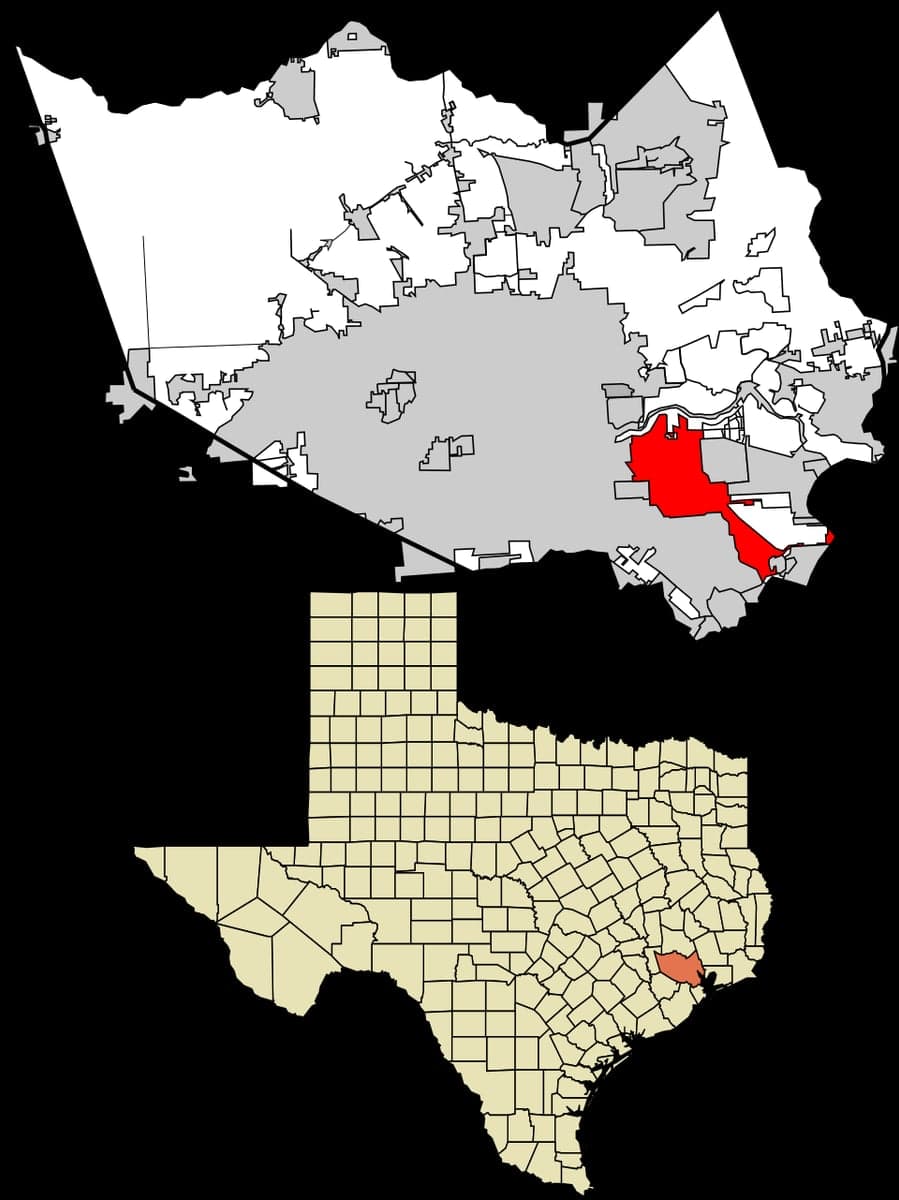
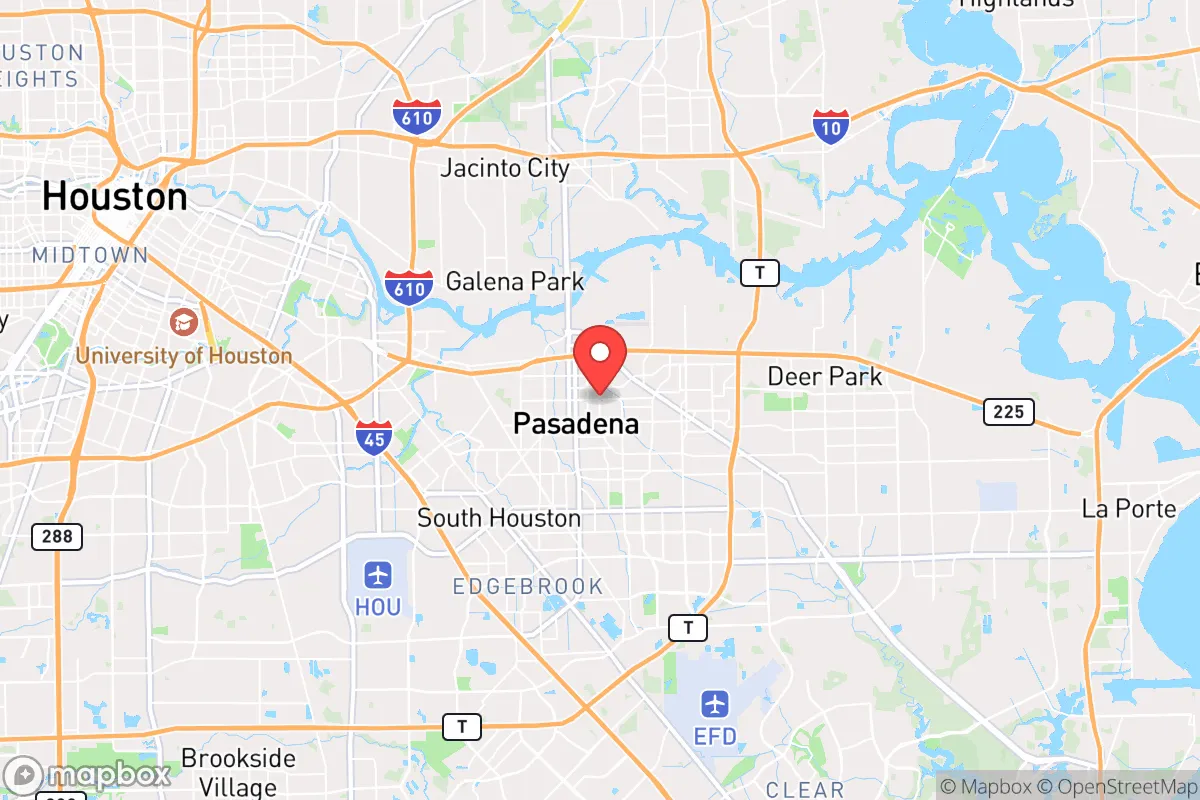
Photo: Wikipedia
Demographics of Pasadena, TX
Affluence Level in Pasadena, TX
A low-income area with significant economic hardship. Household wealth and educational attainment are well below national averages.
People of Pasadena, TX
The people of Pasadena, Texas today form a dense, working-class, and overwhelmingly Hispanic community of 149,345 residents. The city is 70.5% Hispanic, with a White non-Hispanic population of 23.2%, a small Black community at 3.0%, and modest East/Southeast Asian (1.2%) and Indian subcontinent (0.5%) populations. With only 16.1% of adults holding a college degree, Pasadena remains a blue-collar, family-oriented city where the dominant identity is shaped by deep Mexican-American roots, a strong petrochemical industry presence, and a distinct sense of being a self-contained city rather than a Houston suburb.
How the city was settled and grew
Pasadena was founded in 1893 on the coastal prairie southeast of Houston, named by a real estate developer who imagined a "crown of the valley" like its California namesake. The original settlers were Anglo-American farmers and ranchers drawn by cheap land and the promise of rice farming along the Houston Ship Channel. The city incorporated in 1928 with fewer than 1,000 residents. The first major population wave came during the 1940s and 1950s, when the construction of oil refineries and chemical plants along the Ship Channel—including the massive Shell and ExxonMobil facilities—pulled thousands of white, working-class families from the rural South and Midwest. These early refinery workers settled in the Old Pasadena neighborhood near the original downtown and in the Parkview subdivision, which became the heart of the Anglo middle class. By 1960, Pasadena was a nearly all-white city of 58,000, known as the "Strawberry Capital of the South" and a staunchly conservative, union-averse company town for the petrochemical industry.
Modern era (post-1965)
The 1965 Hart-Cellar Immigration Act, combined with the collapse of rice farming and the expansion of refinery maintenance work, triggered a demographic revolution. Mexican-American laborers, many from South Texas and northern Mexico, began arriving in the 1970s to fill lower-skilled positions in construction, pipefitting, and plant maintenance. They initially clustered in the South Houston border area and the Red Bluff corridor, where older, cheaper housing stock was available. By 1990, the Hispanic share had risen to 35%, and by 2000 it had crossed 50%. The white population, meanwhile, began a steady exodus to suburbs like Pearland and Friendswood, a pattern that accelerated after the 1980s oil bust. Today, the Hispanic majority is concentrated across the entire city, but the Golden Acres neighborhood and the area around Pasadena High School remain heavily Hispanic working-class strongholds, while the Vista Villas area near the southern edge retains a slightly higher White and Asian mix. The small Black community (3.0%) is clustered near the Genoa neighborhood in the city's northeast corner, a legacy of post-war migration to industrial jobs.
The future
Pasadena's population is continuing to homogenize along Hispanic lines. The White share has fallen from 23.2% to likely below 20% by 2030, while the Hispanic share is projected to approach 75-80% within a decade. The East/Southeast Asian and Indian communities remain small and stable, concentrated in newer apartment complexes near the Sam Houston Tollway. The city is not tribalizing into distinct ethnic enclaves—rather, the Hispanic majority is becoming the default culture, with English-Spanish bilingualism nearly universal and local politics dominated by Hispanic candidates. The key demographic question is whether Pasadena will see a new wave of domestic in-migration from other parts of Texas or the Gulf Coast, or whether it will continue to lose its remaining non-Hispanic population to surrounding suburbs. The lack of college-educated job growth and the dominance of industrial employment suggest the city will remain a working-class Hispanic hub, with slow population growth and an aging housing stock.
For someone moving in now, Pasadena offers a dense, affordable, and culturally cohesive community where Spanish is heard as often as English and the economy revolves around the Ship Channel. It is not a diverse melting pot in the traditional sense—it is a city where one ethnic group has become the clear majority, and where the remaining minorities are small and dispersed. The trade-off is a strong sense of local identity, low housing costs relative to Houston, and a straightforward, family-oriented lifestyle, but with limited upward mobility for those without a college degree or refinery connections.

* Values derived from national, state, county, city and local statistics and may differ in a specific area. Last updated: 2026-05-03T04:48:54.000Z
Narrative content on this page is AI-generated and may contain mistakes. Verify any details that matter before acting on them.
ReloMaps may earn a commission from affiliate links at no extra cost to you.

