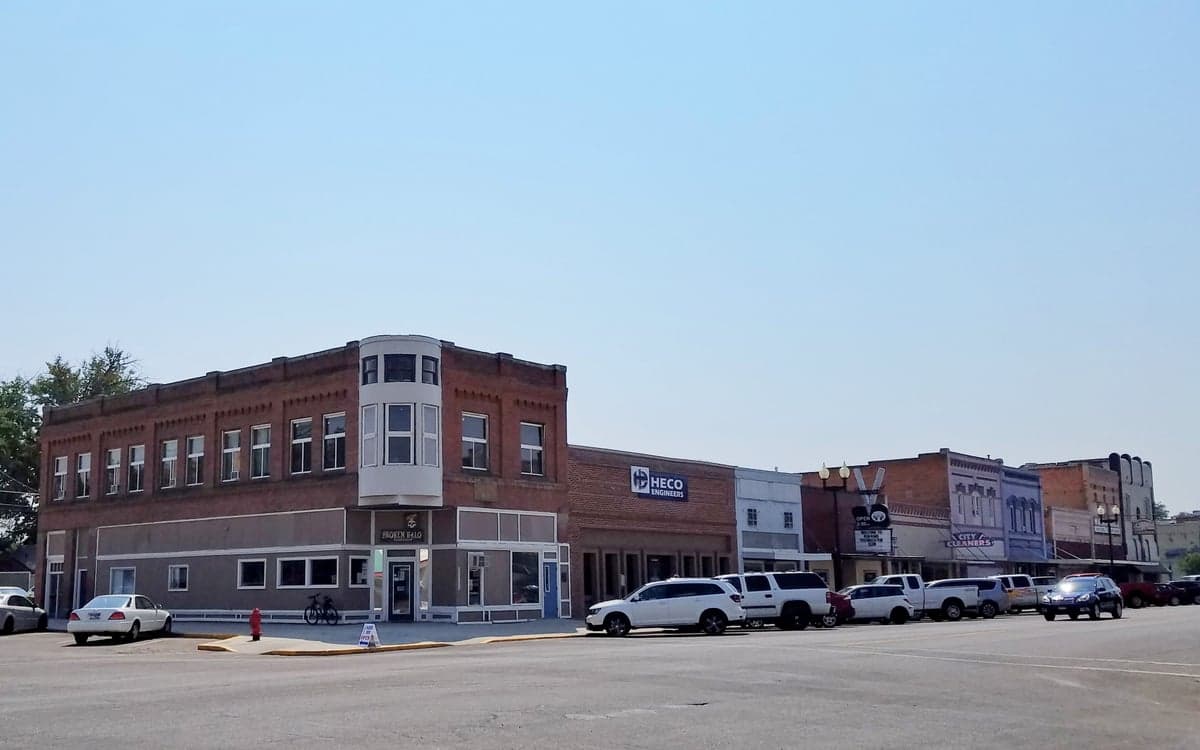
Photo: Wikipedia
Personal Sovereignty in Payette, ID
Moderate friction. Expect trade-offs in some aspect of personal liberty and independence.
What does Personal Sovereignty tell us?
Personal Sovereignty measures your capacity for self-reliance and independence with minimal government friction. Higher scores mean fewer barriers between you and the way you want to live... but it assumes you have the space you need and good neighbors.
What does this tell us?
Personal Sovereignty measures your capacity for self-reliance and independence with minimal government friction. Higher scores mean fewer barriers between you and the way you want to live... but it assumes you have the space you need and good neighbors.
State Policy
Energy independence: Importer (25% of energy produced in-state)
Personal Liberty
Homesteading

Personal Liberty Analysis
Payette, Idaho, offers a level of personal sovereignty that is increasingly rare in the modern United States, functioning as a practical stronghold for those who prioritize individual autonomy over state control. Nestled in the western part of the state along the Snake River, this small city of roughly 8,000 people operates within a state framework that has deliberately pushed back against federal overreach, creating an environment where a survivalist or prepper mindset can actually take root. For single individuals and parents alike, the core question isn't just about what rights exist on paper, but how those rights translate into daily life—and in Payette, the answer leans heavily toward self-determination, with low taxes, permissive gun laws, and a regulatory climate that still respects property rights and family decisions.
Tax burden and regulatory posture: how Idaho’s fiscal restraint protects your autonomy
Idaho’s tax structure is a direct reflection of its constitutional commitment to limited government, and Payette residents benefit from that posture without the urban premium found in Boise or Coeur d’Alene. The state imposes a flat income tax rate of 5.8% as of 2025, with no inheritance or estate tax, meaning your wealth stays in your hands, not the state’s. Property taxes in Payette County average around 0.72% of assessed value, which is significantly lower than the national average of roughly 1.1%, and the city itself has no additional municipal income tax. This low burden is not accidental—Idaho’s legislature has consistently passed tax cuts and resisted new revenue streams, including rejecting Medicaid expansion implementation in ways that would increase state spending. For a prepper, this means more disposable income for supplies, land, and infrastructure, and less fear that a future tax hike will force you off your property. The regulatory environment is equally lean: Idaho has no state-level building codes in unincorporated areas (though Payette city does enforce basic codes), and business licensing is minimal. Zoning is handled at the county level with a light touch, so you won’t face the kind of bureaucratic red tape that chokes homesteading efforts in states like California or Oregon. The state’s right-to-work laws further reinforce personal economic freedom, ensuring you can’t be forced into union membership as a condition of employment.
Self-defense and gun law specifics: what Payette allows that other states restrict
Idaho is a constitutional carry state, meaning that as of July 1, 2016, any law-abiding adult over 18 can carry a concealed firearm without a permit—no training course, no background check beyond the purchase, and no government permission slip. Payette residents live under this framework, and local law enforcement generally respects it. The state also preempts local gun ordinances, so Payette city cannot pass its own bans on magazine capacity, ammunition types, or carry locations beyond what state law allows. For the survivalist, this is critical: you can own NFA items like suppressors and short-barreled rifles without state-level restrictions (federal NFA rules still apply), and there is no state registry for firearms. Stand-your-ground laws are fully in effect, with no duty to retreat in any place you are lawfully present. Castle doctrine protections extend to your vehicle and workplace, not just your home. For parents, this means you can teach your children firearms safety and ownership without fear of state interference—Idaho has no safe storage law that criminalizes how you keep guns in your home. The practical reality in Payette is that gun ownership is normalized, not stigmatized, and the local sheriff’s office is known for issuing concealed carry permits quickly for those who still want one for reciprocity with other states. If you’re coming from a state with magazine bans or red-flag laws, Payette offers a genuine refuge from those infringements.
Self-reliance and homesteading viability: lot sizes, zoning, and off-grid feasibility
Payette’s rural character makes it a prime location for those looking to build a self-sufficient lifestyle, with land availability that is still affordable compared to the rest of the West. Residential lots within city limits typically range from 0.25 to 1 acre, but just outside town in Payette County, you can find parcels of 5 to 40 acres for under $5,000 per acre—far cheaper than comparable land in Washington or Colorado. Zoning in unincorporated areas is permissive: agricultural and rural residential zones allow for livestock, gardens, and even small-scale aquaculture without special permits. Off-grid living is legally feasible, though you’ll need to comply with state health department rules for septic systems and well water. Idaho has no state law requiring connection to the electrical grid, so solar panels with battery storage are a common sight. Rainwater collection is unrestricted, and you can drill a private well without a water right permit if you’re using it for domestic purposes (less than 13,000 gallons per day). For the prepper, this means you can build a compound with food production, water independence, and backup power without fighting the county. The local extension office through the University of Idaho offers resources on soil testing, canning, and livestock management, but there’s no government mandate that you follow their advice. Payette’s agricultural heritage means neighbors are likely to be supportive of homesteading activities, not reporting you for having chickens or a wood-fired stove.
Personal liberties: parental rights, medical autonomy, speech, and property protections
Idaho has become a national leader in protecting parental rights, and Payette families directly benefit from this. The state’s Parental Rights in Education Act (2023) requires schools to obtain parental consent before any medical or mental health screening, and it prohibits classroom instruction on sexual orientation or gender identity in grades K-3. For parents concerned about government overreach into family decisions, this law provides a legal shield—you have the right to opt your child out of any curriculum you find objectionable, and schools cannot hide information from you. Medical autonomy is similarly robust: Idaho has no vaccine mandate for adults or children beyond standard school requirements (which allow religious and philosophical exemptions), and the state passed a law in 2024 prohibiting discrimination against unvaccinated individuals in employment and public accommodations. Telehealth for out-of-state doctors is legal, giving you access to alternative medical opinions without leaving home. Free speech protections are strong, with no hate speech laws that criminalize political or religious expression, and the state has explicitly rejected any form of digital currency or CBDC that could track your transactions. Property rights are enshrined in the Idaho Constitution, and the state has a strong eminent domain reform law that prevents the government from taking land for private economic development. For the survivalist, this means you can build a bunker, store supplies, and live according to your values without the state second-guessing your choices. The only notable limitation is that Idaho does require a permit for large-scale water use (over 13,000 gallons per day for irrigation), but domestic wells are exempt.
In the broader landscape of American personal sovereignty, Payette stands out as a place where the state government is still viewed as a servant, not a master. Compared to the Pacific Coast states or the Northeast, where regulatory overreach has made self-reliance nearly impossible, Payette offers a practical alternative: low taxes, constitutional carry, permissive zoning, and strong parental rights. It’s not a libertarian utopia—you still have to follow federal law, and the county health department will inspect your septic system—but for a single individual or parent looking to build a life free from constant government interference, this small Idaho town delivers on the fundamentals. The key is that the legal framework here is designed to let you make your own choices, even if those choices involve storing food, carrying a firearm, or homeschooling your children. In a country where personal sovereignty is increasingly under assault, Payette remains a viable redoubt.

* Values derived from national, state, county, city and local statistics and may differ in a specific area. Last updated: 2026-04-21T09:53:04.000Z
Narrative content on this page is AI-generated and may contain mistakes. Verify any details that matter before acting on them.
ReloMaps may earn a commission from affiliate links at no extra cost to you.

