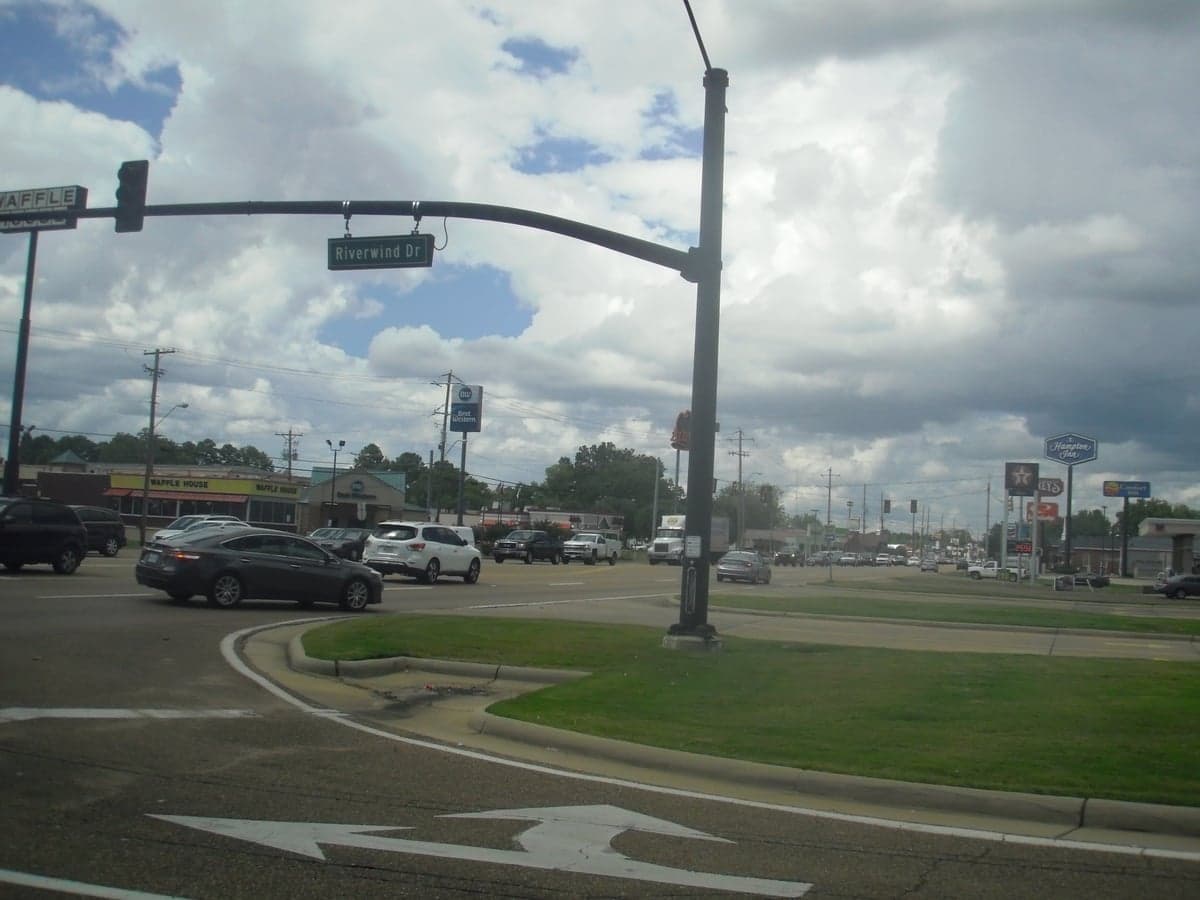
Photo: Wikipedia
Demographics of Pearl, MS
Affluence Level in Pearl, MS
A below-average socioeconomic profile. Incomes, home values, and educational attainment trail the U.S., with higher poverty and unemployment.
People of Pearl, MS
The people of Pearl, Mississippi, today form a predominantly native-born, family-oriented community of 27,458, characterized by a strong manufacturing and logistics workforce and a distinctly suburban, conservative identity. The city is notably less diverse than the national average, with a foreign-born population of just 1.8%, and its racial composition—59.8% White, 29.5% Black, 5.7% Hispanic, 1.3% East/Southeast Asian, and 1.0% Indian—reflects a history of domestic migration rather than international immigration. Residents are concentrated in established subdivisions like Crossgates and Northpark, with a lower-than-average college attainment rate of 26.3% that aligns with the area's blue-collar and trade-oriented employment base.
How the city was settled and grew
Pearl was not a colonial-era settlement but a product of the 20th-century railroad and highway boom. The area was originally part of rural Rankin County, with sparse agricultural homesteads. The city's true founding came in 1865 when the railroad arrived, but its population remained tiny until the post-World War II era. The first significant wave of residents were white families moving from rural Mississippi and from Jackson, drawn by cheap land and the promise of industrial jobs. The Olde Towne district, near the original railroad depot, became the first concentrated residential area, built by these early working-class families. A second wave in the 1950s and 1960s saw the construction of the Crossgates subdivision, a master-planned community that attracted middle-class white families seeking newer, larger homes away from Jackson's urban core. This period established Pearl's character as a bedroom community for Jackson's industrial and government workforce.
Modern era (post-1965)
The post-1965 era brought significant demographic shifts, driven primarily by domestic migration rather than foreign immigration. The 1970s and 1980s saw an influx of Black families moving from Jackson and rural Rankin County, drawn by affordable housing and the expansion of the city's industrial base, including the Nissan plant (opened 1983) and nearby distribution centers. These families concentrated in the Northpark and Southgate neighborhoods, which today have the highest Black population shares in the city. The Hispanic population, while still small at 5.7%, began growing noticeably in the 1990s and 2000s, with families settling in the Brandon Avenue corridor and working in construction, landscaping, and the poultry processing plants in nearby Morton and Forest. The East/Southeast Asian community (1.3%) is largely composed of Vietnamese and Filipino families who arrived in the 1980s and 1990s, many employed in the medical and engineering sectors at the University of Mississippi Medical Center in Jackson, with a small cluster in the Pearl River area. The Indian community (1.0%) is more recent, with many working as motel owners and gas station operators along Highway 80, concentrated in the Airport Road district. Notably, the city's foreign-born share of 1.8% is far below the national average of 13.7%, underscoring Pearl's status as a destination for domestic, not international, migrants.
The future
Pearl's population is projected to grow slowly but steadily, driven by continued suburban expansion from Jackson and the attraction of new industrial and logistics jobs along the I-20 corridor. The city is not homogenizing into a single demographic block but is instead developing distinct enclaves: Crossgates remains overwhelmingly white and affluent, Northpark is becoming a majority-Black middle-class area, and the Brandon Avenue corridor is the primary Hispanic hub. The East/Southeast Asian and Indian communities are small and appear to be plateauing, with little new immigration and some out-migration to larger metro areas like Atlanta or Dallas for better job opportunities. The next 10-20 years will likely see a gradual increase in the Hispanic share as families grow and new arrivals come for construction and service jobs, but the city will remain overwhelmingly native-born and English-speaking. The college attainment rate of 26.3% is unlikely to rise dramatically unless the city attracts more white-collar employers, which is not a current priority for local economic development.
For someone moving in now, Pearl is becoming a more stratified but still stable, family-oriented suburb. The city offers affordable housing, low crime relative to Jackson, and a strong sense of community in its older subdivisions, but it offers little ethnic diversity or international cultural amenities. New residents should expect a place where most people were born in Mississippi, where church and family are central, and where the population is slowly diversifying along domestic racial lines rather than through immigration.

* Values derived from national, state, county, city and local statistics and may differ in a specific area. Last updated: 2026-05-04T02:49:31.000Z
Narrative content on this page is AI-generated and may contain mistakes. Verify any details that matter before acting on them.
ReloMaps may earn a commission from affiliate links at no extra cost to you.

