
Photo: Wikipedia
Personal Sovereignty in Petal, MS
Viable for self-reliance. Generally workable, though some barriers may limit total independence.
What does Personal Sovereignty tell us?
Personal Sovereignty measures your capacity for self-reliance and independence with minimal government friction. Higher scores mean fewer barriers between you and the way you want to live... but it assumes you have the space you need and good neighbors.
What does this tell us?
Personal Sovereignty measures your capacity for self-reliance and independence with minimal government friction. Higher scores mean fewer barriers between you and the way you want to live... but it assumes you have the space you need and good neighbors.
State Policy
Energy independence: Importer (50% of energy produced in-state)
Personal Liberty
Homesteading

Personal Liberty Analysis
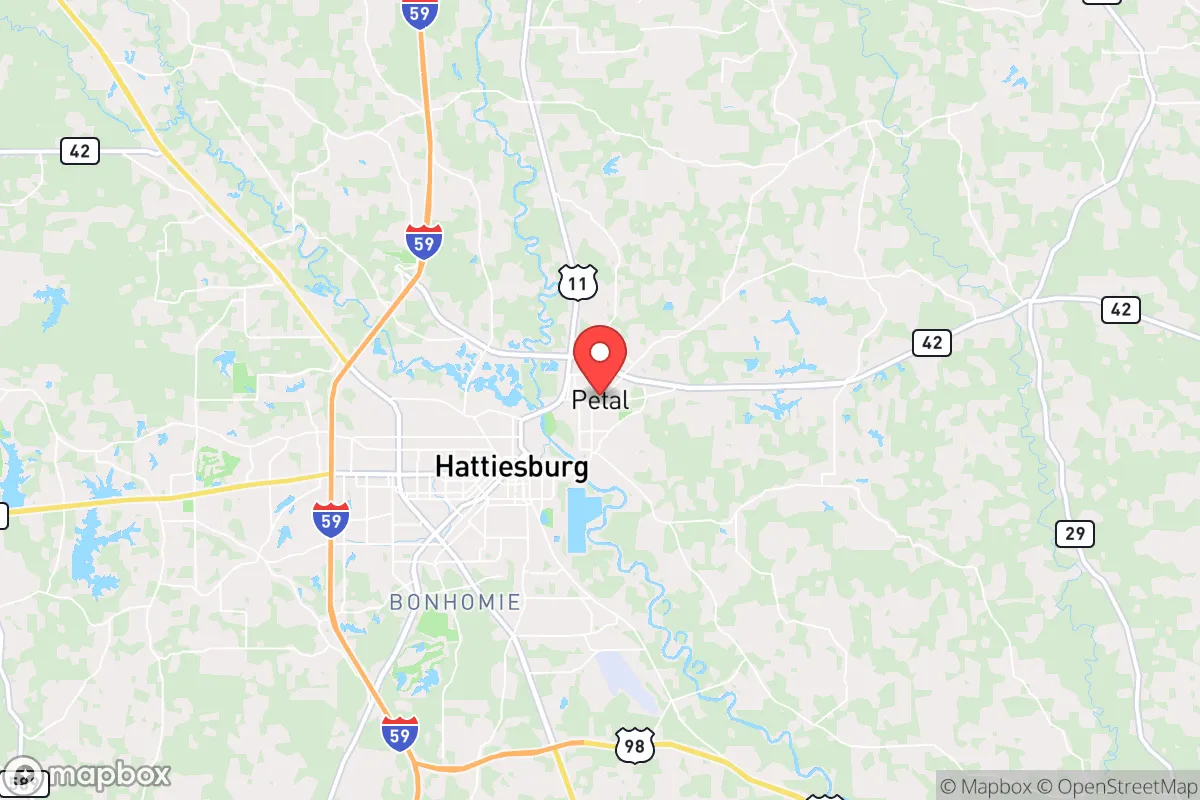
Petal, Mississippi, offers a personal sovereignty environment that stands in stark contrast to the high-regulation, high-tax jurisdictions many conservative families are fleeing. Nestled just outside Hattiesburg, this small city operates under Mississippi’s strong preemption laws and a deeply ingrained culture of self-reliance, making it a viable option for those prioritizing autonomy over government convenience. For the survivalist or prepper mindset, Petal represents a place where the state’s legal framework largely stays out of the way of individual decision-making, though it is not a lawless frontier—local ordinances and zoning still impose some structure. The key question for a strategic relocation is whether this balance of freedom and order aligns with your specific tolerance for government overreach.
Tax burden and regulatory posture: How Mississippi’s policies affect your wallet and autonomy
Mississippi’s tax structure is one of the most favorable in the nation for those seeking to minimize government extraction from their income and property. The state levies a flat income tax rate of 4.0% on all taxable income above $5,000, with no local income tax in Petal, meaning your earnings are not subject to the layered municipal grabs seen in states like New York or California. Property taxes are exceptionally low, with the effective rate in Forrest County hovering around 0.72% of assessed home value—roughly half the national average—and Petal itself does not add a separate city property tax on top of the county levy. Sales tax is a combined 7.0% (state plus local), which is moderate but not punitive, and there is no state-level tax on groceries or prescription medications. From a regulatory posture, Mississippi is a right-to-work state with minimal business licensing hurdles, and Petal’s city government is known for a relatively hands-off approach to home-based enterprises and small-scale agriculture. For the prepper, this means less of your labor is forcibly redirected to government coffers, leaving more capital for land, supplies, and self-sufficiency projects.
Self-defense and gun law specifics: Stand your ground, permitless carry, and castle doctrine
Mississippi is a gold standard for firearm freedom, and Petal residents enjoy the full suite of state preemption protections that prevent local governments from imposing their own gun restrictions. The state enacted permitless (constitutional) carry in 2016, allowing any law-abiding adult 18 or older to carry a concealed or open firearm without a license, background check, or training requirement—though a permit is still available for reciprocity with other states. The castle doctrine is unambiguous: there is no duty to retreat in your home, vehicle, or place of business, and deadly force is presumed justified against unlawful intruders. Mississippi’s stand your ground law extends this principle to any place you have a legal right to be, meaning you are not required to flee before using force if you reasonably believe it is necessary to prevent death or great bodily harm. Petal itself has no local firearm ordinances beyond state law, so you will not encounter the patchwork of magazine bans or waiting periods common in blue cities. For the survivalist, this legal environment means your defensive capabilities are not hamstrung by bureaucratic delays or arbitrary geographic boundaries—a critical factor when considering societal collapse scenarios or simply everyday personal security.
Self-reliance and homesteading viability: Lot sizes, zoning, and off-grid feasibility
Petal’s zoning code is relatively permissive compared to suburban sprawl developments, but it is not a free-for-all. Residential lots in the city proper typically range from one-quarter to one-half acre, though larger parcels of one to five acres are available in the unincorporated areas just outside city limits, particularly along the Leaf River corridor. The city allows backyard chickens, beekeeping, and small livestock (goats, sheep) on lots of one acre or more, but pigs and cattle are restricted to agricultural zoning. Off-grid living is legally feasible but requires navigating some bureaucratic hurdles: Mississippi has no state-level ban on rainwater collection, and Petal does not prohibit solar panels or composting toilets, but you must still meet basic building codes for habitable structures. The biggest constraint is water—drilling a private well is allowed, but the Mississippi Department of Environmental Quality requires a permit and testing, and the local utility may still charge a minimum connection fee if you are within the service area. For the serious homesteader, the sweet spot is buying land in the rural parts of Forrest County or adjacent Lamar County, where zoning is minimal and you can realistically achieve energy independence with solar and battery storage. The climate supports year-round gardening, and the growing season runs from March to November, giving you ample opportunity to reduce reliance on grocery supply chains.
Personal liberties: Parental rights, medical autonomy, speech, and property
Mississippi has been at the forefront of protecting parental rights, with state law explicitly affirming that parents have the fundamental right to direct the upbringing, education, and healthcare of their children. Petal’s school district, while public, operates under a school choice framework that includes open enrollment and charter options, and the state’s homeschooling laws are among the least restrictive in the country—no notification, no testing, no curriculum approval required. Medical autonomy is a mixed bag: Mississippi did not expand Medicaid, which limits low-income healthcare access, but it also means fewer federal strings attached to state medical policy. The state has strong conscience protections for healthcare providers and patients, including exemptions from vaccine mandates and religious objections to medical procedures. Free speech is robustly protected under the Mississippi Constitution, and Petal has no local hate speech ordinances or content-based restrictions that go beyond state law. Property rights are reinforced by the state’s strict eminent domain laws, which prohibit taking land for private economic development—a direct response to the Kelo decision. For the prepper, this legal landscape means you can raise your children without state interference in their education or medical decisions, speak your mind without fear of government censorship, and hold your land against corporate or municipal seizure. The trade-off is that local law enforcement and city council still hold sway over nuisance ordinances and building permits, so you cannot simply do whatever you want on your property without some oversight.
Overall, Petal offers a sovereignty profile that ranks well above the national average for conservative-leaning individuals and families, particularly when compared to the regulatory chokeholds of the Northeast, West Coast, or even parts of the Midwest. The combination of low taxes, strong gun rights, permissive homesteading rules, and robust parental autonomy creates a foundation for genuine self-reliance, but it is not a libertarian utopia—you still pay sales tax, follow building codes, and cannot ignore the county health department. For the survivalist weighing relocation, Petal is a solid B+ option: the state-level framework is excellent, but the city’s proximity to Hattiesburg means you are never fully isolated from municipal governance. If your priority is maximum autonomy with minimal government contact, you would look further into rural Forrest County or neighboring Covington County, but for a balance of community infrastructure and personal freedom, Petal is a strategic choice that respects your right to live as you see fit.

* Values derived from national, state, county, city and local statistics and may differ in a specific area. Last updated: 2026-04-19T09:41:54.000Z
Narrative content on this page is AI-generated and may contain mistakes. Verify any details that matter before acting on them.
ReloMaps may earn a commission from affiliate links at no extra cost to you.

