Photo: Wikipedia
Demographics of Picayune, MS
Affluence Level in Picayune, MS
A below-average socioeconomic profile. Incomes, home values, and educational attainment trail the U.S., with higher poverty and unemployment.
People of Picayune, MS
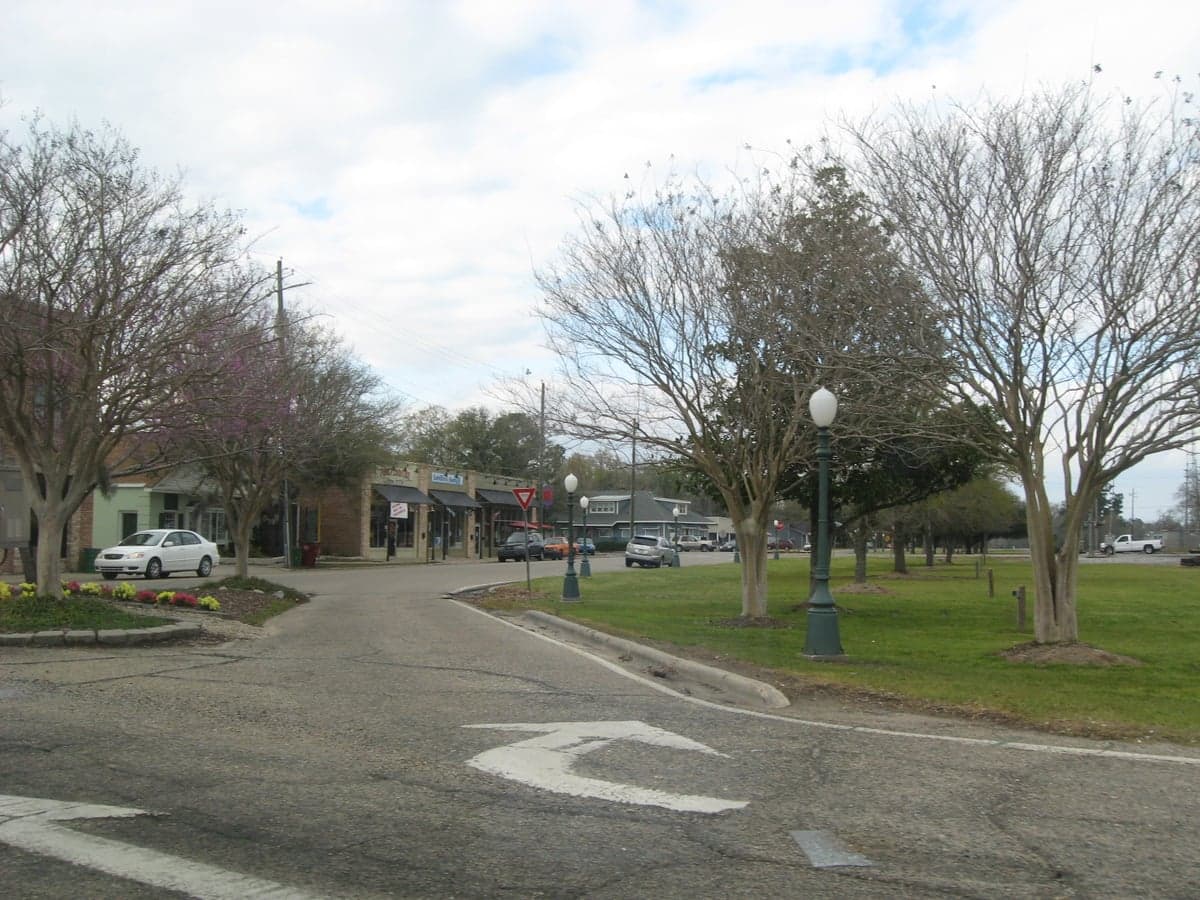
The people of Picayune, Mississippi today number roughly 11,839, forming a community defined by its deep Southern roots and a starkly biracial character. The city is 52.8% White and 39.1% Black, with a negligible foreign-born population of just 0.4% and a small Hispanic share of 3.8%. This is a place where the population is overwhelmingly native-born, with a low college attainment rate of 14.2%, and where the historic timber and railroad economy still shapes the local identity. The population is concentrated in distinct neighborhoods that trace their origins to the city’s founding and the waves of migration that followed.
How the city was settled and grew
Picayune was founded in 1882 as a railroad town, carved out of pine forest along the New Orleans and Northeastern Railroad. The original settlers were largely White loggers, railroad workers, and small farmers drawn by the region’s abundant longleaf pine and the promise of work in the burgeoning timber industry. The city’s first residential area, the Historic Downtown District, grew around the rail depot and housed the merchants and railroad employees who built the town’s early economy. By the early 1900s, a second wave of Black laborers arrived from rural Pearl River County and neighboring Louisiana, seeking work in the sawmills and turpentine camps. They settled in what became the West Side neighborhood, a historically Black area west of the railroad tracks that remains a center of African American life today. A third wave of White families, many from the Appalachian foothills, came during the 1920s and 1930s as the timber industry expanded, establishing the North Side neighborhood around the new mill sites. These three groups—White railroad and timber workers, Black mill laborers, and Appalachian migrants—formed the city’s demographic foundation through the mid-20th century.
Modern era (post-1965)
After the 1965 Hart-Cellar Act, Picayune saw almost no international immigration; its foreign-born share remains at 0.4%, one of the lowest in Mississippi. Instead, the post-1965 period was defined by domestic migration and suburbanization. White families began moving from the older Historic Downtown and North Side neighborhoods into newer subdivisions like South Meadow Estates and Lakewood Hills, developed in the 1970s and 1980s along the Highway 11 corridor. These areas remain predominantly White today, with larger lots and newer housing stock. Meanwhile, the Black population consolidated in the West Side and expanded into the East Picayune area, a historically mixed but increasingly Black section east of the railroad. The city’s Black share grew from roughly 30% in 1970 to 39.1% today, driven by natural increase and some return migration from New Orleans after Hurricane Katrina in 2005. The small Hispanic population (3.8%) is concentrated in a few blocks near the Goodyear Boulevard industrial zone, where a handful of Latino families work in the remaining manufacturing and poultry processing plants. The East/Southeast Asian share (0.3%) is negligible, with no Indian subcontinent population recorded. The city’s college education rate of 14.2% reflects the limited white-collar job base; most residents work in retail, healthcare, or the remaining timber and manufacturing sectors.
The future
Picayune’s population is projected to remain stable or grow slowly, driven by domestic in-migration from the Gulf Coast and New Orleans metro area. The city is not homogenizing; instead, it is solidifying its biracial character, with White and Black populations each maintaining distinct neighborhood enclaves. The West Side and East Picayune are becoming more uniformly Black, while South Meadow Estates and Lakewood Hills remain overwhelmingly White. The Hispanic population is growing slowly but remains too small to alter the city’s demographic balance. The immigrant communities are essentially nonexistent, so assimilation is not a factor. Over the next 10-20 years, Picayune will likely remain a low-density, low-education, working-class Southern town, with a slowly aging population as younger adults move to Hattiesburg or the Mississippi Coast for better jobs. The city’s future depends on whether it can attract new industry to reverse the brain drain and stabilize its tax base.
For someone moving in now, Picayune offers a quiet, affordable, and deeply rooted community where neighborhood choice largely determines social networks and school quality. It is a place where the past is still visible in the layout of the West Side and the Historic Downtown, and where the future will likely look much like the present—stable, slow-growing, and defined by the enduring divide between the city’s White and Black populations.

* Values derived from national, state, county, city and local statistics and may differ in a specific area. Last updated: 2026-04-19T05:36:22.000Z
Narrative content on this page is AI-generated and may contain mistakes. Verify any details that matter before acting on them.
ReloMaps may earn a commission from affiliate links at no extra cost to you.

