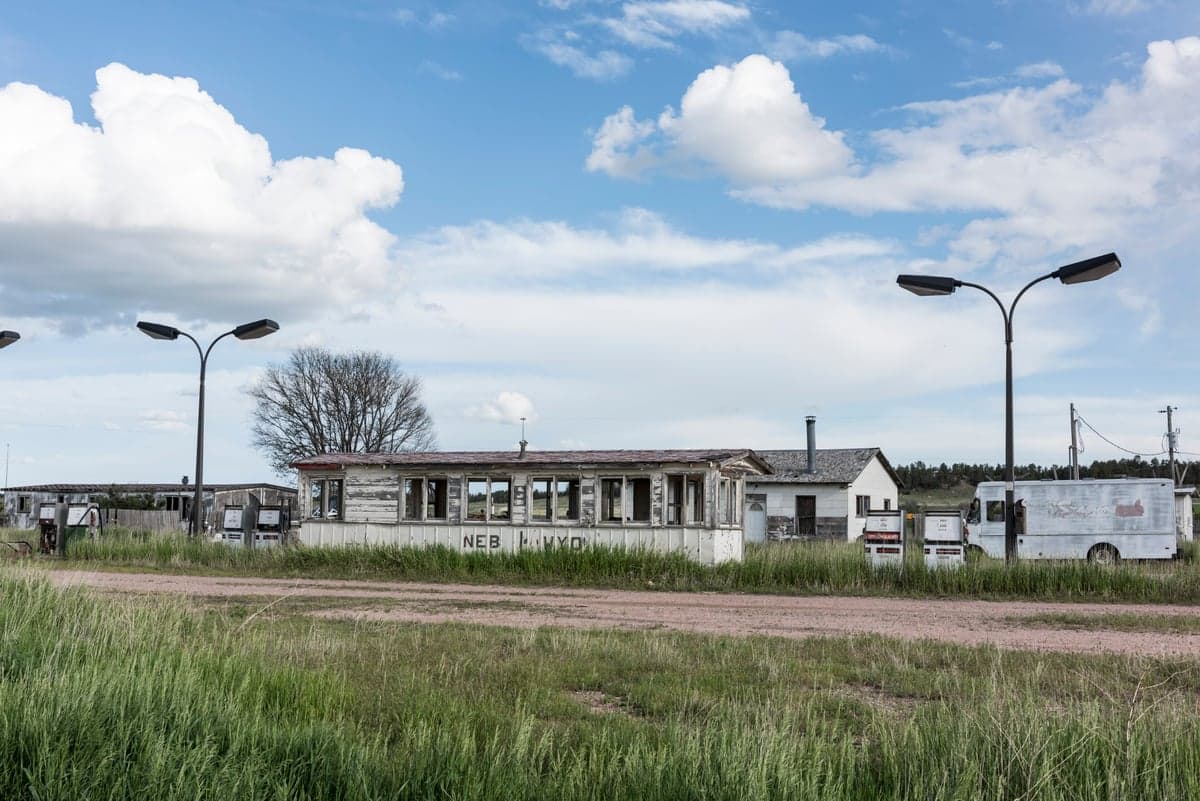
Photo: Wikipedia
Demographics of Pine Bluffs, WY
Affluence Level in Pine Bluffs, WY
A middle-class area roughly in line with national averages across income, home values, education, and employment.
People of Pine Bluffs, WY
Pine Bluffs, Wyoming, is a small, predominantly white community of 1,260 residents where a strong agricultural and railroad heritage still shapes daily life. The town’s population is 84.8% white and 12.1% Hispanic, with a foreign-born share of just 1.9%, reflecting limited recent international immigration. With only 25.3% of adults holding a college degree, the workforce leans heavily toward blue-collar and trade-based employment. The town’s identity is rooted in its role as a quiet, family-oriented border community where generational ties to the land and local industry remain the dominant social fabric.
How the city was settled and grew
Pine Bluffs was founded in the late 1860s as a railroad town along the transcontinental Union Pacific line, which drew the first wave of settlers—primarily Anglo-American homesteaders and railroad workers. The town’s original core, now known as Old Town Pine Bluffs around the railroad depot, was built by these early laborers who constructed the tracks and established the first grain elevators. A second wave arrived in the 1880s and 1890s, consisting of German and Scandinavian immigrant farmers drawn by the Homestead Act’s promise of cheap land; they settled in the North Side district, where many of the original farmsteads still stand. The town incorporated in 1908, and by the 1920s, the population had stabilized around 800, supported by wheat farming and cattle ranching. The South Railroad District grew during this period as a working-class neighborhood housing railroad employees and their families. No significant non-white population settled in Pine Bluffs during this era; the town remained overwhelmingly white and native-born through the mid-20th century.
Modern era (post-1965)
After the 1965 Hart-Cellar Act, Pine Bluffs saw virtually no new international immigration, and its demographic composition remained static through the 1970s and 1980s. The most notable shift began in the 1990s, when Hispanic families—many from Texas and New Mexico—moved into the area for agricultural labor, particularly at the Pine Bluffs Feedlot and surrounding wheat and hay operations. These families concentrated in the West End neighborhood, a modest area of older homes and rental properties near the feedlot. By 2020, the Hispanic share had grown to 12.1%, making it the only significant minority group in town. The white population, meanwhile, has aged and slowly declined as younger adults leave for larger cities like Cheyenne (30 miles west) or Denver. The Eastside neighborhood, originally built for railroad workers in the 1920s, has seen a modest influx of retirees and remote workers seeking low property taxes and quiet rural living. No Black, Asian, or Indian-subcontinent populations are recorded in the current data, reflecting the town’s continued lack of diversity beyond the Hispanic community.
The future
Pine Bluffs’ population is projected to remain stable or decline slightly over the next decade, as the aging white cohort shrinks and outmigration of young adults continues. The Hispanic population is likely to grow slowly, potentially reaching 15–18% by 2035, driven by natural increase and continued agricultural labor demand, but this growth will not dramatically alter the town’s overall character. The Downtown District, centered on the historic depot, is seeing a small revival as a few boutique businesses and a craft brewery open, but this has not yet attracted significant new residents. The town is not tribalizing into distinct ethnic enclaves; rather, the Hispanic community is gradually integrating into existing neighborhoods, with second-generation families moving from the West End into the North Side and Eastside. For a new resident, Pine Bluffs offers a stable, low-cost, and safe environment where community ties are strong but economic opportunities are limited, and where the population will remain predominantly white and conservative for the foreseeable future.
Pine Bluffs is becoming a slightly more diverse but still deeply traditional small town, where agricultural and railroad roots remain central to local identity. For someone moving in now, the town offers a tight-knit, low-crime community with affordable housing and a slower pace of life, but limited job growth and a shrinking youth population mean that long-term vitality depends on attracting new families and businesses. The demographic trajectory points toward gradual Hispanic integration and white aging, with no major shifts expected in the next two decades.

* Values derived from national, state, county, city and local statistics and may differ in a specific area. Last updated: 2026-04-21T11:39:31.000Z
Narrative content on this page is AI-generated and may contain mistakes. Verify any details that matter before acting on them.
ReloMaps may earn a commission from affiliate links at no extra cost to you.

