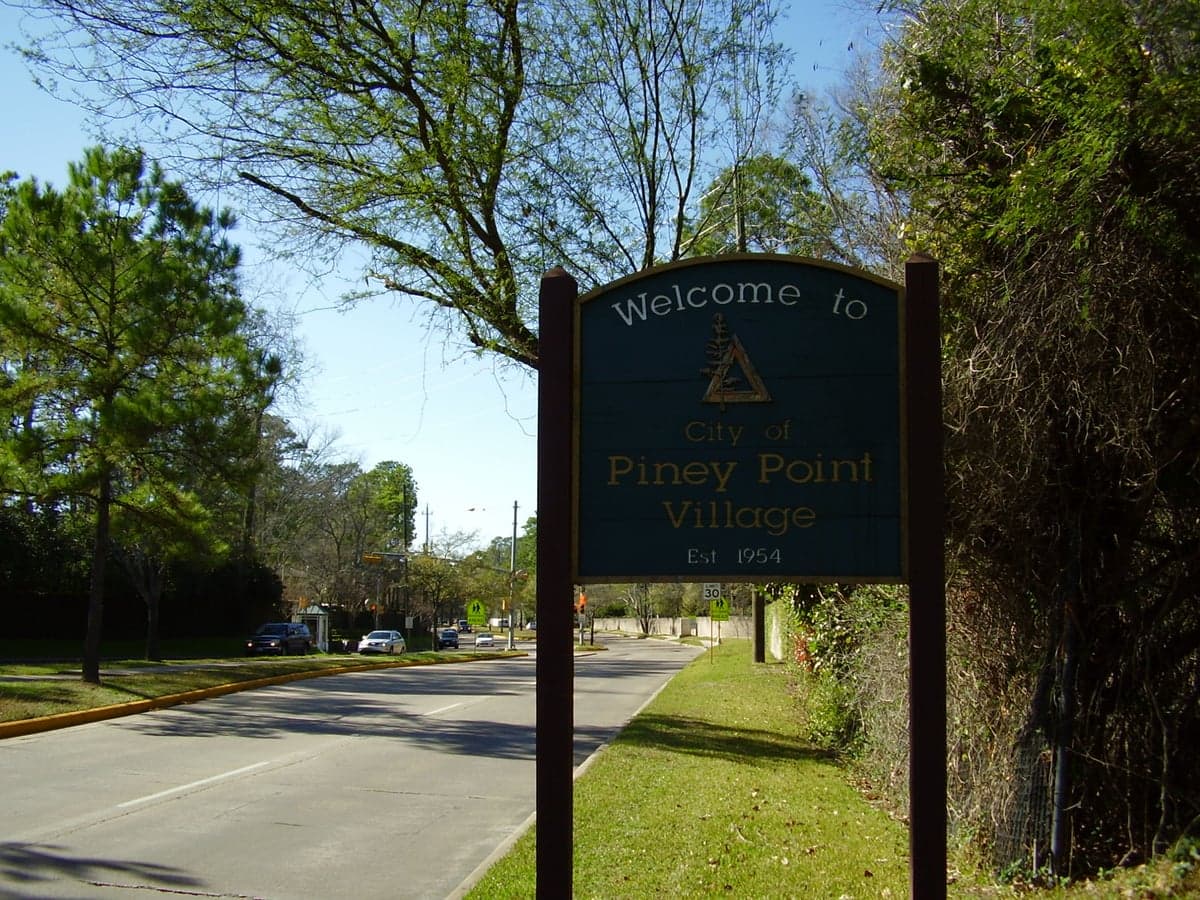
Photo: Wikipedia
Strategic Assessment of Piney Point Village, TX
Multiple tactical vulnerabilities. Population density, target proximity, or disaster risk are likely compounding. A retreat property and exit planning is required.
What does the Strategic Assessment tell us?
Our Strategic Assessment grades tactical survivability of an area. Major population centers, military targets, fallout zones, natural disasters, and border exposure all drive risk — lower exposure means a more defensible position in a crisis.
This is heavily inspired by Joel Skousen's Strategic Relocation book. Highly recommended you checkout the book ($)What does this tell us?
Our Strategic Assessment grades tactical survivability of an area. Major population centers, military targets, fallout zones, natural disasters, and border exposure all drive risk — lower exposure means a more defensible position in a crisis.
This is heavily inspired by Joel Skousen's Strategic Relocation book. Highly recommended you checkout the book ($)Strategic Pillars

Key Distances
Regional Safe Places
Below is our recommended "safe zones" in Texas and the surrounding area based on our strategic heuristics. For most people, it's unrealistic to live in a “safe zone” full-time due to work, family or other personal reasons. They tend to be more rural. However, many of these areas are perfect for second homes and retreat properties that double as a vacation home or even a short-term rental.

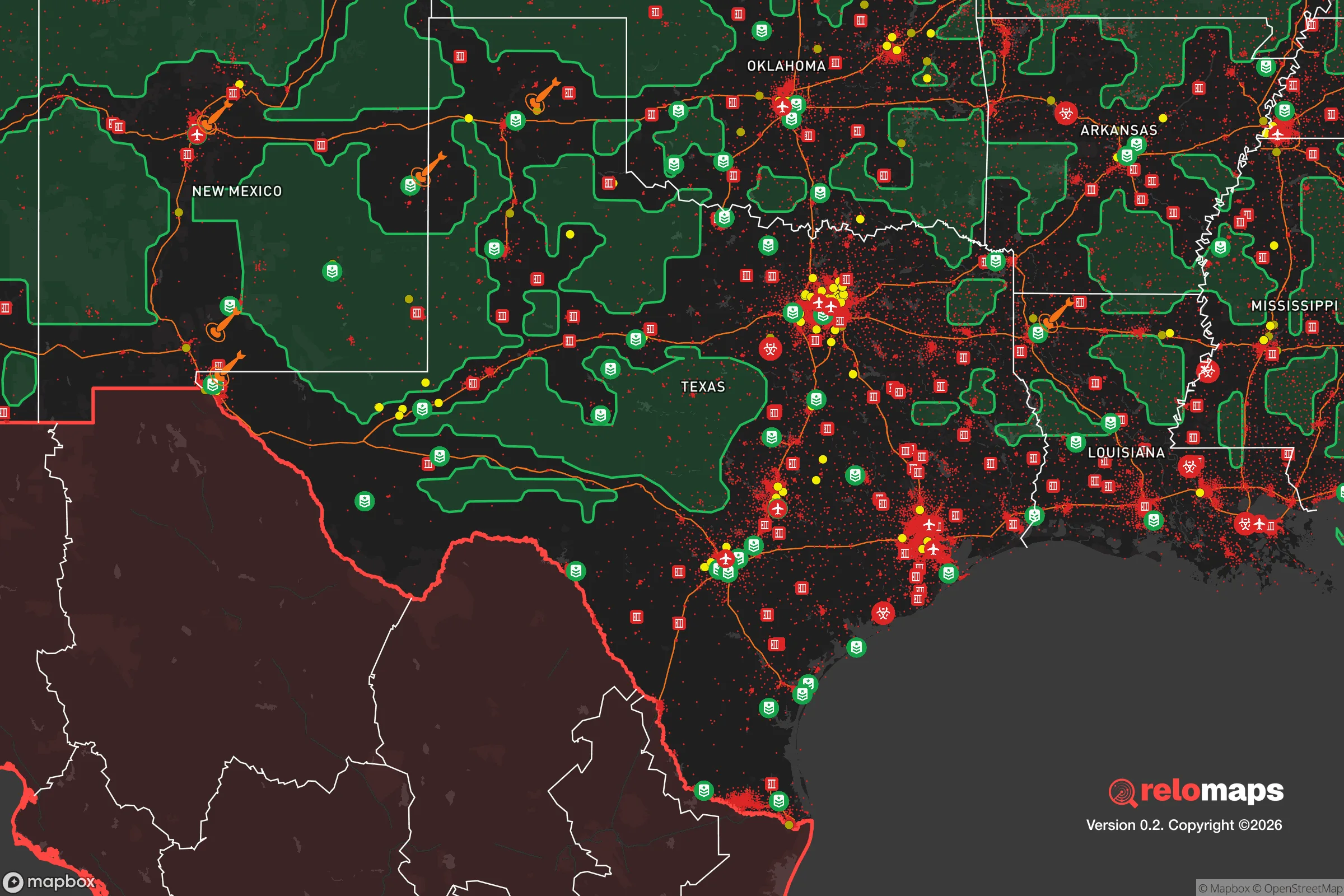


Important Note: For informational purposes only. This does not mean nothing bad ever happens in the green zones. Please use common sense. This is based on public data and modeled with AI. We tried to take a conservative approach but mistakes happen. We update this regularly as new information becomes available.
Solar Generator Recommendations
Backup power matters more here than in safer locations. We've picked three solar generators across budgets and capacity tiers — start with the budget unit if you only need a few essentials, or step up if you want to run a fridge and HVAC for days at a time.

Jackery Portable Power Station Explorer 300
Budget OptionPower on the Go: Weighing only 11 lbs, it's convenient to set up and store with book-sized foldable solar panels

BLUETTI Portable Power Station AC180
Designed for both indoor and outdoor scenarios, AC180 is highly capable as it has a robost capacity and continuous output power.

EF ECOFLOW DELTA Pro Ultra Power Station
Upgraded PickEcoFlow DELTA Pro Ultra is a whole-home energy system designed to grow with your family. Integrated with the Smart Home Panel 2, it scales to meet your evolving energy needs — keeping your home powered, intelligent, and secure through every stage of life.
We earn a commission, at no additional cost to you.
Strategic Assessment Analysis
Piney Point Village, an affluent enclave within Houston’s Memorial area, presents a complex strategic picture for the survival-minded relocator. Its primary advantage is its location within the robust, resource-rich Houston metroplex, but that same proximity to a major urban center introduces significant vulnerabilities in a crisis scenario. For those prioritizing resilience against civic unrest, mass casualty events, and systemic collapse, Piney Point Village offers a mix of high-end defensibility and dangerous exposure that demands careful, unflinching assessment.
Geographic position and natural advantages for long-term survival
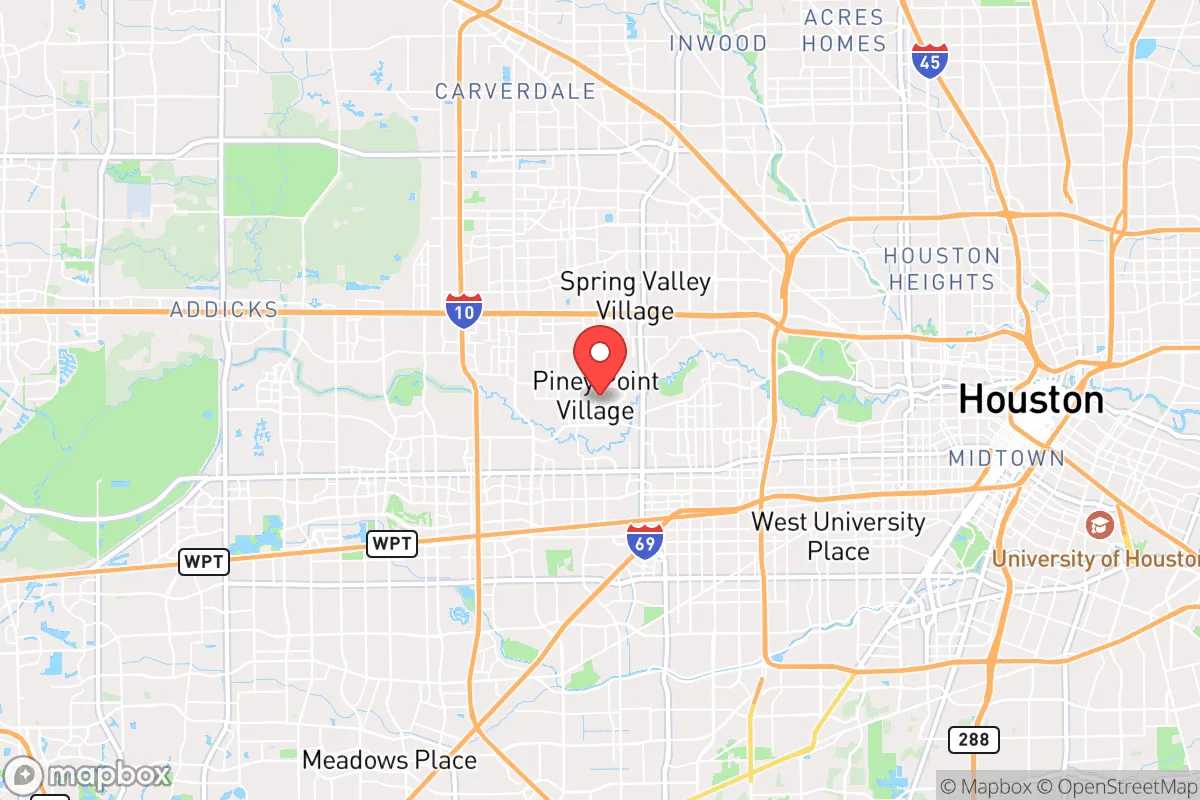
Piney Point Village sits in a relatively flat, wooded area of Harris County, approximately 15 miles west of downtown Houston. Its geographic position is a double-edged sword. On the positive side, the area is part of the larger Memorial Villages, a cluster of small, independently governed cities that share police, fire, and public works services. This creates a de facto defensive perimeter—a series of interconnected, low-density neighborhoods that are harder to penetrate than a sprawling, unincorporated suburb. The village itself is bisected by Memorial Drive, a major east-west artery, but the residential streets are narrow, winding, and often dead-end, which naturally slows vehicle traffic and creates chokepoints. The tree canopy is dense, offering concealment and potential resources for firewood or construction in a prolonged grid-down scenario. The area’s elevation is low—typically 50-70 feet above sea level—but it is not in a designated floodplain, unlike many parts of Houston. This means flood risk is minimal compared to nearby neighborhoods like Briargrove or the Heights, a critical advantage for maintaining a stable residence during weather-related disasters that often precede or accompany civil unrest.
Risks, exposures, and proximity to fallout-relevant landmarks
The most glaring vulnerability is Piney Point Village’s location within the Houston metropolitan area, a city of over 2.3 million people. In a mass casualty event—whether from a coordinated attack, a pandemic, or a cascading infrastructure failure—the village would be directly affected by the collapse of Houston’s supply chains, healthcare system, and law enforcement capacity. The Texas Medical Center, the world’s largest medical complex, is only 8 miles east. While this seems beneficial, in a crisis it becomes a magnet for desperate people, looters, and those seeking medical aid, creating a massive human wave that could wash westward. The Port of Houston and the Houston Ship Channel, a critical national energy hub, are roughly 20 miles east-southeast. A major incident there—a terrorist strike, a refinery explosion, or a blockade—would trigger immediate panic and potential evacuation orders, clogging every major highway, including I-10 and the West Loop, which border the village. Additionally, the village is within a 10-mile radius of multiple chemical plants and refineries along the Ship Channel. A toxic release or a fire at one of these facilities could force a rapid, chaotic evacuation with no safe direction to flee. The presence of George Bush Intercontinental Airport (IAH) 18 miles north and William P. Hobby Airport 12 miles southeast means the area is a potential target for aerial or ground-based attacks, though the village itself is not a high-value target.
Practical resilience for a relocator: food, water, energy, and defensibility
For a single individual or family looking to hunker down, Piney Point Village offers some practical advantages but also serious logistical hurdles. Water security is a major concern. The village is served by the City of Houston’s water system, which draws from Lake Houston and the Trinity River. In a prolonged power outage, water treatment plants fail, and the distribution system becomes vulnerable to contamination. A private well is not an option in this area due to the shallow, clay-heavy soil and municipal restrictions. Relocators would need to stockpile at least 2-3 gallons per person per day for a minimum of 30 days, plus water filtration systems like Berkey or Sawyer filters for potential surface water from Buffalo Bayou, which runs along the village’s southern edge. Food security is similarly dependent on pre-stocking. The nearest grocery stores—a Kroger and a Whole Foods—are within a 5-minute drive, but these will be stripped bare within hours of a crisis. Gardening is possible in the sandy loam soil, but the intense Texas heat and humidity make it a year-round battle. A greenhouse or raised beds with shade cloth would be necessary for any meaningful food production. Energy resilience is a mixed bag. The grid in this area is prone to outages during hurricanes and winter storms, as seen in 2021’s Winter Storm Uri. A whole-house generator, preferably a natural gas or propane model with a buried tank, is non-negotiable. Solar panels are viable but require battery storage to be useful during grid failures, and the tree canopy limits sun exposure. Defensibility is the village’s strongest suit. Homes are typically set back from the street on large lots (1-3 acres), with mature trees and shrubs providing natural cover. Many properties have gated driveways and high fences. The village’s police department is well-funded and responsive, but in a widespread collapse, they will be overwhelmed. The key is to create a layered security perimeter: reinforced doors, impact-resistant windows, and a clear line of sight to the street. The village’s low population density (roughly 1,200 residents) means fewer potential threats, but also fewer allies. Building a mutual assistance network with like-minded neighbors is critical.
The overall strategic picture for Piney Point Village is one of calculated risk. It is not a remote bug-out location; it is a suburban fortress within a failing system. For the prepper who values proximity to medical care, employment, and infrastructure during normal times, it offers a high quality of life. But in a crisis, the same proximity becomes a liability. The village’s best-case scenario is a localized, short-term disruption where its wealth and resources allow residents to ride out the storm. The worst-case scenario—a regional or national collapse—would see Piney Point Village become a target for looters and refugees from the east, with escape routes clogged and supply lines severed. The serious relocator must weigh these factors: the defensibility of the property, the ability to stockpile for months, and the willingness to potentially fight for what you have. If you are prepared for that reality, Piney Point Village can work. If you are looking for a low-maintenance, low-risk retreat, look farther west, past Katy, toward the Hill Country. Here, you are betting on the status quo holding—and that is a bet with increasingly long odds.

* Values derived from national, state, county, city and local statistics and may differ in a specific area. Last updated: 2026-04-27T14:34:32.000Z
Narrative content on this page is AI-generated and may contain mistakes. Verify any details that matter before acting on them.
ReloMaps may earn a commission from affiliate links at no extra cost to you.

