Photo: Wikipedia
Political ClimatePolitical Climate in Piney Point Village, TX
District shown is the primary district for this city’s centroid. Cities may span multiple districts.
Local Political AnalysisPolitical Analysis of Piney Point Village, TX
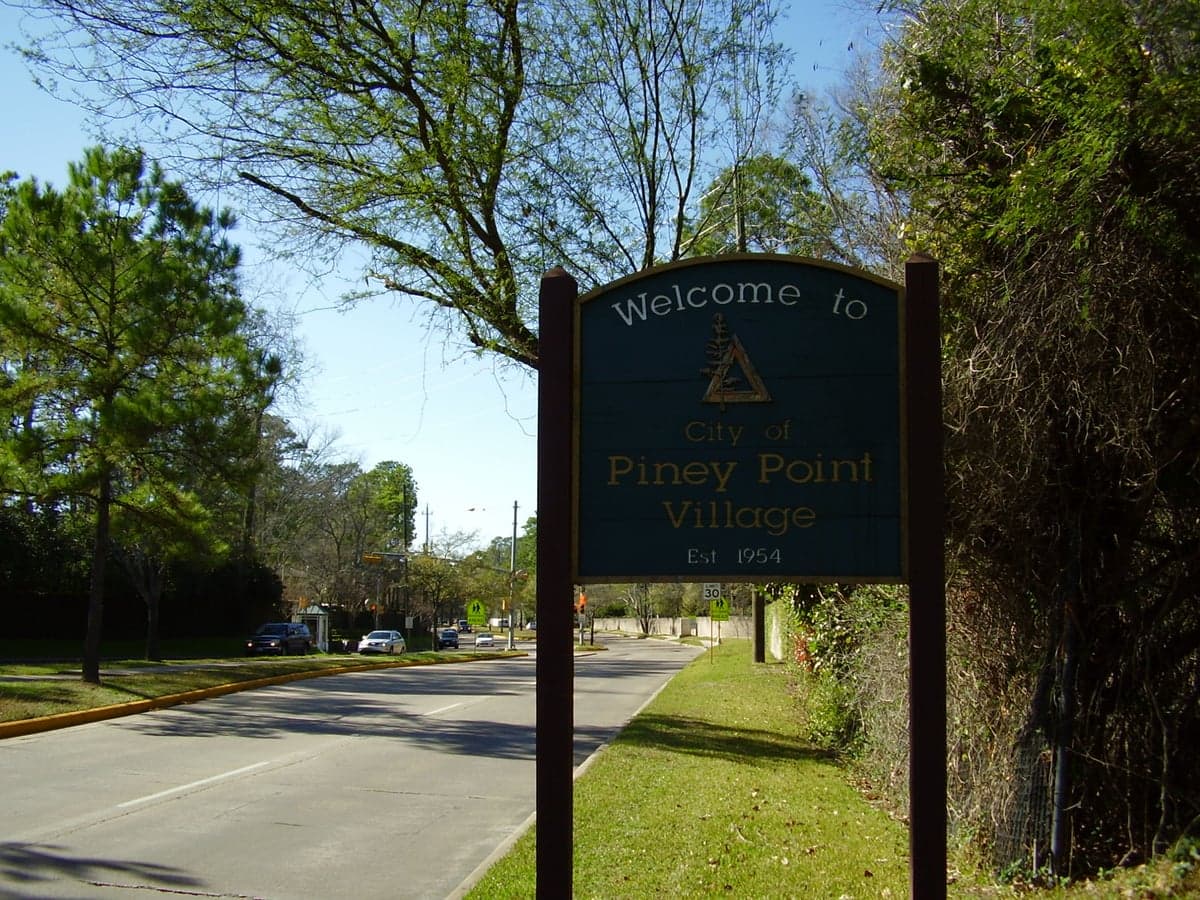
Piney Point Village has long been one of the most reliably conservative enclaves in the Houston metro, and that hasn't changed much despite the broader shift in Harris County. The area's Cook PVI of R+10 tells you a lot—this isn't a purple suburb hedging its bets; it's a place where folks tend to vote their values and expect local government to stay out of their business. If you look at the voting patterns over the last decade, you'll see that while Houston proper has drifted left, Piney Point has held steady, with precincts routinely breaking 60-70% for Republican candidates. The trajectory here is one of stubborn stability—neighbors aren't panicking, but they're watching the county commission and school board races a lot more closely than they used to.
How it compares
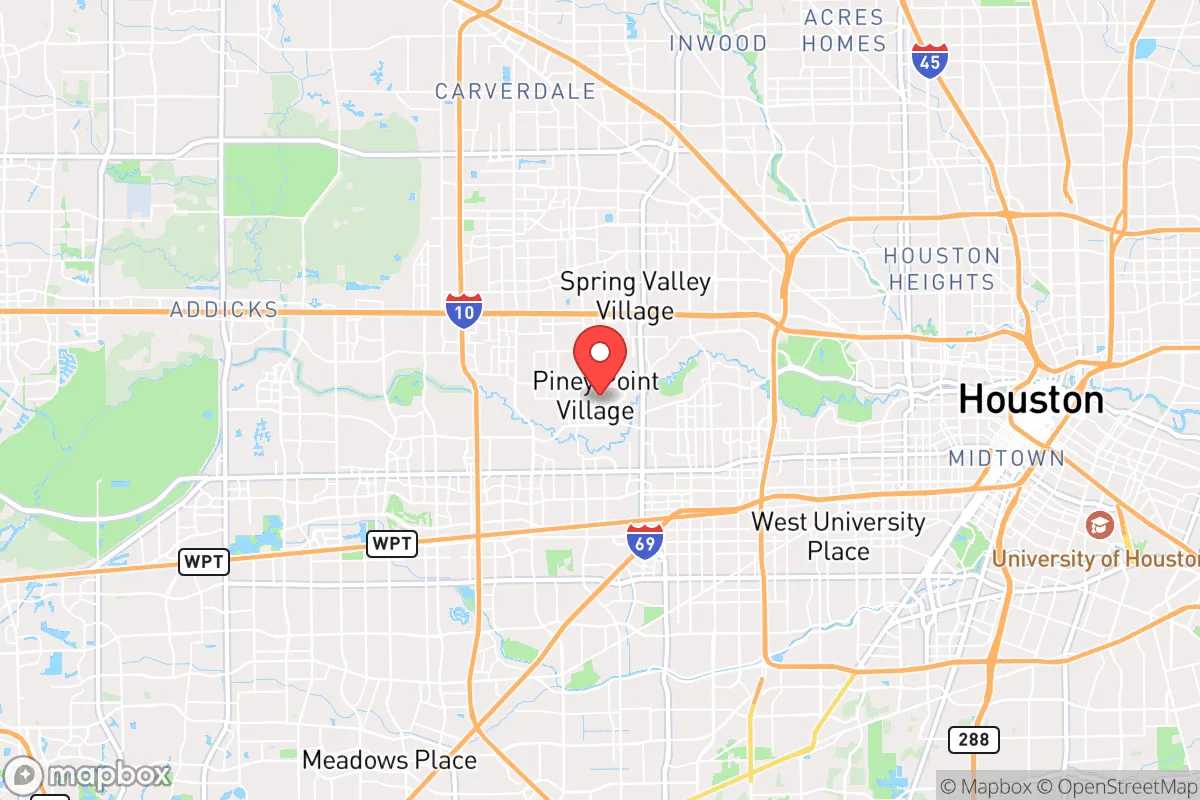
Drive ten minutes east into the Houston city limits, and you're in a completely different political universe—precincts there can lean D+20 or more, with all the progressive policy experiments that come with it. Contrast that with Piney Point's neighbors like Bunker Hill Village or Hunters Creek Village, which share a similar R+10 to R+12 profile. The real contrast is with places like Bellaire or West University Place, which have shifted noticeably leftward over the past two cycles as younger, more progressive families have moved in. Piney Point hasn't seen that same influx, partly because the housing stock and lot sizes tend to attract folks who value privacy and low taxes over walkable urbanism. If you're looking for a place where your vote actually counts toward keeping property taxes in check and local ordinances minimal, this is still one of the safest bets in the region.
What this means for residents
For the people who live here, the political climate translates directly into a lighter touch from government. You won't see the kind of zoning fights or mask mandate battles that dominate city council meetings in Houston. The city council in Piney Point is small, nonpartisan in name but conservative in practice, and they tend to view their job as maintaining infrastructure and public safety—not engineering social change. That means fewer new regulations on your property, less noise about density or affordable housing mandates, and a general attitude that if it isn't broken, don't fix it. The trade-off is that you're on your own for a lot of services—there's no city-run trash pickup or robust public transit—but for most residents, that's exactly the point. You pay lower taxes and keep more control over your own land and life.
One cultural distinction that's worth noting: Piney Point has a strong tradition of homeowners' associations that actually enforce deed restrictions, which can feel like a double-edged sword. On one hand, it keeps property values stable and prevents anyone from turning their lot into a commercial operation. On the other, it's a form of local governance that some newcomers find intrusive. But the prevailing sentiment among long-time residents is that these rules are a necessary check against the kind of government overreach you see in larger cities—here, the rules are clear, enforced by neighbors, and can be changed by a vote of the community. The real concern going forward is whether Harris County's progressive leadership will try to preempt these local controls with county-wide mandates on things like short-term rentals or environmental regulations. So far, Piney Point has held the line, but it's a fight that requires staying engaged. If you value a place where your voice still matters more than a bureaucrat's, this is still that kind of town.

State Political ClimatePolitical Climate in Texas
State Political AnalysisPolitical Environment in the State
Texas has been a reliably red state for decades, but the political landscape is far from monolithic. The state’s overall partisan lean remains solidly Republican at the statewide level, with no Democrat winning a statewide office since 1994. However, the margin has tightened in recent presidential cycles—Donald Trump won Texas by 9 points in 2016 and 5.5 points in 2020—driven by explosive growth in the urban corridors of Austin, Dallas-Fort Worth, Houston, and San Antonio. The 10-20 year arc shows a state that is culturally conservative at its core but undergoing a demographic and geographic realignment that is making the suburbs the primary battleground.
Urban vs. rural divide
The political map of Texas is a tale of three distinct regions. The vast rural and exurban areas—think Lubbock, Amarillo, and the Panhandle—vote Republican by margins of 70-80% or more. These areas are the backbone of the state’s conservative identity. At the opposite end, the major urban cores are deep blue: Harris County (Houston) went for Biden by 13 points in 2020, Dallas County by 16 points, Travis County (Austin) by a staggering 42 points, and El Paso County by 37 points. The real story is in the suburbs. Collin County (north of Dallas) voted for Trump by 14 points in 2016 but only 4 points in 2020. Tarrant County (Fort Worth), once a Republican stronghold, flipped to Biden in 2020 by 1 point. Williamson County (north of Austin) went from a 22-point Romney win in 2012 to a 9-point Trump win in 2020—a dramatic shift driven by tech workers and Californians moving in. The urban-rural divide is sharpening, with the suburbs becoming the decisive swing territory.
Policy environment
Texas’s policy environment is defined by a low-tax, low-regulation posture that has made it a magnet for business and conservative families. There is no state income tax, and property taxes are high (among the top 10 nationally) but offset by the lack of income tax. The regulatory climate is business-friendly, with no state-level minimum wage above the federal $7.25 and right-to-work laws that keep unions weak. On education, the state has leaned into school choice, with the 2023 passage of a universal education savings account (ESA) program that allows families to use state funds for private school or homeschooling—a major win for parental rights. Healthcare policy is limited: Texas did not expand Medicaid under the ACA, and the state has some of the strictest abortion laws in the nation following the 2021 Heartbeat Act (SB 8) and the 2023 trigger ban. Election laws tightened after 2021’s SB 1, which restricted mail-in voting, added ID requirements, and banned drive-through voting. For a conservative, the policy environment is largely aligned with limited government, though property tax burdens remain a persistent complaint.
Trajectory & freedom
On the freedom front, Texas has moved in two directions simultaneously. On personal liberty, the state has expanded gun rights significantly: permitless carry (HB 1927) became law in 2021, allowing most adults to carry a handgun without a license. Parental rights were strengthened with the 2023 passage of the “Parental Bill of Rights” (HB 900), which requires schools to notify parents of curriculum changes and restricts sexually explicit content in libraries. Medical autonomy saw a major contraction with the near-total abortion ban, but also an expansion of medical freedom with the 2021 law prohibiting vaccine passports (HB 1687). On property rights, the 2023 “Texas Property Tax Relief” package (SB 2) cut school property tax rates and raised the homestead exemption, though critics argue it didn’t go far enough. The concerning trend is the growing influence of local progressive governments in blue cities imposing their own mandates—mask mandates, vaccine requirements for city employees, and sanctuary policies—which creates a patchwork of freedom depending on where you live. The state legislature has pushed back with preemption laws, but the tension is real.
Civil unrest & political movements
Texas has seen its share of political flashpoints. The 2020 Black Lives Matter protests in Austin, Dallas, and Houston were large and sometimes violent, leading to property damage and a lasting distrust of local authorities. On the right, the “Texas Nationalist Movement” (Texit) has gained some traction, with a 2022 Texas GOP platform including a call for a secession referendum, though it remains fringe. Immigration politics are front and center: Governor Abbott’s Operation Lone Star has deployed state troopers and National Guard to the border, bused migrants to blue cities like New York and Chicago, and installed razor wire along the Rio Grande—a direct challenge to federal authority that has sparked lawsuits. The 2021 “Sanctuary Cities” ban (SB 4) remains in effect, but cities like Austin and Houston have resisted, creating a constant legal battle. Election integrity remains a hot-button issue: the 2020 election saw no widespread fraud, but the 2021 voting law (SB 1) was passed in response to concerns, and it remains a point of contention. A new resident will notice the strong presence of both conservative and progressive activism, especially in the suburbs where school board meetings have become battlegrounds over curriculum and library books.
Projection
Over the next 5-10 years, Texas is likely to become more politically competitive, but not necessarily more liberal. The in-migration of roughly 1,000 people per day—many from California and other blue states—is changing the electorate, but a significant portion of those newcomers are conservatives fleeing high taxes and regulation. The suburbs will continue to be the key battleground, with places like Fort Bend County (Houston) and Denton County (Dallas) trending purple. The state’s growing Hispanic population, long assumed to be a Democratic lock, is showing signs of shifting right—Trump improved his share of the Hispanic vote in Texas by 5 points between 2016 and 2020. The Republican Party is likely to remain dominant at the state level, but the margin will narrow, and the party itself may shift further right in response to primary challenges. A new resident moving in now should expect a state that remains culturally conservative in its laws and governance, but with increasing friction between blue cities and red state government. The freedom to live as you choose will depend heavily on which county you settle in.
For a conservative individual or family considering relocation, Texas offers a policy environment that largely respects personal liberty—low taxes, strong gun rights, school choice, and parental control. The trade-off is that you’ll need to choose your community carefully. The rural and exurban areas offer the most aligned political culture, while the inner suburbs are becoming more contested. The bottom line: Texas is still a place where you can build a life on your own terms, but the political winds are shifting, and the fight over the state’s soul is just getting started. If you value freedom from government overreach, you’ll find plenty of allies here—just be prepared to engage in the local battles to keep it that way.
* Values derived from national, state, county, city and local statistics and may differ in a specific area. Last updated: 2026-04-27T14:34:32.000Z
Narrative content on this page is AI-generated and may contain mistakes. Verify any details that matter before acting on them.
ReloMaps may earn a commission from affiliate links at no extra cost to you.

