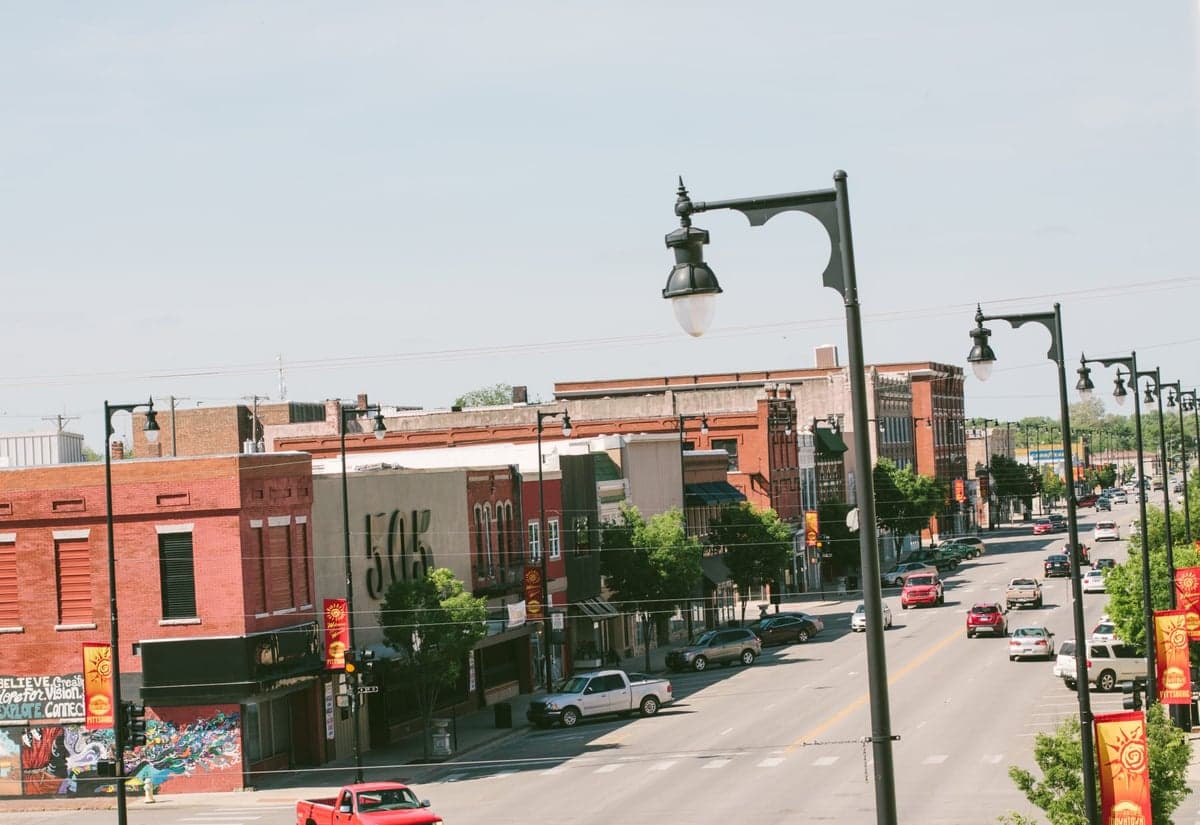
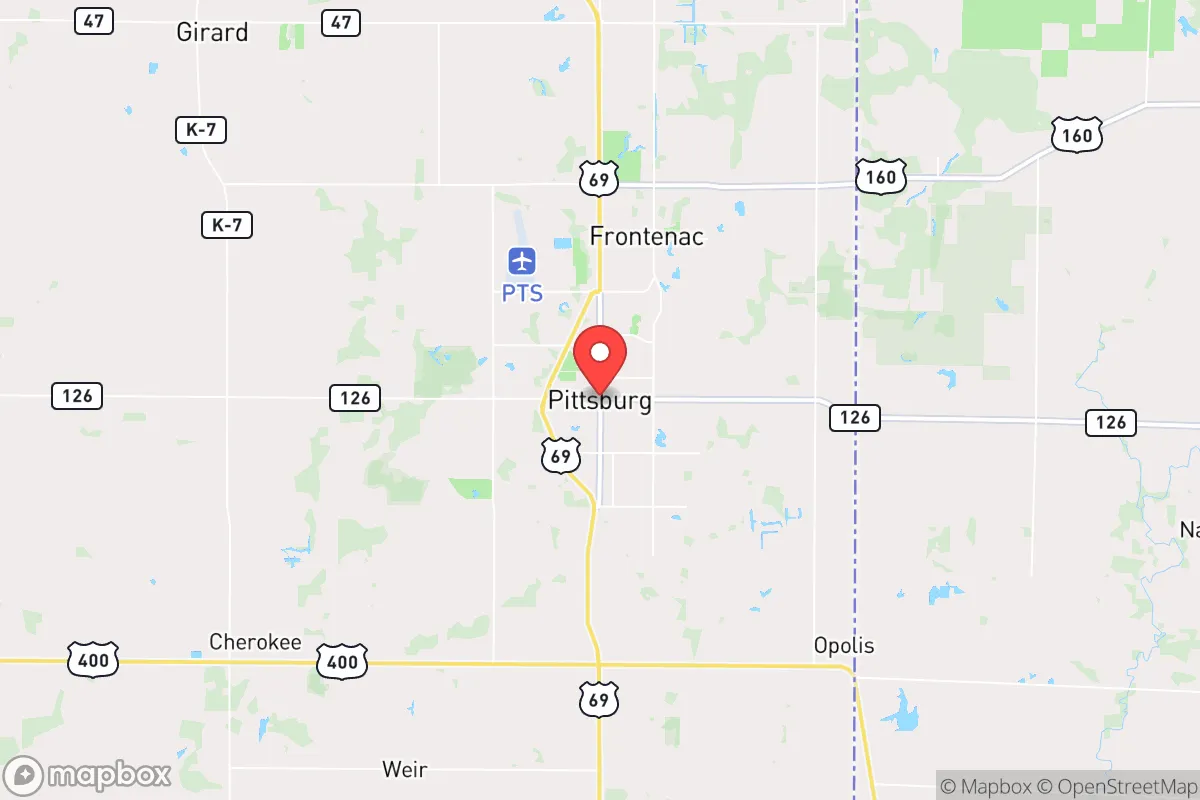
Photo: Wikipedia
Demographics of Pittsburg, KS
Affluence Level in Pittsburg, KS
A low-income area with significant economic hardship. Household wealth and educational attainment are well below national averages.
People of Pittsburg, KS
The people of Pittsburg, Kansas, today number 20,606, forming a compact, historically rooted community where 77.8% of residents identify as white, 12.0% as Hispanic, 2.8% as Black, and 2.8% as East/Southeast Asian. The city carries a distinctive identity as a former coal-mining and railroad hub that has reinvented itself around Pittsburg State University, giving it a younger, more transient population than surrounding rural areas. With 33.9% of adults holding a college degree—well above the Kansas average—Pittsburg blends small-town affordability with an educated, civic-minded character that appeals to families and conservative-leaning professionals seeking a stable, midwestern environment.
How the city was settled and grew
Pittsburg was founded in 1876 as a coal-mining camp on the Cherokee-Crawford Coal Field, drawing its first major wave of immigrants from the British Isles and Germany. The discovery of bituminous coal beneath the prairie triggered a boom, and by 1880 the population had surged past 1,500, with miners and their families settling in what is now the Old Town district around Broadway and Euclid Avenue. A second wave arrived between 1890 and 1910, composed largely of Italian, Croatian, and Slovenian immigrants who worked the deep-shaft mines. These southern and eastern European groups concentrated in the North Side neighborhood, near the rail yards and mine tipples along the Kansas City Southern line. The city’s name itself—a deliberate echo of Pittsburgh, Pennsylvania—reflected the ambition to replicate that city’s industrial success. By 1920, Pittsburg had grown to over 18,000 residents, making it one of the largest cities in southeast Kansas. The mines declined after World War II, but the founding of what is now Pittsburg State University in 1903 (then a manual training school) provided a new economic anchor, drawing faculty and students from across the region.
Modern era (post-1965)
The post-1965 period saw Pittsburg’s population stabilize and then slowly decline, falling from a peak of 20,855 in 1960 to 18,678 by 1990, as the last mines closed and younger residents left for larger cities. The most significant demographic shift came with the growth of the Hispanic population, which rose from under 2% in 1990 to 12.0% today. This wave was driven by Mexican and Central American immigrants who arrived for work in the region’s poultry processing plants and construction sector, settling primarily in the South Side neighborhood along South Broadway and in the Westside area near the industrial parks. The East/Southeast Asian population—2.8% today—is largely composed of Vietnamese and Korean families who came as refugees and secondary migrants after 1975, many of whom established small businesses and found work at the university. They concentrated in the Eastside neighborhood around East 4th Street, near the university campus. The Black population, at 2.8%, has remained small and stable, with families historically living in the Midtown area between the railroad tracks and the university. The Indian-subcontinent population remains negligible at 0.1%, reflecting the absence of a large tech or medical employer that typically attracts that group.
The future
Pittsburg’s population is slowly homogenizing in racial terms, even as it grows modestly. The white share has declined from 87% in 2000 to 77.8% today, while the Hispanic share continues to rise, driven by both immigration and higher birth rates. The East/Southeast Asian community is plateauing, as younger generations assimilate and move to larger cities for professional opportunities. The city is not tribalizing into distinct enclaves—neighborhoods remain relatively integrated by income and ethnicity—but the South Side is becoming more visibly Hispanic, with Spanish-language signage and ethnic groceries appearing along South Broadway. The university remains the primary driver of in-migration, attracting students from across the Midwest, many of whom stay after graduation. Over the next 10–20 years, Pittsburg is likely to see its Hispanic share approach 18–20%, while the white share settles around 70–72%. The foreign-born population, currently 3.8%, will likely rise to 5–6% as the poultry and logistics sectors continue to recruit immigrant labor.
For someone moving in now, Pittsburg is becoming a more diverse but still predominantly white, midwestern college town where the economy is stable but not booming. The city offers affordable housing, low crime, and a strong sense of community, but those seeking rapid job growth or a highly diverse urban environment will find it too small and slow-paced. The conservative-leaning audience will appreciate the city’s traditional values, low taxes, and family-oriented neighborhoods, while the growing Hispanic presence adds a layer of cultural variety without disrupting the city’s fundamental character.

* Values derived from national, state, county, city and local statistics and may differ in a specific area. Last updated: 2026-05-04T02:50:10.000Z
Narrative content on this page is AI-generated and may contain mistakes. Verify any details that matter before acting on them.
ReloMaps may earn a commission from affiliate links at no extra cost to you.

