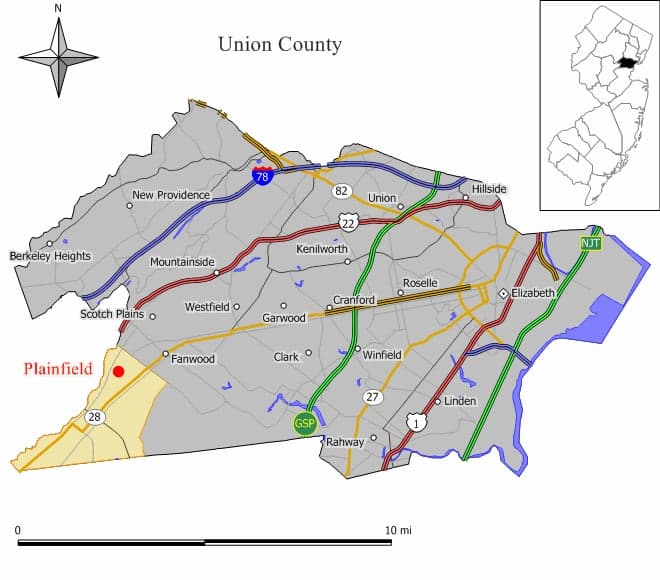
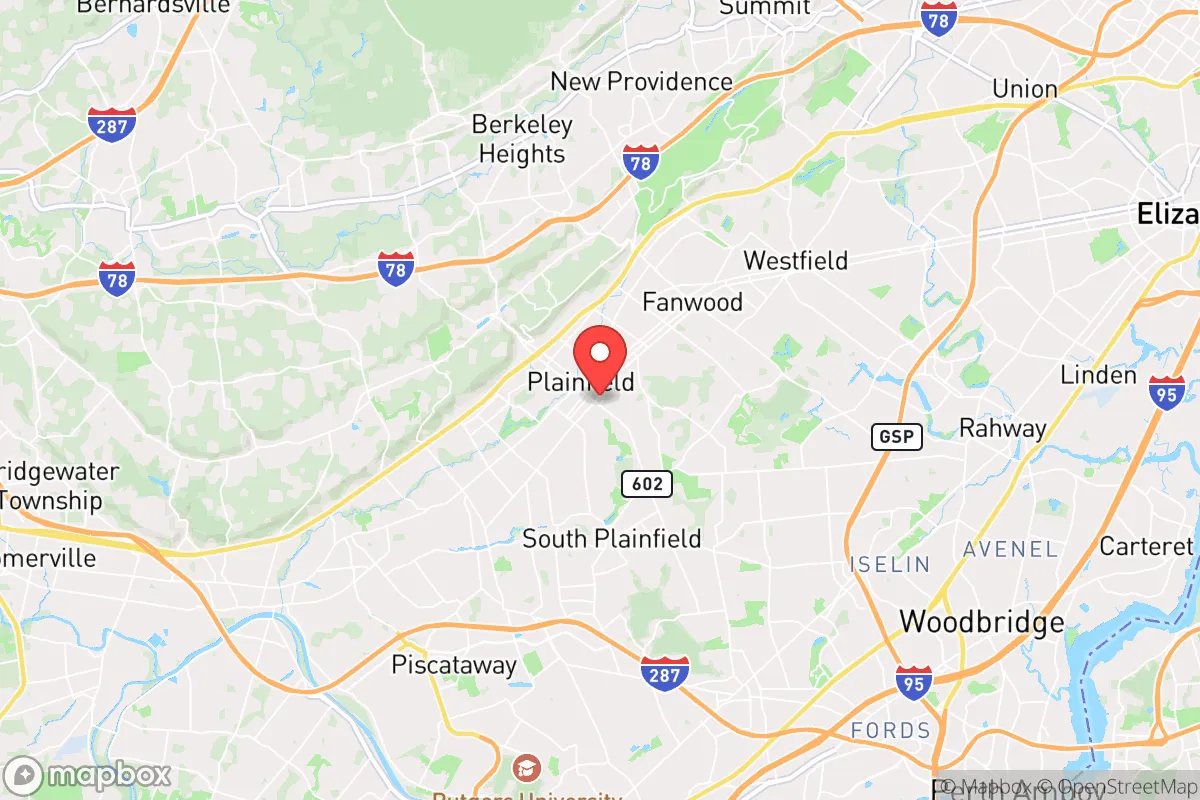
Photo: Wikipedia
Personal Sovereignty in Plainfield, NJ
Viable for self-reliance. Generally workable, though some barriers may limit total independence.
What does Personal Sovereignty tell us?
Personal Sovereignty measures your capacity for self-reliance and independence with minimal government friction. Higher scores mean fewer barriers between you and the way you want to live... but it assumes you have the space you need and good neighbors.
What does this tell us?
Personal Sovereignty measures your capacity for self-reliance and independence with minimal government friction. Higher scores mean fewer barriers between you and the way you want to live... but it assumes you have the space you need and good neighbors.
State Policy
Energy independence: Importer (8% of energy produced in-state)
Personal Liberty
Homesteading

Personal Liberty Analysis
Plainfield, New Jersey, presents a challenging environment for personal sovereignty, where state-level overreach significantly constrains individual autonomy. For those with a survivalist or prepper mindset, the city sits within a state that aggressively regulates nearly every aspect of daily life, from what you can own to how you can educate your children. While the city itself has a dense, urban character that limits self-reliance, the primary threats to personal freedom here come from Trenton, not the local municipal government. Anyone considering relocation to Plainfield must understand that New Jersey’s legal and tax framework is designed to centralize power, making it one of the least sovereign states in the nation for individuals and families seeking to live outside the system.
Tax burden and regulatory posture: How New Jersey’s fiscal policies restrict autonomy
New Jersey’s tax burden is the highest in the country, and this directly erodes personal sovereignty by forcing residents to fund a sprawling state apparatus. Property taxes in Plainfield are among the steepest in Union County, often exceeding $8,000 annually on a modest home, with effective rates above 3% of assessed value. This is not a one-time cost; it is a perpetual lien on your property, effectively making you a renter of your own land at the state’s pleasure. The state income tax is progressive, topping out at 10.75% for high earners, and sales tax is 6.625%, with no local option to reduce it. For a prepper, this means every dollar earned is heavily taxed before you can allocate it to supplies, land improvements, or emergency funds. The regulatory posture is equally hostile: New Jersey’s building codes, environmental regulations, and business licensing requirements are among the most stringent in the Northeast. Starting a home-based business, constructing a shed, or even installing a rainwater collection system can trigger permit fees and inspections that discourage self-sufficiency. The state’s Uniform Construction Code mandates that even minor structural changes require licensed contractors and approvals, effectively outlawing the kind of DIY resilience that defines a prepper lifestyle. Compared to states like Texas or New Hampshire, Plainfield’s tax and regulatory climate is a direct assault on the principle that you should control the fruits of your labor and the use of your property.
Self-defense and gun law specifics: What Plainfield residents can and cannot own
New Jersey’s gun laws are among the most restrictive in the nation, and Plainfield residents face severe limitations on their right to self-defense. The state requires a Firearms Purchaser Identification Card (FPID) for handguns and long guns, which involves background checks, fingerprinting, and a wait period that can stretch weeks. Concealed carry is effectively impossible for most law-abiding citizens due to the state’s “justifiable need” standard, which was only partially reformed after the Bruen decision but still requires a demonstrable threat. Magazine capacity is capped at 10 rounds, and “assault weapons” — a broad category including many common semi-automatic rifles — are banned outright. For a prepper, this means you cannot own an AR-15, cannot carry a concealed handgun for daily protection, and cannot stockpile standard-capacity magazines for emergencies. The state also mandates that firearms be stored unloaded and locked, which defeats the purpose of a home-defense weapon during a break-in. Plainfield itself has a higher-than-average crime rate, with property crime and violent incidents concentrated in certain neighborhoods, making these restrictions particularly galling. If you value the ability to defend your home and family without government permission, Plainfield is a poor choice. The only saving grace is that New Jersey does not have a state preemption law, meaning local ordinances could theoretically be stricter, but Plainfield has not added additional restrictions beyond state law. Even so, the state-level framework ensures that your self-defense options are severely curtailed compared to free states like Florida or Arizona.
Self-reliance and homesteading viability: Lot sizes, zoning, and off-grid feasibility
Plainfield’s dense urban layout makes traditional homesteading nearly impossible, and zoning laws actively discourage self-reliance. The typical residential lot is a quarter-acre or less, with many homes on narrow 25-foot-wide plots. Zoning regulations prohibit keeping livestock — chickens, goats, or bees — in most residential zones, and the city’s code enforcement is active in responding to complaints about “nuisance” animals. Off-grid living is effectively illegal: New Jersey requires all habitable structures to be connected to the municipal water and sewer system, and solar panels must be grid-tied with utility approval. Rainwater collection is restricted to non-potable uses and must not exceed 100 gallons per property without a permit. For a prepper seeking to reduce dependency on supply chains, this is a dead end. You cannot grow a significant portion of your own food on a small city lot, you cannot generate your own power without state oversight, and you cannot treat your own waste. The city’s Master Plan emphasizes density and transit-oriented development, meaning future zoning changes will likely further restrict self-sufficient practices. If homesteading is a priority, look to rural areas of Hunterdon or Sussex counties, where lot sizes are larger and zoning is more permissive. Plainfield is a place to work and earn, not to build a resilient, self-reliant homestead.
Personal liberties: Parental rights, medical autonomy, speech, and property
New Jersey’s progressive governance extends to personal liberties, often overriding parental and individual choice. On parental rights, the state mandates comprehensive sex education in public schools, including LGBTQ+ content, with no opt-out for parents who object on moral or religious grounds. The state also has a “medical aid in dying” law, but it restricts access to alternative treatments: the Board of Medical Examiners has pursued disciplinary action against doctors offering off-label or experimental therapies, limiting medical autonomy. During the COVID-19 pandemic, New Jersey imposed one of the nation’s strictest vaccine mandates for schoolchildren, and the state retains broad emergency powers that could be used again. Free speech is protected under the First Amendment, but New Jersey has a bias intimidation law that can be used to prosecute speech perceived as threatening, and the state’s anti-discrimination laws extend to public accommodations in ways that can limit expressive conduct. Property rights are weak: the state’s Eminent Domain authority is broad, and Plainfield has used it in the past for redevelopment projects, displacing homeowners. The New Jersey Environmental Rights Act allows third parties to sue over perceived environmental harms, which can tie up property development for years. For a conservative individual, these policies represent a systematic erosion of the traditional liberties that allow families to live according to their own values. The state’s legal framework prioritizes collective outcomes over individual rights, making Plainfield a place where you must constantly navigate government permission for basic life decisions.
Overall, Plainfield offers very low personal sovereignty compared to most of the United States. The combination of the highest taxes in the nation, near-total restrictions on firearms, zoning that prohibits self-reliance, and a legal culture that subordinates parental and medical autonomy to state mandates creates an environment hostile to the prepper or survivalist mindset. If you are considering relocation and value the ability to control your own life, your property, and your family’s future, Plainfield should be a hard pass. The only strategic advantage is its proximity to New York City for employment, but that comes at the cost of living under one of the most intrusive state governments in the country. For true sovereignty, look to states with lower tax burdens, constitutional carry, and zoning that respects property rights — places like Wyoming, Idaho, or even parts of Pennsylvania offer a dramatically different balance of power between the individual and the state.

* Values derived from national, state, county, city and local statistics and may differ in a specific area. Last updated: 2026-05-01T03:36:23.000Z
Narrative content on this page is AI-generated and may contain mistakes. Verify any details that matter before acting on them.
ReloMaps may earn a commission from affiliate links at no extra cost to you.

