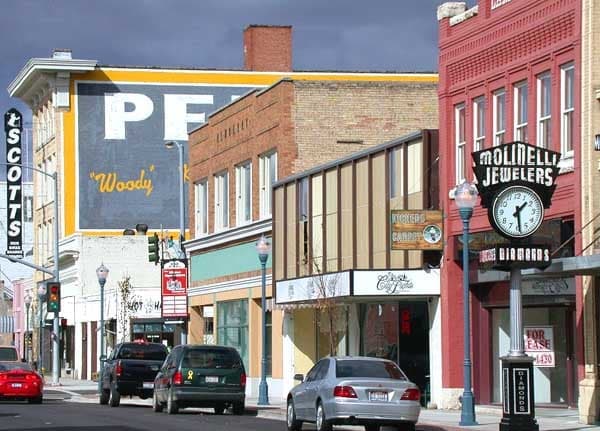
Photo: Wikipedia
Demographics of Pocatello, ID
Affluence Level in Pocatello, ID
A below-average socioeconomic profile. Incomes, home values, and educational attainment trail the U.S., with higher poverty and unemployment.
People of Pocatello, ID
The people of Pocatello, Idaho, today number 57,152, forming a predominantly white (81.9%) and native-born (97.9% U.S.-born) community with a modest Hispanic minority (9.2%) and small but distinct East/Southeast Asian (1.7%) and Indian subcontinent (0.4%) populations. The city’s character is shaped by its history as a railroad and agricultural hub, producing a practical, working-class identity with a strong Mormon and Catholic influence. Residents often describe Pocatello as a place where families stay for generations, reflected in its relatively low college attainment rate (32.9%) compared to national averages and a population density of roughly 2,100 people per square mile. The city’s distinctive marker is its blend of historic railroad-era neighborhoods and newer subdivisions, with a demographic profile that has remained remarkably stable over the past three decades.
How the city was settled and grew
Pocatello’s population history begins with the Shoshone-Bannock tribes, who used the Portneuf River valley as a seasonal hunting ground. The city itself was founded in 1889 as a railroad town, named after a Shoshone chief, when the Oregon Short Line Railroad (a Union Pacific subsidiary) established a major depot and maintenance yard here. The first wave of settlers were railroad workers—Irish, Italian, and German immigrants—who built the yards and laid track. They settled in the Old Town district, the original commercial core along Center Street, where modest wood-frame houses and boarding houses sprang up. A second wave arrived between 1900 and 1920, drawn by the establishment of the Idaho State Academy (later Idaho State University) in 1901 and the expansion of the Bannock County agricultural economy. These newcomers were predominantly Mormon settlers from Utah and the surrounding Intermountain West, who established the Alameda neighborhood east of downtown, characterized by its grid of wide streets and brick homes. By 1930, Pocatello’s population had reached 15,000, with a third of residents foreign-born—a mix of railroad laborers, Basque sheepherders, and Scandinavian farmers. The Chubbuck area, originally a separate farming community north of town, absorbed many of these agricultural families. World War II brought a temporary boom as the nearby Pocatello Army Air Base (now the airport) trained bomber crews, but the city’s growth slowed after the war, with the railroad workforce declining from its peak of 3,500 in the 1940s to under 1,000 by the 1970s.
Modern era (post-1965)
After the 1965 Hart-Cellar Act, Pocatello saw only a modest increase in foreign-born residents, reaching just 2.1% today—far below the national average. The city’s modern demographic story is one of domestic in-migration rather than international immigration. The Hispanic population grew from 3.5% in 1990 to 9.2% today, driven by Mexican and Central American families moving for agricultural work in the surrounding potato and sugar beet fields. These families concentrated in the Pocatello Creek area, a lower-cost neighborhood south of downtown near the Portneuf River, and in the Westside district, where older, smaller homes and rental properties offered affordable entry points. The East/Southeast Asian community (1.7%) is largely composed of Vietnamese and Filipino families who arrived in the 1980s and 1990s, many sponsored by Idaho State University or working in healthcare and manufacturing. They settled primarily in the University District near ISU, where a small cluster of Asian grocery stores and restaurants now operates. The Indian subcontinent population (0.4%) is almost entirely tied to ISU’s graduate programs in engineering and pharmacy, living in rental apartments near campus. Suburbanization reshaped the city after 1980, with the Highland Estates neighborhood on the city’s southeast side attracting middle-class families seeking newer, larger homes on larger lots. This area is overwhelmingly white (over 90%) and has become the preferred destination for families moving from California and other Western states, drawn by lower housing costs and conservative values.
The future
Pocatello’s population is projected to grow slowly, reaching roughly 62,000 by 2040, driven primarily by natural increase and domestic migration from other Western states. The city is not homogenizing but rather tribalizing into distinct enclaves: the University District and Old Town are becoming more diverse, with younger, more transient populations, while Highland Estates and Chubbuck remain predominantly white and family-oriented. The Hispanic community is growing steadily, projected to reach 12-14% by 2040, and is slowly assimilating into the broader population, with second-generation families moving into mixed neighborhoods. The East/Southeast Asian and Indian communities are plateauing, as ISU’s international enrollment has stabilized and few new arrivals settle permanently. The foreign-born share is unlikely to exceed 3% in the next decade, given the city’s limited economic draw for immigrants. The next 10-20 years will likely see Pocatello remain a predominantly white, native-born community with a growing Hispanic minority, but with little change in its overall demographic character.
For someone moving in now, Pocatello is becoming a more stable, family-oriented version of itself—less a melting pot than a collection of distinct neighborhoods where newcomers can choose their fit. The city offers a low-cost, low-crime environment with a conservative social fabric, but those seeking significant ethnic diversity or a rapidly changing population will find it elsewhere. The bottom line: Pocatello is a place where demographic trends move slowly, and the people who thrive here are those who value continuity over change.

* Values derived from national, state, county, city and local statistics and may differ in a specific area. Last updated: 2026-04-21T20:51:18.000Z
Narrative content on this page is AI-generated and may contain mistakes. Verify any details that matter before acting on them.
ReloMaps may earn a commission from affiliate links at no extra cost to you.

