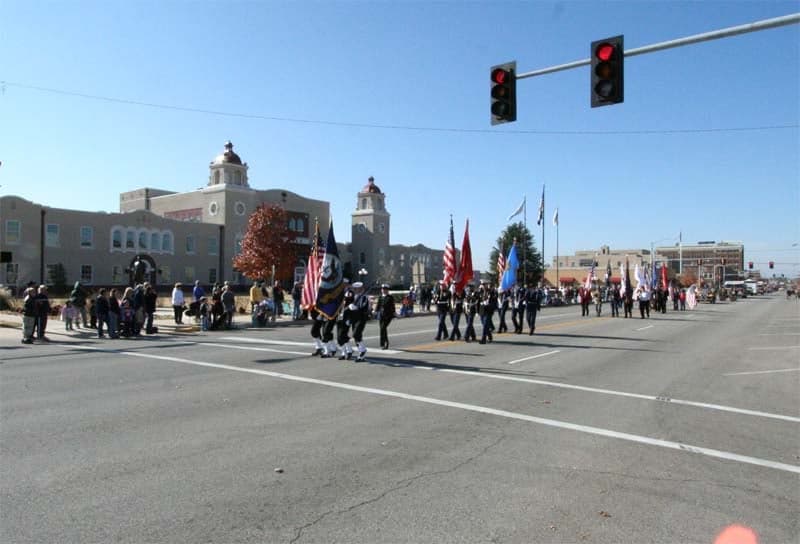
Photo: Wikipedia
Demographics of Ponca City, OK
Affluence Level in Ponca City, OK
A below-average socioeconomic profile. Incomes, home values, and educational attainment trail the U.S., with higher poverty and unemployment.
People of Ponca City, OK
Today, Ponca City, Oklahoma is a community of 24,377 residents defined by its deep-rooted Native American and European heritage, a modestly growing Hispanic population, and a notably low foreign-born share of just 1.8%. The city remains predominantly white (67.9%) and is characterized by a strong sense of place tied to the oil boom and the nearby Ponca Tribe of Oklahoma. For a conservative-leaning audience, Ponca City offers a stable, family-oriented environment with a population density of roughly 1,100 people per square mile, where traditional values and community ties remain central to daily life.
How the city was settled and grew
Ponca City’s human history begins not with European settlers but with the forced relocation of the Ponca Tribe to Indian Territory in the 1870s. The tribe was removed from Nebraska and settled on a reservation that included the present-day city site. The city itself was founded in 1893 after the Cherokee Outlet land run, which opened the area to non-Native homesteaders. The original settlers were largely white farmers and ranchers from the Midwest and Upper South, drawn by cheap land and the promise of a new start. The discovery of oil in the nearby Ponca Field in 1910 transformed the town almost overnight. The boom brought a wave of white and a small number of Black workers, who settled in distinct neighborhoods. The historic Downtown Ponca City district, centered around Grand Avenue, became the commercial and social hub for the oil-era arrivals. The East Side neighborhood, near the old refinery and rail yards, housed many of the working-class oil field laborers and their families. The Ponca Tribe’s reservation lands remained a separate, rural community just south of the city limits, with its own governance and cultural institutions. By the 1930s, the city’s population had stabilized around 15,000, with a clear social hierarchy: white professionals and oil executives in the Highlands neighborhood near the lake, white working-class families in the East Side, and the Ponca Tribe living largely outside the city’s formal boundaries.
Modern era (post-1965)
After the 1965 Hart-Cellar Act, Ponca City saw very little new immigration. The foreign-born population remains at just 1.8%, one of the lowest rates in Oklahoma. The most significant demographic shift since the 1970s has been the growth of the Hispanic population, which now stands at 9.9%. This growth came primarily from domestic migration—Mexican-American families moving from Texas and the Southwest for agricultural and service jobs. These families concentrated in the West Ponca area, near the industrial parks and along Highway 60, where affordable housing and proximity to work drew them. The Black population, at 3.2%, is largely descended from the oil-era arrivals and remains concentrated in the East Side neighborhood, though many have moved to newer subdivisions in the North Ponca area. The East/Southeast Asian community (0.7%) is small and dispersed, with no single ethnic enclave. The Indian subcontinent population is statistically zero. The white population, while still the majority, has declined from over 80% in 1990 to 67.9% today, driven by out-migration of younger adults to larger cities and an aging demographic. The Ponca Tribe’s population has grown modestly, with many tribal members living on the reservation or in the South Ponca area near the tribal headquarters. Suburbanization has been limited; the city’s boundaries have expanded only slightly, and most new housing has been built in the Lake Ponca area, attracting retirees and commuters who work in nearby Stillwater or Tulsa.
The future
Ponca City’s population is slowly homogenizing. The white majority is aging, with a median age of 40.3, while the Hispanic population is younger and growing through natural increase. The Hispanic share is projected to reach 12-14% by 2035, but this growth is unlikely to create a distinct ethnic enclave; instead, Hispanic families are dispersing across the West Ponca and North Ponca neighborhoods. The East/Southeast Asian and Black populations are plateauing, with little new in-migration. The Ponca Tribe’s population is stable, with a growing number of young adults staying on or near the reservation. The city’s overall population has been flat to slightly declining since 2010, a trend that is expected to continue as the oil and gas sector automates and the agricultural sector consolidates. For a new resident, Ponca City is becoming a quieter, more homogeneous place—a small, stable community where the major demographic story is the gradual aging of the white population and the slow, steady growth of a Hispanic minority that is integrating into existing neighborhoods rather than forming new ones.
For someone moving in now, Ponca City offers a predictable, low-immigration environment with a strong Native American cultural presence and a conservative social fabric. The city is not diversifying rapidly; it is slowly becoming more Hispanic while the white population ages in place. The neighborhoods remain distinct by history rather than by ethnicity, and the overall character is one of stability, not transformation.

* Values derived from national, state, county, city and local statistics and may differ in a specific area. Last updated: 2026-04-25T13:53:41.000Z
Narrative content on this page is AI-generated and may contain mistakes. Verify any details that matter before acting on them.
ReloMaps may earn a commission from affiliate links at no extra cost to you.

