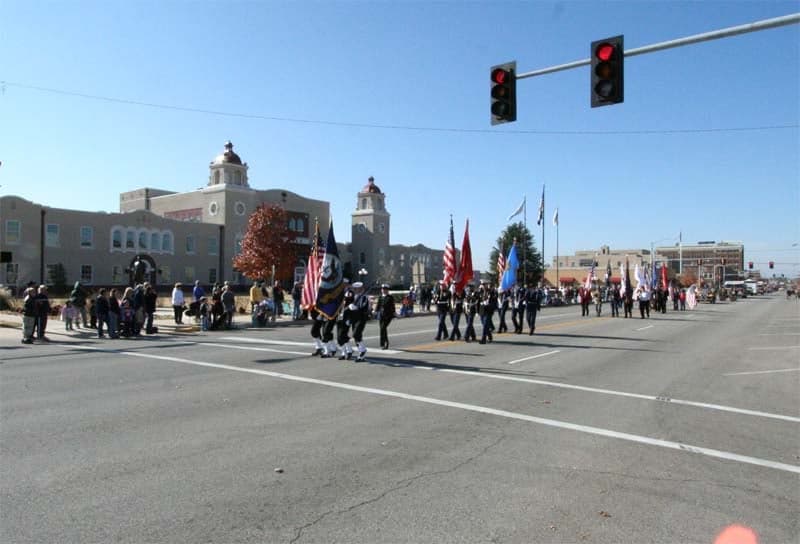
Photo: Wikipedia
Strategic Assessment of Ponca City, OK
Workable tactical position. Some exposure to population density or targets, but generally defensible in a crisis.
What does the Strategic Assessment tell us?
Our Strategic Assessment grades tactical survivability of an area. Major population centers, military targets, fallout zones, natural disasters, and border exposure all drive risk — lower exposure means a more defensible position in a crisis.
This is heavily inspired by Joel Skousen's Strategic Relocation book. Highly recommended you checkout the book ($)What does this tell us?
Our Strategic Assessment grades tactical survivability of an area. Major population centers, military targets, fallout zones, natural disasters, and border exposure all drive risk — lower exposure means a more defensible position in a crisis.
This is heavily inspired by Joel Skousen's Strategic Relocation book. Highly recommended you checkout the book ($)Strategic Pillars

Key Distances
Regional Safe Places
Below is our recommended "safe zones" in Oklahoma and the surrounding area based on our strategic heuristics. For most people, it's unrealistic to live in a “safe zone” full-time due to work, family or other personal reasons. They tend to be more rural. However, many of these areas are perfect for second homes and retreat properties that double as a vacation home or even a short-term rental.
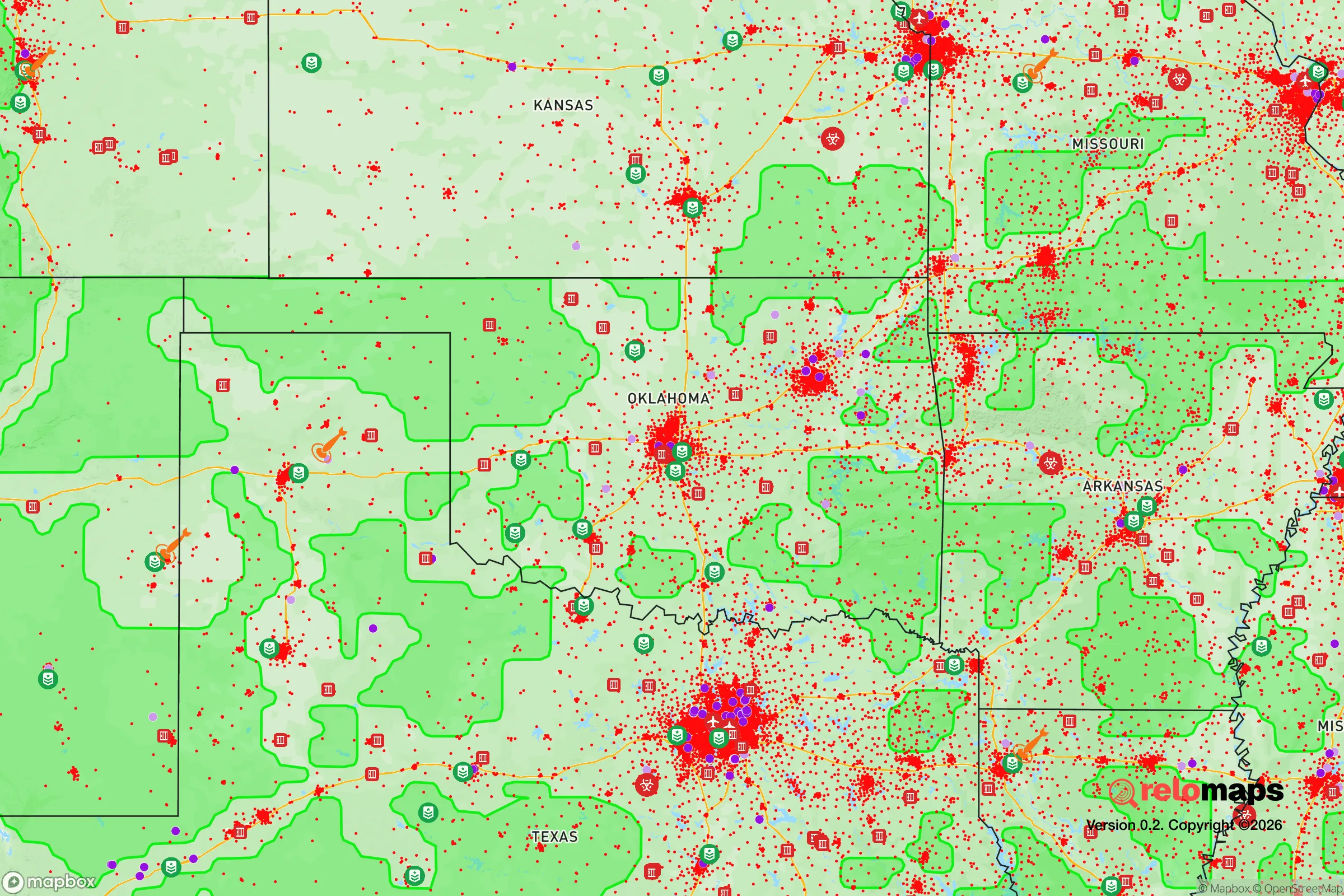
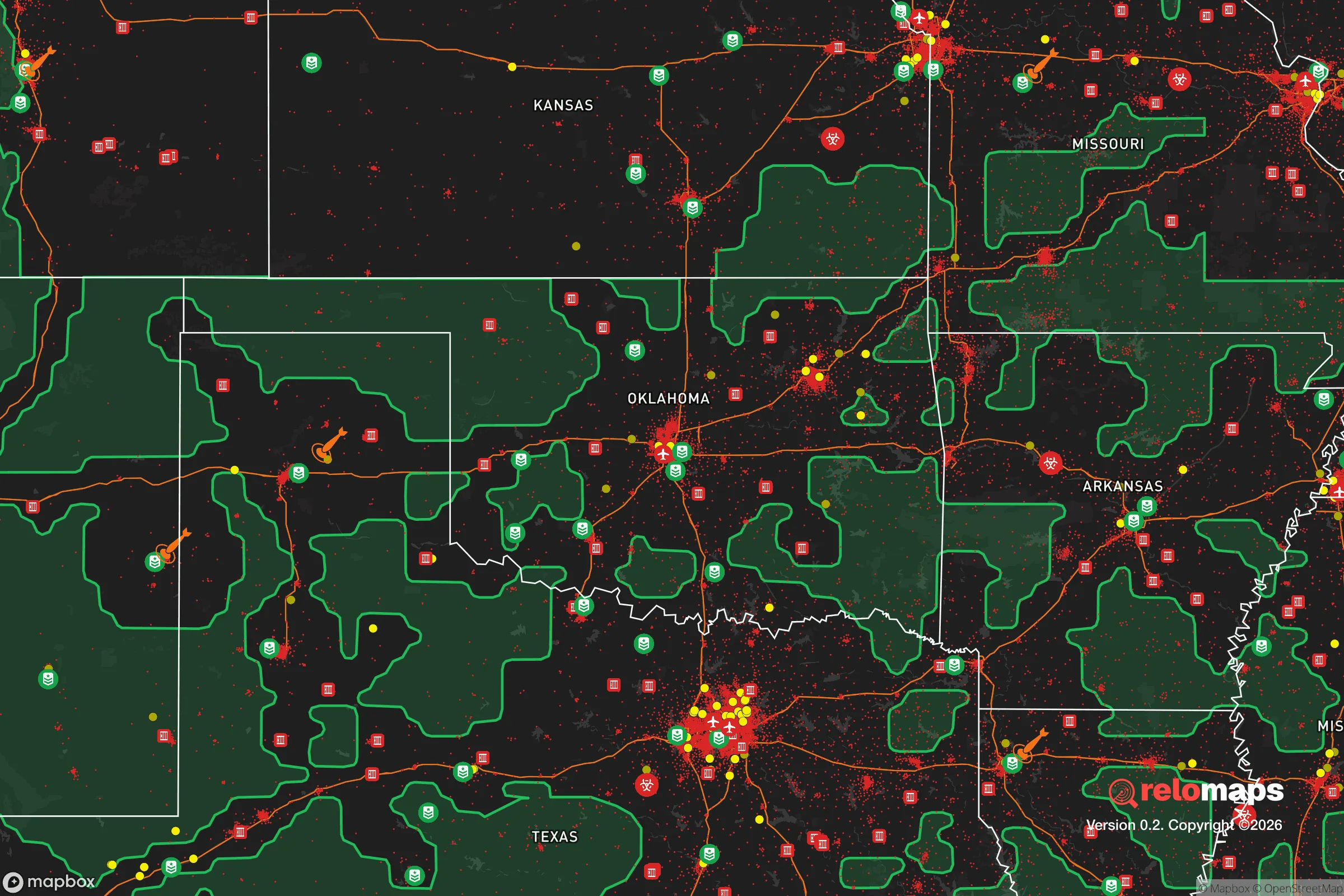


Important Note: For informational purposes only. This does not mean nothing bad ever happens in the green zones. Please use common sense. This is based on public data and modeled with AI. We tried to take a conservative approach but mistakes happen. We update this regularly as new information becomes available.
Solar Generator Recommendations
Backup power matters more here than in safer locations. We've picked three solar generators across budgets and capacity tiers — start with the budget unit if you only need a few essentials, or step up if you want to run a fridge and HVAC for days at a time.

Jackery Portable Power Station Explorer 300
Budget OptionPower on the Go: Weighing only 11 lbs, it's convenient to set up and store with book-sized foldable solar panels

BLUETTI Portable Power Station AC180
Designed for both indoor and outdoor scenarios, AC180 is highly capable as it has a robost capacity and continuous output power.

EF ECOFLOW DELTA Pro Ultra Power Station
Upgraded PickEcoFlow DELTA Pro Ultra is a whole-home energy system designed to grow with your family. Integrated with the Smart Home Panel 2, it scales to meet your evolving energy needs — keeping your home powered, intelligent, and secure through every stage of life.
We earn a commission, at no additional cost to you.
Strategic Assessment Analysis
Ponca City, Oklahoma, sits in a strategic sweet spot that resilience-minded relocators should take seriously: far enough from major metropolitan chaos to avoid the worst of civic unrest, yet close enough to essential supply chains and infrastructure to remain functional when things go sideways. Located in Kay County along the Arkansas River border with Kansas, this town of roughly 24,000 offers a blend of industrial backbone, agricultural self-sufficiency, and geographic isolation that makes it a viable fallback position for those concerned about national instability. Its position roughly 90 miles from Oklahoma City and 100 miles from Tulsa means you can access those metros when conditions are stable, but you're not in the blast radius—literal or figurative—when they aren't.
Geographic position and natural advantages for long-term stability
Ponca City's location along the Arkansas River provides a reliable freshwater source, which is the single most critical resource in any extended disruption scenario. The surrounding landscape is flat to gently rolling Osage prairie, offering good visibility and limited natural cover for anyone approaching—a defensive advantage if you're securing a property. The area sits in USDA Hardiness Zone 6b, with a growing season long enough for serious food production: roughly 200 frost-free days from April to October. The soil in the Arkansas River valley is fertile alluvial loam, well-suited for row crops and orchards, and the region's annual rainfall of about 35 inches means you're not dependent on irrigation in most years. For a prepper focused on food security, this is a meaningful edge over drier western Oklahoma or the Texas Panhandle. The nearby Kaw Lake and Lake Ponca reservoirs add redundancy for water storage and recreation-based food sourcing (fishing, waterfowl). The terrain lacks mountains for retreat-style defensibility, but the open plains offer long sightlines and limited approach routes, which can be turned to advantage with proper planning.
Risks, exposures, and proximity to fallout-relevant landmarks
No location is risk-free, and Ponca City has exposures that a strategic relocator must weigh. The most obvious is the ConocoPhillips refinery and chemical plant just south of town—a major industrial facility that processes crude oil and produces petroleum coke, asphalt, and sulfur. In a grid-down or civil unrest scenario, this facility becomes a double-edged sword: it's a source of fuel and industrial goods, but also a potential target for sabotage, accidental release, or civil disruption. The refinery's proximity to the Arkansas River raises the risk of water contamination in a worst-case event. Additionally, the nearby Ponca City Nuclear Power Plant (the decommissioned but still monitored site) and the general presence of rail lines carrying hazardous materials through the region mean that a major transportation accident or targeted attack could create localized fallout zones. On the positive side, Ponca City is far from any major military installations, nuclear weapons storage sites, or high-value government targets that would draw strategic strikes. The nearest significant military presence is Tinker Air Force Base near Oklahoma City, roughly 90 miles south—outside the likely blast or fallout radius of a conventional or low-yield nuclear event. The town's distance from major interstate highways (I-35 is 40 miles west, I-44 is 50 miles east) reduces the risk of being caught in mass evacuation traffic or refugee flows during a crisis, but also means supply chains may be slower to recover.
Practical resilience for a relocator: food, water, energy, and defensibility
For someone serious about self-sufficiency, Ponca City offers several practical advantages. Water security is strong: the Arkansas River runs year-round, and the municipal water system draws from both surface and groundwater sources. A well-drilled property outside city limits can tap into the Garber-Wellington aquifer, which provides reliable water at depths of 100-300 feet. Food production is viable on most residential lots of half an acre or more—the growing season supports tomatoes, peppers, squash, beans, corn, and root vegetables, and the local agricultural extension office at Oklahoma State University's Kay County branch offers soil testing and crop advice. The area has a strong hunting culture (deer, turkey, waterfowl, and small game are abundant in the surrounding Osage County and Kaw Wildlife Management Area), and fishing in the Arkansas River and Kaw Lake is productive. Energy resilience is mixed: the grid is served by OG&E and is reasonably stable, but rural properties are more vulnerable to storm-related outages. Solar potential is good—the region averages 5.2 peak sun hours per day—and zoning in unincorporated Kay County is generally permissive for off-grid systems, including wind turbines and battery storage. Defensibility is where Ponca City requires honest assessment: the flat terrain means you can't hide, but you can see threats coming from miles away. A rural property with a perimeter fence, good lighting, and a clear field of fire offers practical security. The local law enforcement presence is modest—Kay County Sheriff's Office covers a large area with limited deputies—so community mutual aid networks and personal preparedness are essential. The town's population is politically and culturally conservative, which means a prepper mindset is more likely to be understood than ridiculed, and there are active gun culture and outdoor recreation communities that can serve as informal support networks.
The overall strategic picture for Ponca City is one of moderate-to-strong resilience with manageable trade-offs. It's not a bug-out location in the mountain-redoubt sense, but it's a solid "live and work" base for someone who wants to be prepared without living in a bunker. The industrial assets (refinery, chemical plants) are a risk, but they also mean the local economy has real jobs and infrastructure that won't vanish overnight. The distance from major metros is a buffer against the worst of civil unrest, but not so far that you can't access medical care, supplies, or information when needed. For a conservative-leaning relocator who values community, self-reliance, and a low-probability-of-attack location, Ponca City deserves a serious look—especially if you're willing to invest in a well, solar panels, and a good relationship with your neighbors. The key is to buy property outside the refinery's plume zone, secure your water source, and build your network before you need it. In a world where the next crisis could be anything from a pandemic to a supply chain collapse to civil disorder, Ponca City offers a defensible, productive, and affordable place to ride it out.

* Values derived from national, state, county, city and local statistics and may differ in a specific area. Last updated: 2026-04-25T13:53:41.000Z
Narrative content on this page is AI-generated and may contain mistakes. Verify any details that matter before acting on them.
ReloMaps may earn a commission from affiliate links at no extra cost to you.

