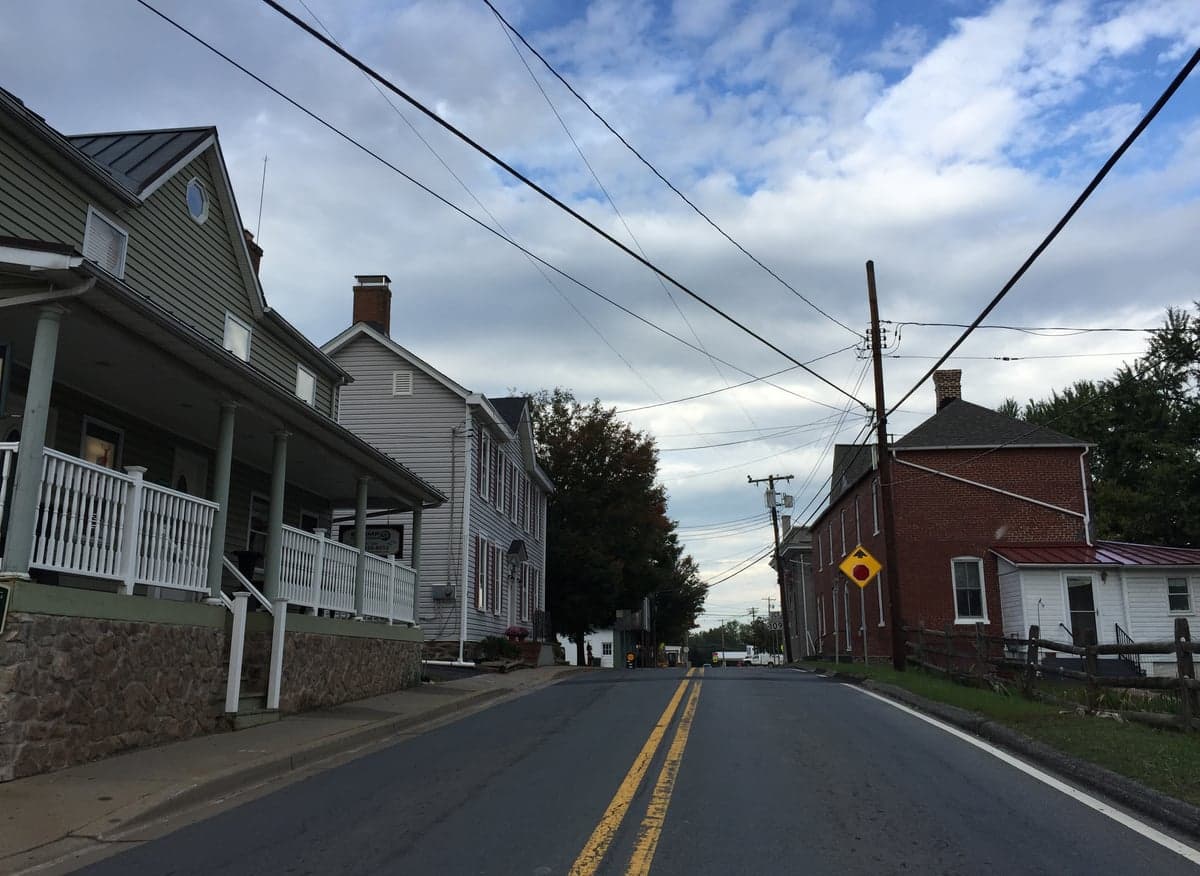
Photo: Wikipedia
Personal Sovereignty in Poolesville, MD
Viable for self-reliance. Generally workable, though some barriers may limit total independence.
What does Personal Sovereignty tell us?
Personal Sovereignty measures your capacity for self-reliance and independence with minimal government friction. Higher scores mean fewer barriers between you and the way you want to live... but it assumes you have the space you need and good neighbors.
What does this tell us?
Personal Sovereignty measures your capacity for self-reliance and independence with minimal government friction. Higher scores mean fewer barriers between you and the way you want to live... but it assumes you have the space you need and good neighbors.
State Policy
Energy independence: Importer (8% of energy produced in-state)
Personal Liberty
Homesteading

Personal Liberty Analysis
Poolesville, Maryland, offers a nuanced environment for personal sovereignty that is increasingly rare in the densely regulated Washington, D.C. corridor. While the town itself retains a rural, small-town character with a strong sense of community self-reliance, it operates under the full weight of Montgomery County and State of Maryland governance—two jurisdictions with aggressive tax policies, expansive regulatory codes, and a track record of limiting individual freedoms. For a single individual or family with a survivalist or prepper mindset, Poolesville presents a strategic trade-off: genuine geographic buffer from urban chaos, but with legal and fiscal constraints that require careful navigation. The key is understanding where the local autonomy ends and where state overreach begins.
Tax burden and regulatory posture: How Maryland's fiscal policies affect your autonomy
Maryland’s tax burden is among the highest in the nation, and Poolesville residents are not exempt. The state imposes a progressive income tax with rates up to 5.75%, and Montgomery County adds its own local income tax of 3.2%—for a combined top marginal rate near 9%. Property taxes in the county average roughly 1.1% of assessed value, which on a $500,000 home translates to about $5,500 annually. This is a significant recurring cost that eats into funds better spent on supplies, land improvements, or emergency reserves. The regulatory posture is equally burdensome: Maryland has some of the strictest environmental and land-use regulations in the Mid-Atlantic, including the Maryland Department of the Environment’s (MDE) permitting requirements for any well, septic, or construction project. Building a detached garage, installing a backup generator, or adding a rainwater catchment system can trigger months of review and thousands in fees. For those seeking to minimize government entanglement, these are real frictions. However, Poolesville’s status as an Agricultural Reserve area does offer some zoning flexibility for farming and livestock—a rare concession in an otherwise heavily regulated county.
Self-defense and gun law specifics: What you can and cannot do in Poolesville
Maryland is a shall-issue state for concealed carry permits, but the process is far from simple. Applicants must complete a 16-hour training course, pass a background check, and submit fingerprints. The state also bans so-called "assault weapons" and limits magazine capacity to 10 rounds. Poolesville itself has no additional local gun ordinances beyond state law, which is a small mercy—Montgomery County has considered local restrictions in the past, but the town’s rural character has kept such measures at bay. Open carry is legal with a permit, but rarely practiced and likely to draw unwanted attention from law enforcement. For preppers, the practical takeaway is that building a defensive firearms cache requires careful legal compliance: purchasing handguns is subject to a 7-day waiting period, and private firearm sales must go through a licensed dealer. Stand-your-ground laws do not exist in Maryland; you have a duty to retreat if safely possible before using deadly force. This legal reality means that self-defense planning must emphasize avoidance, perimeter security, and de-escalation over armed confrontation. The state’s red flag law also allows for temporary seizure of firearms based on a court order, which is a significant concern for those who value absolute control over their defensive tools.
Self-reliance and homesteading viability: Lot sizes, zoning, and off-grid feasibility
Poolesville’s location within the Montgomery County Agricultural Reserve is its strongest asset for self-reliance. Minimum lot sizes in the reserve are 25 acres for most residential uses, though existing smaller lots exist in the town proper. Zoning allows for keeping chickens, goats, sheep, and up to two horses on properties of two acres or more, and beekeeping is permitted with a simple registration. Vegetable gardens, fruit trees, and small-scale crop production are unrestricted. However, off-grid living faces significant hurdles: Maryland requires connection to the electrical grid for any habitable dwelling, and solar panels must be grid-tied unless you obtain a special exemption. Rainwater collection for potable use is technically allowed but must meet MDE water quality standards, which effectively mandates filtration and testing. Composting toilets are permitted only if a conventional septic system is also present—a costly redundancy. Wood-burning stoves are allowed but must comply with EPA emissions standards, and any new construction must meet the state’s stringent energy code. For a serious prepper, the best strategy is to buy a 25+ acre parcel in the reserve, build a conventional house as a legal base, and then develop a separate, off-grid "bug-out" structure on the same property—a gray area that many locals exploit. The town’s water supply comes from wells and the Potomac River, so a deep well with a hand pump backup is a wise investment.
Personal liberties: Parental rights, medical autonomy, speech, and property
Maryland’s track record on parental rights is mixed. The state mandates comprehensive sex education in public schools, with an opt-out provision that requires active parental action each year. Vaccine mandates for school attendance are strict, with only medical exemptions recognized—no religious or philosophical exemptions. Medical autonomy is heavily restricted: Maryland has some of the nation’s most permissive abortion laws and requires insurance coverage for contraception and abortion services. For those who prioritize medical freedom, this means that any healthcare decisions for minors are subject to state override in certain situations. Free speech is protected under the First Amendment, but Montgomery County has enacted hate speech ordinances that can be used to prosecute perceived harassment—a potential chill on robust political or cultural expression. Property rights are the most concerning: Maryland’s eminent domain authority is broad, and the state has used it for environmental conservation projects, including land acquisitions in the Agricultural Reserve. While outright seizure is rare, the threat of regulatory takings—where new rules devalue your land—is real. For example, a 2022 county proposal to restrict pesticide use on private farms was only defeated after intense local pushback. The town’s small population (about 5,500) and tight-knit community do provide a buffer: local officials are more responsive to residents than in denser parts of the county, and town council meetings are accessible venues for voicing concerns.
Overall, Poolesville offers a higher degree of personal sovereignty than most of the D.C. suburbs, but it is not a libertarian haven. The town’s rural character, large lot sizes, and agricultural zoning create genuine opportunities for self-reliance, homesteading, and community defense. However, the state and county overlay imposes significant tax burdens, regulatory hurdles, and restrictions on firearms, medical choice, and property use. For a survivalist or prepper, Poolesville is a viable base of operations—provided you are willing to navigate the legal landscape with care, invest in compliance upfront, and maintain a low profile. Compared to rural areas in West Virginia or Pennsylvania, the sovereignty trade-offs are steeper, but the proximity to resources, markets, and a like-minded community may be worth the cost for those who value strategic positioning over absolute freedom.

* Values derived from national, state, county, city and local statistics and may differ in a specific area. Last updated: 2026-04-22T01:23:42.000Z
Narrative content on this page is AI-generated and may contain mistakes. Verify any details that matter before acting on them.
ReloMaps may earn a commission from affiliate links at no extra cost to you.

