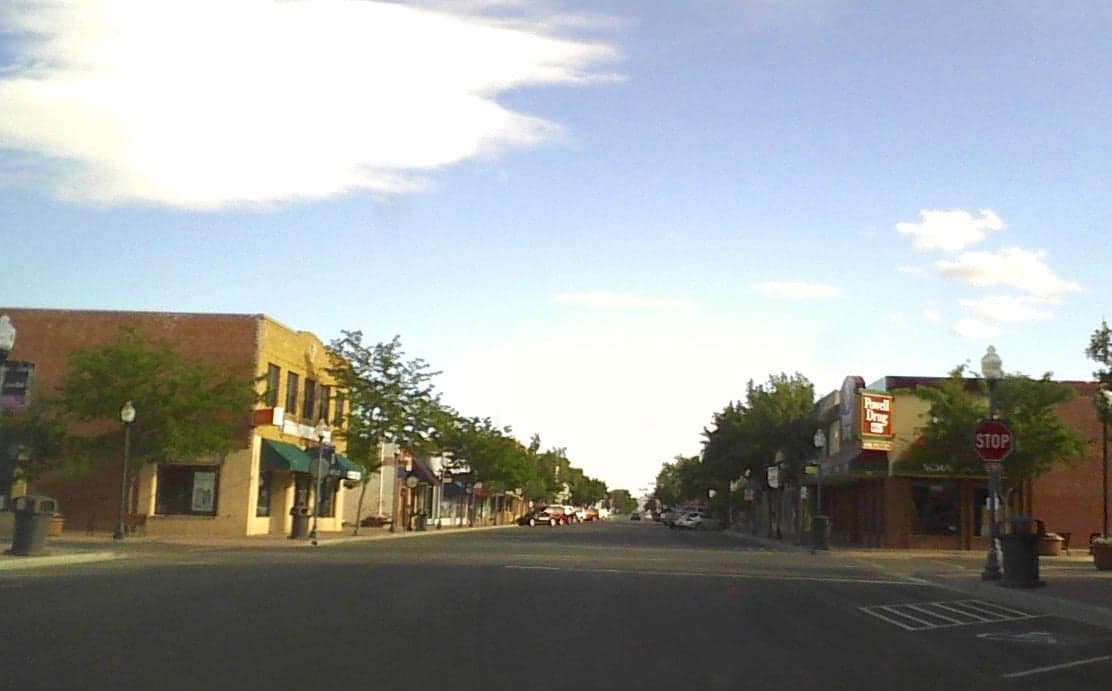
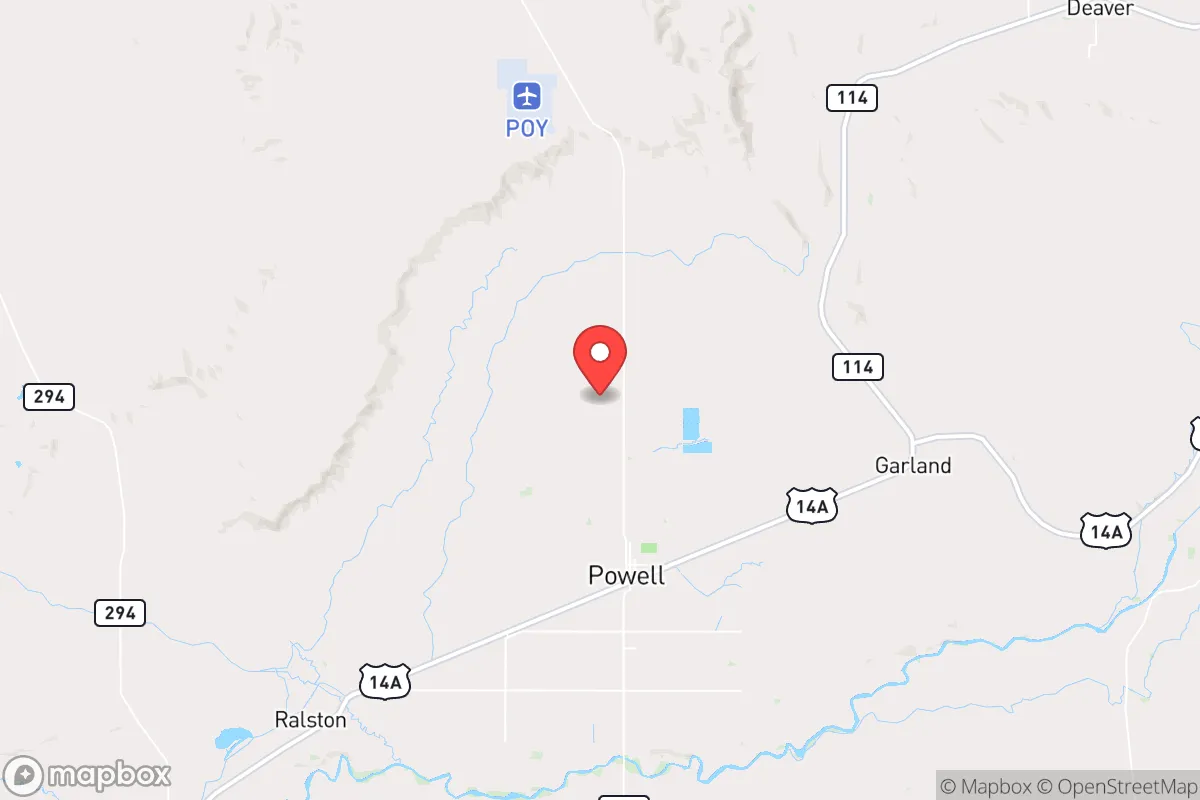
Photo: Wikipedia
Demographics of Powell, WY
Affluence Level in Powell, WY
A middle-class area roughly in line with national averages across income, home values, education, and employment.
People of Powell, WY
Powell, Wyoming, is a small, tight-knit agricultural community of 6,466 residents where 82.0% of the population identifies as White, and the foreign-born share is just 0.4%. The city’s character is defined by its deep roots in homesteading and the sugar beet industry, with a notably high college attainment rate of 32.9%—a reflection of Northwest College’s presence. Powell remains predominantly White and native-born, with a Hispanic population of 10.4% that forms the largest minority group, while East/Southeast Asian (0.7%) and Black (0.2%) communities are very small. The city feels stable and family-oriented, with little of the rapid demographic change seen in larger Western towns.
How the city was settled and grew
Powell was founded in 1909 as a planned agricultural colony under the Carey Act, which brought irrigation to the arid Bighorn Basin. The original settlers were predominantly White homesteaders from the Midwest and Great Plains—farmers of German, Scandinavian, and English descent drawn by the promise of 40-acre irrigated plots. The Powell townsite was laid out in a grid around the railroad depot, and the first neighborhoods emerged near the downtown core, such as Old Town Powell (the original blocks around Coulter Avenue) and the Homestead Addition (east of the tracks), where many early farming families built modest frame houses. The sugar beet industry, anchored by the Great Western Sugar Company factory (opened 1916), attracted a small wave of Mexican laborers in the 1910s and 1920s, who settled in a pocket near the factory known historically as Beet Field Flats (south of the railroad). This enclave remained the primary Hispanic neighborhood for decades. The city grew steadily through the 1930s–1950s as the Bureau of Reclamation expanded irrigation, but the population remained overwhelmingly White and native-born, with the 1960 census showing less than 1% non-White residents.
Modern era (post-1965)
After the 1965 Immigration Act, Powell saw minimal foreign-born influx—the 2020 data shows only 0.4% foreign-born, one of the lowest rates in Wyoming. The Hispanic population grew modestly from 2% in 1980 to 10.4% today, driven by domestic migration of Hispanic families from the Southwest and Mexico, many working in agriculture and the oil-and-gas sector. These newer Hispanic residents settled in the South Side (south of Highway 14A) and in the Powell Industrial Park area, where affordable housing and proximity to farm jobs exist. The White population, while still dominant, has aged slightly, with a median age of 36.7. The East/Southeast Asian community (0.7%) is mostly tied to Northwest College—international students from Japan, South Korea, and Vietnam who often leave after graduation. The Black population (0.2%) is negligible, and there is no measurable Indian-subcontinent community. Suburbanization has been limited: newer subdivisions like Sunset Hills (west of town) and Powell Valley Estates (north of the college) have attracted White families seeking larger lots, while the historic core has seen some reinvestment. The city has not experienced the ethnic enclave formation seen in larger cities; instead, neighborhoods remain largely integrated by income rather than race.
The future
Powell’s population is projected to grow slowly, reaching roughly 7,000 by 2040, driven by natural increase and modest domestic in-migration from other Western states. The Hispanic share is likely to rise to 12–14% as younger Hispanic families have higher birth rates and some continue to arrive for agricultural work, but the city is not expected to see rapid diversification. The White population will remain the overwhelming majority, with the East/Southeast Asian and Black shares staying below 2% each. The foreign-born rate will likely stay under 1%, as Powell lacks the job diversity or urban amenities to attract international migrants. The city is homogenizing in the sense that the small Hispanic enclave in the South Side is slowly blending into the broader community through intermarriage and upward mobility, rather than forming a permanent ethnic neighborhood. The biggest demographic shift is aging: the 65+ cohort is growing as younger adults leave for college and careers elsewhere, which could strain local services. For a newcomer, Powell offers a stable, culturally homogeneous environment with little racial or ethnic tension, but also limited diversity and a population that is slowly graying.
Powell is becoming a quieter, older version of its agricultural self—still overwhelmingly White, still rooted in farming and the college, with a small but stable Hispanic minority that is integrating rather than segregating. For someone moving in now, the city offers a predictable, low-crime community where neighbors know each other and change comes slowly. The trade-off is a lack of the cultural variety or rapid growth seen in other parts of the Mountain West, making it best suited for those seeking stability over dynamism.

* Values derived from national, state, county, city and local statistics and may differ in a specific area. Last updated: 2026-04-21T11:32:11.000Z
Narrative content on this page is AI-generated and may contain mistakes. Verify any details that matter before acting on them.
ReloMaps may earn a commission from affiliate links at no extra cost to you.

