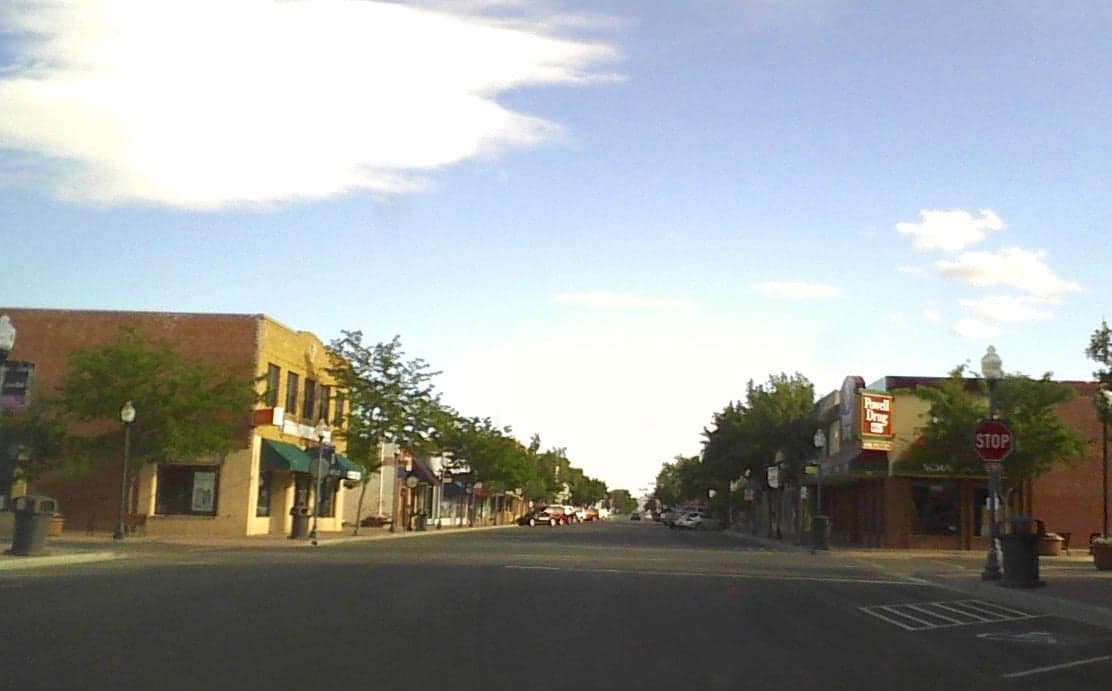
Photo: Wikipedia
Political ClimatePolitical Climate in Powell, WY
District shown is the primary district for this city’s centroid. Cities may span multiple districts.
Inherited from parent state — no local data available.
Local Political AnalysisPolitical Analysis of Powell, WY
Powell, Wyoming, is about as solidly conservative as they come, with a Cook PVI of R+23 that tells you everything you need to know about the local voting habits. This isn't a purple area that's trending blue; it's a deep-red stronghold where Republican candidates routinely win by double-digit margins, and that's been the case for as long as anyone can remember. The political lean here is rooted in a fierce independence and a distrust of big government—whether it's from Washington D.C. or Cheyenne—and that's not changing anytime soon. If you're looking for a place where your rights and freedoms are taken seriously, Powell is about as good as it gets in the modern West.
How it compares
Drive an hour east to Cody, and you'll find a similar conservative vibe, though Cody's tourism economy brings in a slightly more transient crowd that can dilute the local politics. Head south to Worland or Thermopolis, and you're still in safe Republican territory, but those towns have a more rural, agricultural focus that makes Powell feel almost cosmopolitan by comparison. The real contrast comes when you go west over the mountains into Cody's more touristy areas or, worse, down to Jackson Hole—that's a whole different world, where progressive politics and government overreach have taken hold, with strict land-use regulations and a cost of living that prices out locals. Powell residents look at Jackson and see a cautionary tale of what happens when you let outside money and progressive ideology dictate local policy. Compared to the rest of Big Horn Basin, Powell is a bastion of common-sense conservatism, where the Second Amendment is a given, property rights are respected, and the idea of a carbon tax or a land grab by the feds would be laughed out of town.
What this means for residents
For folks living here, the political climate means you can go about your daily life without worrying about the government breathing down your neck. You won't see mask mandates or business shutdowns like you did in blue states during the pandemic—Powell's leaders trusted residents to make their own choices, and that's the way it should be. Property taxes are low, zoning is minimal, and you can build a shop in your backyard or keep a few chickens without needing a permit from a bureaucrat. The downside? If you're hoping for a lot of government-funded amenities or progressive social programs, you'll be disappointed. The local schools are solid, but they're not pushing critical race theory or gender ideology; they're focused on reading, writing, and arithmetic. The county commission and city council are filled with folks who believe in fiscal restraint and personal responsibility, so don't expect handouts or big public works projects. For a long-time resident like me, that's a feature, not a bug—it means we keep more of our own money and our own freedom.
One cultural distinction worth noting is Powell's strong agricultural and Mormon heritage, which reinforces the conservative values here. The LDS community is a stabilizing force, emphasizing family, self-reliance, and community service without the government's help. You'll also notice a deep skepticism of federal land management—the Bureau of Land Management and Forest Service are often seen as overreaching, especially when they try to restrict grazing or recreation on public lands. In the near term, I see Powell staying the course, but there's a quiet concern about newcomers from blue states moving in and trying to change things. If that trend accelerates, we could see a slow shift toward more progressive policies, but for now, Powell remains a place where your rights come first and the government stays out of your business. That's the kind of place worth fighting for.

State Political ClimatePolitical Climate in Wyoming
State Political AnalysisPolitical Environment in the State
Wyoming is the most reliably Republican state in the nation by partisan voting index, with a GOP lean of +25 points in 2024 and a political culture that has only hardened over the last two decades. The dominant coalition is a blend of rural ranchers, energy-sector workers, and second-amendment advocates who have consistently rejected progressive governance at the state and local level. Over the last 10-20 years, the state has shifted further right, driven by out-migration of moderates from the shrinking coal towns and a steady influx of conservative refugees from blue states seeking lower taxes and fewer regulations.
Urban vs. rural divide
The political map of Wyoming is starkly divided between its few small cities and the vast rural expanse. Cheyenne, the capital and largest city, leans Republican but is the state’s most moderate area, with Laramie County voting about +15 R in 2024 — a full 10 points less red than the state average. Casper (Natrona County) is a reliable conservative stronghold, voting +25 R, driven by the energy industry and a strong ranching base. Jackson (Teton County) is the notable exception: it’s the only county that votes Democratic, flipping +12 D in 2024, fueled by wealthy second-home owners, ski resort workers, and a growing progressive activist class. The real power lies in the rural counties: Sublette County (+60 R), Niobrara County (+55 R), and Hot Springs County (+50 R) are among the most conservative in the nation. The divide isn’t just cultural — it’s economic, with rural areas dependent on extractive industries and Jackson reliant on tourism and real estate speculation.
Policy environment
Wyoming’s policy environment is a model of limited government, with no state income tax, a low 4% corporate tax, and a property tax system that is among the most favorable in the country — though recent reassessments have sparked backlash. The regulatory posture is aggressively pro-business, especially for energy: the state has streamlined permitting for oil, gas, and coal, and has fought federal overreach on public lands. Education policy is a mixed bag: the state funds schools through a mineral trust, but per-pupil spending is below the national average, and school choice is limited to a few charter schools and a weak open-enrollment law. Healthcare is a sore spot — Wyoming has the highest per-capita healthcare costs in the nation and has refused Medicaid expansion, leaving a coverage gap for low-income adults. Election laws are solid: voter ID is required, same-day registration is not allowed, and absentee voting requires an excuse. The state legislature has passed laws to ban ballot drop boxes and limit mail-in voting, maintaining high election integrity.
Trajectory & freedom
Wyoming is becoming more free in several key areas, but there are warning signs. On gun rights, the state passed constitutional carry in 2017 and a “Second Amendment Sanctuary” law in 2021, making it one of the most firearm-friendly states in the union. Parental rights were strengthened in 2023 with a law requiring schools to notify parents of any curriculum involving sexual orientation or gender identity, and a ban on transgender athletes in K-12 sports. Medical autonomy is robust: Wyoming has no vaccine mandates, and the legislature passed a law in 2022 prohibiting discrimination against the unvaccinated. Property rights are strong, with a 2023 law limiting county-level zoning authority. However, the state’s reliance on federal mineral royalties creates a vulnerability — any federal energy policy shift could devastate the budget. The biggest threat to freedom is the creeping influence of Jackson’s progressive politics, which have pushed for local land-use restrictions and a carbon tax on tourism. The state legislature has pushed back, but the cultural battle is intensifying.
Civil unrest & political movements
Wyoming has seen remarkably little civil unrest compared to other states. The most visible flashpoint is the ongoing fight over federal land management, with the “Sagebrush Rebellion” alive and well — local activists have pushed for the transfer of federal lands to state control, and in 2024, the legislature passed a resolution demanding the return of 30 million acres. Immigration politics are quiet, as the state has a tiny foreign-born population (under 4%), but the legislature passed a law in 2023 requiring local law enforcement to cooperate with ICE. Election integrity controversies are minimal — the state’s paper ballot system and low population make fraud nearly impossible. The most organized activist movement is on the right: the Wyoming Liberty Group and local Tea Party chapters have successfully pushed for tax cuts and school choice. On the left, the Jackson-based “Wyoming Rising” group has organized protests against fossil fuel development, but they remain a fringe force outside Teton County. There is no serious secession or nullification rhetoric, though some rural counties have discussed “county sovereignty” resolutions in response to federal land policies.
Projection
Over the next 5-10 years, Wyoming will likely become even more conservative, but with a growing tension between the rural base and the Jackson-area progressive enclave. In-migration from blue states is accelerating — Sheridan and Laramie have seen the fastest growth, with newcomers often bringing higher expectations for services and a more moderate political outlook. The energy transition will be the defining issue: as coal declines, the state will need to diversify its economy, which could shift the political calculus. The legislature is likely to pass a school choice voucher program within the next two years, and property tax reform is almost certain after the 2024 reassessment backlash. The biggest risk is a federal Democratic administration that could impose energy restrictions, which would devastate the state budget and force painful cuts. A new resident moving in now should expect a state that remains deeply red, but with a growing cultural divide between the rural heartland and the urbanizing corridors of Cheyenne and Jackson.
For a new resident, the bottom line is this: Wyoming offers maximum personal freedom on guns, taxes, and parental rights, but you’ll need to accept limited healthcare access, a weak school system, and a state budget that is dangerously tied to fossil fuels. If you’re a conservative looking for a place where government stays out of your life, Wyoming delivers — but don’t expect the amenities or services of a blue state. The trade-off is real, and it’s worth understanding before you pack the truck.
* Values derived from national, state, county, city and local statistics and may differ in a specific area. Last updated: 2026-04-21T11:32:11.000Z
Narrative content on this page is AI-generated and may contain mistakes. Verify any details that matter before acting on them.
ReloMaps may earn a commission from affiliate links at no extra cost to you.

