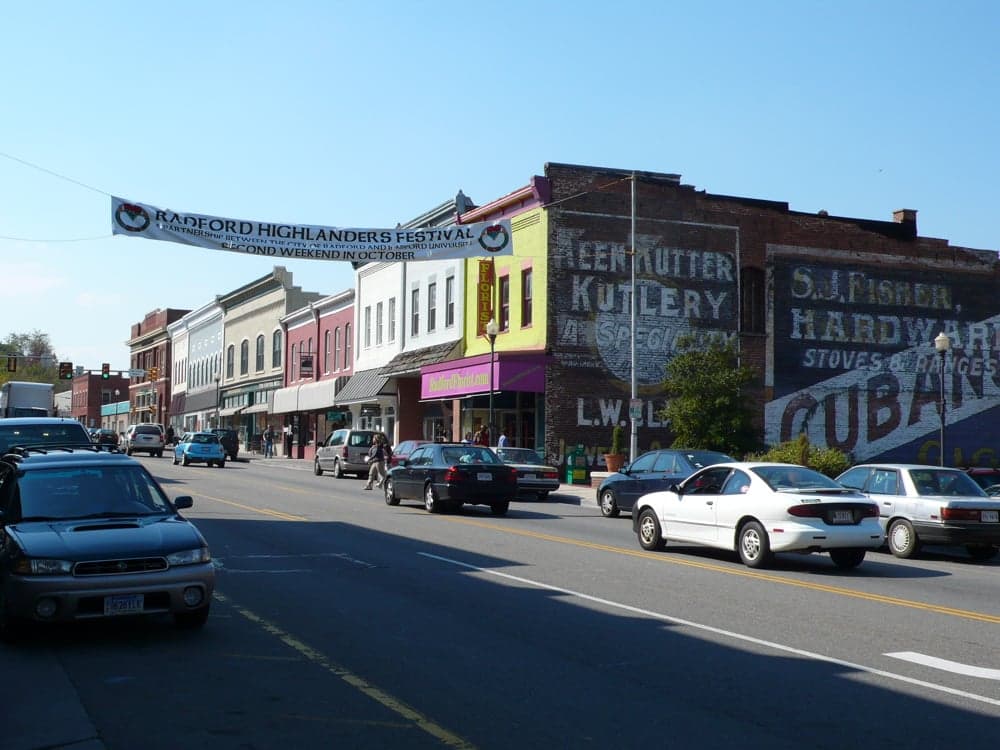
Photo: Wikipedia
Personal Sovereignty in Radford, VA
Viable for self-reliance. Generally workable, though some barriers may limit total independence.
What does Personal Sovereignty tell us?
Personal Sovereignty measures your capacity for self-reliance and independence with minimal government friction. Higher scores mean fewer barriers between you and the way you want to live... but it assumes you have the space you need and good neighbors.
What does this tell us?
Personal Sovereignty measures your capacity for self-reliance and independence with minimal government friction. Higher scores mean fewer barriers between you and the way you want to live... but it assumes you have the space you need and good neighbors.
State Policy
Energy independence: Importer (20% of energy produced in-state)
Personal Liberty
Homesteading

Personal Liberty Analysis
Radford, Virginia offers a notably strong environment for personal sovereignty, particularly when measured against the encroaching regulatory and fiscal pressures found in many other parts of the country. This small city, nestled in the New River Valley, operates within a state framework that, while not perfect, still respects a significant degree of individual autonomy—especially in areas of self-defense, property rights, and resistance to federal overreach. For the survivalist or prepper evaluating a relocation, Radford presents a strategic balance: it is far enough from the D.C. swamp to avoid the worst of its administrative creep, yet close enough to mountains, water, and rural buffer zones to enable a self-reliant lifestyle. The key is understanding where the local and state lines of freedom are drawn, and where they are fraying.
Tax burden and regulatory posture in Radford and Virginia
Virginia’s tax structure is a mixed bag for the sovereignty-minded individual. The state imposes a flat income tax of 5.75% on all taxable income, which is moderate compared to high-tax states like New York or California, but still a noticeable bite. Property taxes in Radford are relatively low, with a real estate tax rate of $1.06 per $100 of assessed value as of 2025, which is competitive for the region. However, the city does levy a personal property tax on vehicles and other tangible assets—a common annoyance in Virginia that adds an annual cost. The regulatory posture in Radford is generally business-friendly, with no city-level income tax and a streamlined permitting process for small-scale construction and home-based enterprises. The state’s regulatory environment, however, has been trending toward more oversight in areas like environmental permitting and land use, so anyone planning significant off-grid infrastructure should budget for state-level compliance. For the prepper, the key takeaway is that Radford’s local government is not aggressively expansionist, but Virginia’s state-level bureaucracy can still be a hurdle—especially if you plan to operate outside the conventional grid.
Self-defense and gun law specifics in Radford and Virginia
Virginia remains a shall-issue state for concealed carry permits, meaning that if you meet the basic requirements—background check, proof of training—the state must issue the permit. Radford itself has no additional local restrictions beyond state law, which is a critical advantage for those prioritizing self-defense. The state allows open carry without a permit for anyone legally allowed to possess a firearm, and there is no statewide ban on standard-capacity magazines or specific firearm types. However, Virginia does have a one-handgun-per-month purchase limit for most buyers, which is a lingering restriction from previous administrations. The state also requires a background check for all firearm transfers, including private sales, through the Virginia State Police. For the survivalist, this means you can legally carry and defend yourself, but you cannot rapidly stockpile handguns without bureaucratic friction. Radford’s local law enforcement is generally supportive of Second Amendment rights, and the city has not enacted any of the more restrictive ordinances seen in Northern Virginia. The proximity to federal land (Jefferson National Forest) also provides ample opportunity for training and practice without drawing unwanted attention.
Self-reliance and homesteading viability in Radford
Radford’s zoning and land-use policies offer a mixed but workable environment for homesteading and off-grid living. The city itself is compact, with most residential lots averaging 0.25 to 0.5 acres, which limits large-scale self-sufficiency within city limits. However, the surrounding Pulaski and Montgomery counties have more rural zoning that permits lots of 1 to 5 acres at reasonable prices—often under $10,000 per acre for raw land. Radford’s city code does not explicitly prohibit rainwater collection, composting toilets, or small-scale livestock (chickens are allowed with a permit), but it does require connection to municipal water and sewer in most developed areas. For true off-grid feasibility, you will need to look just outside city limits, where county regulations are more lenient. The New River provides a reliable water source, and the region’s moderate climate allows for extended growing seasons. Solar panels are permitted without excessive red tape, though net metering with Appalachian Power requires a standard interconnection agreement. For the prepper, the strategy is clear: use Radford as a base for employment and community access, but secure land in the surrounding counties for your homesteading and retreat operations.
Personal liberties in Radford: parental rights, medical autonomy, speech, and property
Virginia’s legal landscape for personal liberties is a patchwork, but Radford sits in a region that leans more toward individual freedom than the state’s urban centers. Parental rights are relatively strong in Virginia, with a state law that allows parents to opt their children out of specific instructional materials or activities that conflict with their religious or moral beliefs. The state does not have a universal vaccine mandate for school attendance, though individual school districts can impose requirements—Radford City Public Schools currently follows state guidelines without additional local mandates. Medical autonomy is more contested: Virginia has not enacted a right-to-try law for terminally ill patients, but it does allow for medical decision-making by competent adults without state interference. Speech protections are robust under both the U.S. and Virginia constitutions, and Radford has no local ordinances restricting public assembly or expression beyond standard time-place-manner rules. Property rights are generally respected, with Virginia being a “Dillon’s Rule” state, meaning local governments only have powers explicitly granted by the state—this limits Radford’s ability to impose overly restrictive land-use or rental regulations. For the sovereignty-minded individual, the main concern is the state’s willingness to enforce federal mandates, particularly in health emergencies, which has been inconsistent. Radford’s local culture, however, is more libertarian-leaning than the state average, with a strong sense of community self-reliance.
Overall, Radford offers a solid B+ grade for personal sovereignty when compared to other mid-sized Virginia cities. It avoids the worst of Northern Virginia’s regulatory overreach and the coastal elite’s cultural impositions, while still providing access to modern infrastructure and employment. The tax burden is manageable, gun laws are favorable, and the surrounding rural areas enable a genuine self-reliant lifestyle. The primary risks are state-level creep on medical and educational autonomy, and the potential for future federal mandates to be enforced locally. For the strategic relocator with a prepper mindset, Radford is a viable base of operations—not a libertarian utopia, but a place where you can live largely on your own terms, with enough buffer to weather the coming storms. The key is to buy land outside city limits, stay engaged with local politics, and keep your powder dry—literally and figuratively.

* Values derived from national, state, county, city and local statistics and may differ in a specific area. Last updated: 2026-05-01T09:30:54.000Z
Narrative content on this page is AI-generated and may contain mistakes. Verify any details that matter before acting on them.
ReloMaps may earn a commission from affiliate links at no extra cost to you.

