Photo: Wikipedia
Demographics of Radford, VA
Affluence Level in Radford, VA
A below-average socioeconomic profile. Incomes, home values, and educational attainment trail the U.S., with higher poverty and unemployment.
People of Radford, VA
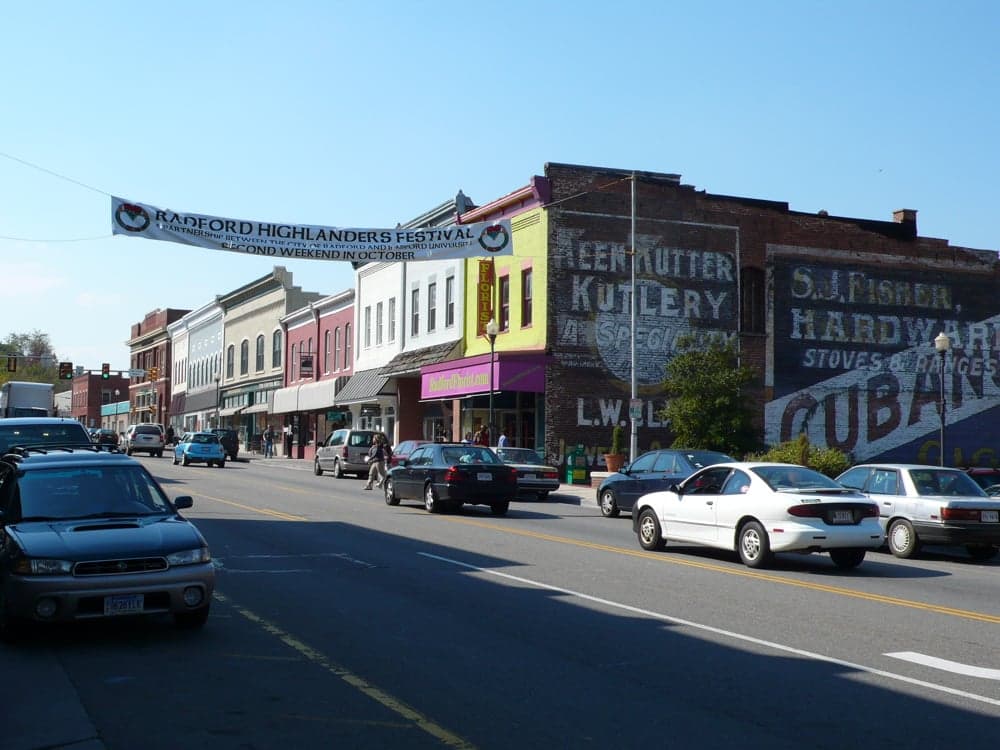
Radford, Virginia, is a small, historically white Appalachian city of 16,505 residents, where the population is notably older and more rooted than the national average. Its character is shaped by a blend of university influence from Radford University and a working-class industrial past, creating a community that is both educated (39.8% hold a bachelor’s degree) and culturally insular. The city’s population is overwhelmingly native-born (99.1% U.S.-born), with a racial composition of 81.3% white, 9.2% Black, 4.3% Hispanic, and 1.8% East/Southeast Asian, alongside a very small Indian subcontinent community at 0.4%.
How the city was settled and grew
Radford’s original population was drawn by the railroad and the New River’s industrial potential. The city was incorporated in 1892, but its growth exploded after the Norfolk and Western Railway built a major yard and repair shop here in the early 1900s. This brought a wave of white Appalachian laborers from surrounding counties, who settled in the West End and East Radford neighborhoods, building modest frame houses near the tracks. A smaller Black workforce arrived during the same period, concentrated in the Fairlawn area (now partly annexed into Radford) and the historically Black section of Preston Street, where a tight-knit community formed around churches and the segregated school system. The city’s growth peaked around 1970 at roughly 14,000 residents, driven by the railroad and the expansion of Radford University (founded 1910 as a women’s normal school). The university drew faculty and staff, many of whom settled in the Norwood and University Park neighborhoods, giving Radford a small professional class distinct from its industrial base.
Modern era (post-1965)
After the 1965 Hart-Cellar Act, Radford saw virtually no new immigration—its foreign-born share remains below 1%, one of the lowest in Virginia. Instead, the post-1965 story is one of domestic out-migration and suburbanization. The railroad’s decline in the 1970s and 1980s triggered a population drop to about 15,000 by 1990, with many working-class white families moving to newer subdivisions in Belview or neighboring Montgomery County. The Black population, which had been around 12% in 1970, declined to 9.2% by 2020, as younger Black families left for larger cities like Roanoke or Charlotte. The Hispanic share grew slowly from near zero in 1990 to 4.3% today, with most settling in the West End and East Radford rental stock, often working in construction or service jobs tied to the university. The East/Southeast Asian community (1.8%) is almost entirely tied to Radford University—faculty and graduate students from China, South Korea, and Vietnam, living near campus in University Park or the Highland Avenue corridor. The Indian subcontinent community (0.4%) is similarly university-linked, though much smaller.
The future
Radford’s population is projected to remain flat or decline slightly through 2040, as the city lacks the job growth or housing stock to attract significant in-migration. The white population is aging and shrinking, while the Hispanic share is slowly rising but remains small. The Black population is stable but not growing. The university will continue to be the primary driver of demographic churn, bringing temporary residents (students and faculty) who do not permanently settle. The city is not tribalizing into distinct ethnic enclaves—rather, it is homogenizing into an older, whiter, and more native-born core, with small pockets of diversity near campus. The foreign-born share is unlikely to exceed 2% in the next decade, given the city’s limited economic draw and lack of refugee resettlement programs.
For someone moving to Radford now, this is a stable, culturally homogeneous city where the population is not rapidly changing. The university provides a modest liberal influence, but the broader community remains traditional and rooted. New residents will find a place where neighbors know each other, where the past is still present, and where demographic shifts are slow enough to be barely noticeable. This is not a city of rapid growth or diversification—it is a small Appalachian city holding steady, with all the stability and insularity that implies.

* Values derived from national, state, county, city and local statistics and may differ in a specific area. Last updated: 2026-05-01T09:30:54.000Z
Narrative content on this page is AI-generated and may contain mistakes. Verify any details that matter before acting on them.
ReloMaps may earn a commission from affiliate links at no extra cost to you.

