Photo: Wikipedia
Demographics of Rawlins, WY
Affluence Level in Rawlins, WY
A below-average socioeconomic profile. Incomes, home values, and educational attainment trail the U.S., with higher poverty and unemployment.
People of Rawlins, WY
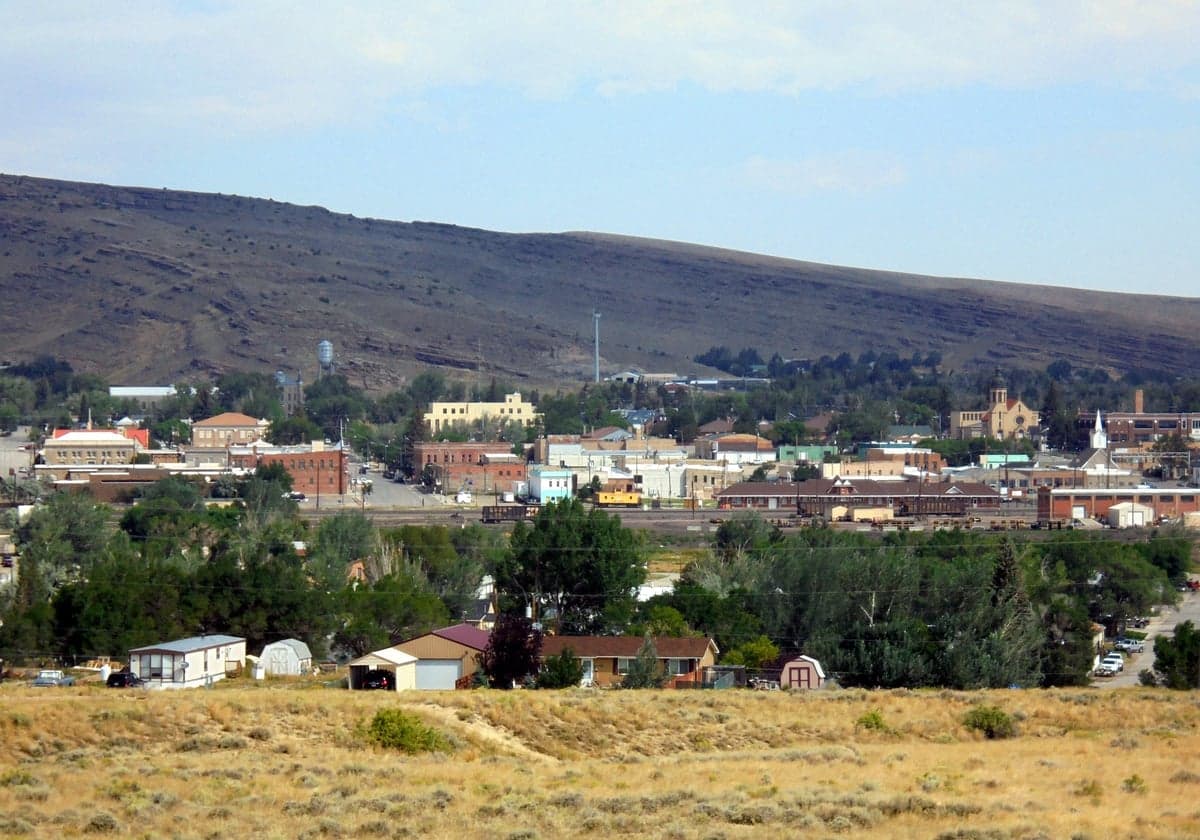
The people of Rawlins, Wyoming today number 8,217, forming a community that is predominantly white (69.5%) with a substantial and growing Hispanic population (24.1%). The city’s character is shaped by its history as a railroad and mining hub, resulting in a blue-collar, independent-minded population with a lower college attainment rate (17.9%) than the national average. Despite its small size, Rawlins has a distinct cultural identity rooted in the high plains of south-central Wyoming, where a sparse, self-reliant ethos prevails.
How the city was settled and grew
Rawlins was founded in 1868 as a Union Pacific Railroad division point, named after General John A. Rawlins. The original population was a mix of railroad workers, miners drawn to nearby copper and coal deposits, and cattle ranchers who utilized the open range. The first major wave of settlers were predominantly white Americans from the Midwest and East Coast, along with a significant number of Irish and Italian immigrants who built the railroad and established the Downtown Rawlins district near the depot. By the early 20th century, the discovery of coal in the Carbon Basin and the establishment of the Wyoming State Penitentiary (now the Wyoming Frontier Prison) in 1901 brought a second wave of laborers, many of whom settled in the East Side neighborhood, a working-class area of small homes and boarding houses. The Hispanic population began arriving in small numbers during the 1910s and 1920s, primarily as railroad section hands and agricultural laborers, forming a modest enclave in the West Rawlins area near the tracks. The city’s population peaked at around 9,500 in the 1950s, driven by the post-war boom in coal mining and the expansion of the prison complex.
Modern era (post-1965)
After the 1965 Hart-Cellar Act, Rawlins did not experience the large-scale immigration seen in coastal cities, but its Hispanic population grew steadily through chain migration from northern Mexico and the southwestern U.S. These families concentrated in the West Rawlins and South Side neighborhoods, where affordable housing and proximity to railroad and construction jobs provided a foothold. The 1970s and 1980s saw a domestic out-migration of younger white residents seeking opportunities in larger cities, while the Hispanic share of the population rose from roughly 5% in 1970 to over 24% today. The Black population (2.3%) and East/Southeast Asian population (0.2%) remain very small, largely tied to the prison workforce and a handful of professional families. The Indian subcontinent population (0.9%) is a recent addition, primarily consisting of professionals working at the local hospital and the state prison, with no distinct neighborhood concentration. The Rawlins Heights subdivision, developed in the 1990s on the city’s northern edge, attracted middle-class white and Hispanic families seeking newer homes, while the Downtown core has seen a slight decline in residential population as retail and services have consolidated.
The future
The population of Rawlins is projected to remain stable or decline slightly over the next decade, as the city’s economy—heavily reliant on the prison, the railroad, and energy extraction—faces headwinds from automation and shifting energy markets. The Hispanic population is expected to continue growing as a share of the total, driven by higher birth rates and continued migration for construction and service jobs, but this growth is likely to plateau as the region’s overall economic opportunities remain limited. The white population is aging and declining, with younger residents leaving for college and careers elsewhere. The city is not tribalizing into distinct ethnic enclaves; rather, the Hispanic and white populations are increasingly integrated in the South Side and Rawlins Heights neighborhoods, while the East Side remains predominantly white and older. The small Black, Asian, and Indian communities are likely to remain stable or shrink, as they lack the critical mass to sustain growth through natural increase.
Rawlins is becoming a more Hispanic-influenced community, but it remains a predominantly white, working-class town with a slow-growth trajectory. For someone moving in now, the city offers a low cost of living, a strong sense of local history, and a population that values self-sufficiency, but limited economic diversity and a declining youth population mean that long-term demographic vitality is uncertain.

* Values derived from national, state, county, city and local statistics and may differ in a specific area. Last updated: 2026-04-21T11:15:38.000Z
Narrative content on this page is AI-generated and may contain mistakes. Verify any details that matter before acting on them.
ReloMaps may earn a commission from affiliate links at no extra cost to you.

