Photo: Wikipedia
Demographics of Red Lodge, MT
Affluence Level in Red Lodge, MT
A middle-class area roughly in line with national averages across income, home values, education, and employment.
People of Red Lodge, MT
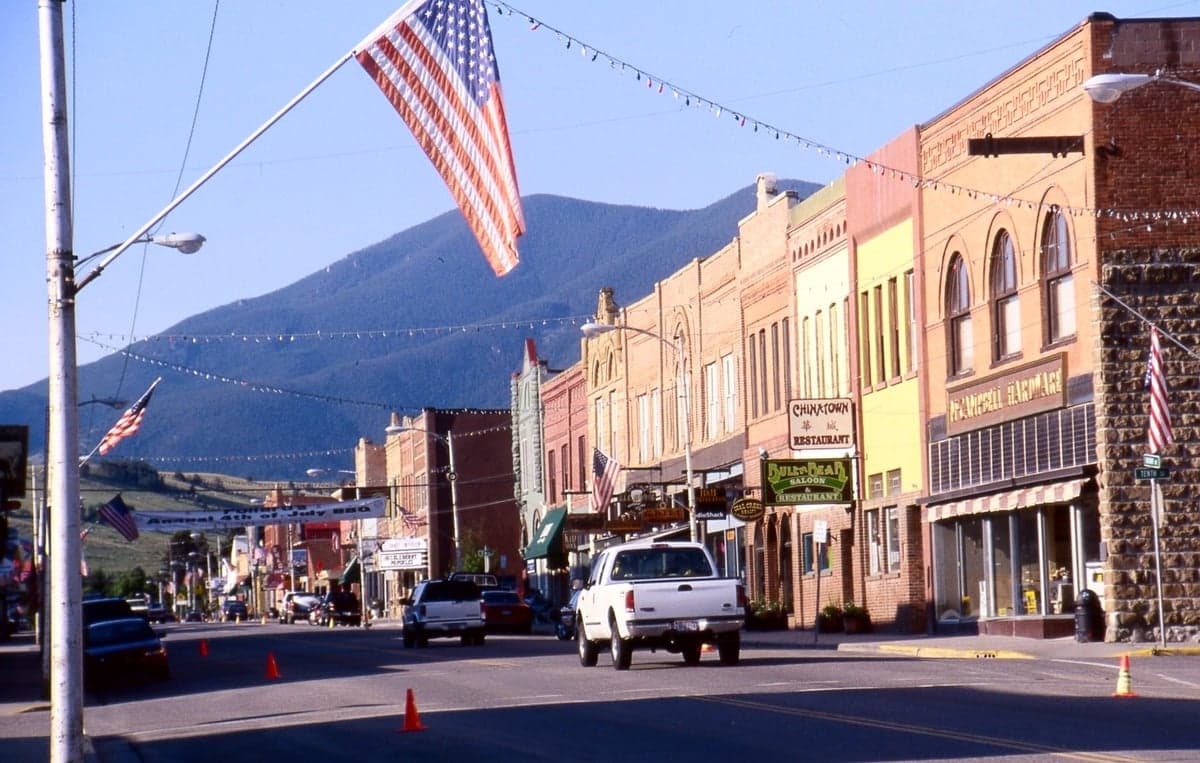
Red Lodge, Montana, is a small, predominantly white community of 2,399 residents where 90.6% of the population identifies as white alone. The city is characterized by a tight-knit, outdoors-oriented culture, a high college attainment rate of 44.7%, and a notably low foreign-born population of just 3.0%. Its identity is rooted in a working-class mining past, now layered with a growing tourism and recreation economy that draws new residents seeking mountain lifestyle and conservative values.
How the city was settled and grew
Red Lodge was founded in the 1880s as a coal mining camp, with the arrival of the Northern Pacific Railway in 1889 triggering the first major population wave. The original settlers were a mix of Anglo-American prospectors and European immigrants—primarily Finnish, Italian, Slavic, and Irish miners—who built the town's early infrastructure. These groups established distinct ethnic neighborhoods: Finnish families concentrated along Upper Broadway and the hillside above town, while Italian and Slavic miners settled in the West End near the original mine shafts. The town's population peaked at around 5,000 in the 1910s during the coal boom, but declined sharply after the mines closed in the 1930s and 1940s. The post-war era saw a slow stabilization as ranching and the newly created Beartooth Highway (1936) began shifting the economy toward tourism.
Modern era (post-1965)
After the 1965 Immigration and Nationality Act, Red Lodge experienced minimal international immigration. The foreign-born share today is just 3.0%, and the city's racial composition has remained overwhelmingly white. The most significant demographic shift since the 1970s has been domestic in-migration: retirees, second-home buyers, and remote workers from California, Colorado, and the Pacific Northwest. These newcomers have concentrated in newer subdivisions like Beartooth Meadows and Silver Run Estates on the town's southern and eastern edges, while the historic Downtown core has seen a wave of boutique shops and vacation rentals. The Hispanic population, at 3.2%, is small but visible, with families primarily working in hospitality and construction, and residing in the South Side area near the fairgrounds. East/Southeast Asian residents (2.0%) are a tiny but stable presence, often connected to seasonal hospitality or academic roles at nearby Montana State University in Bozeman. The Black population (1.5%) is similarly small and dispersed, with no concentrated neighborhood. Indian-subcontinent residents are statistically zero.
The future
Red Lodge is likely to remain a predominantly white, culturally conservative community over the next 10–20 years. The foreign-born population is not growing significantly, and the Hispanic and Asian shares are expected to remain in the low single digits. The primary driver of future growth will be continued domestic migration from out-of-state buyers seeking mountain recreation and lower taxes, which is already pushing home prices higher and creating tension between long-time locals and newcomers. The town is not tribalizing into distinct ethnic enclaves; rather, it is experiencing economic stratification, with wealthier retirees and remote workers buying into Beartooth Meadows and Silver Run Estates, while younger working families are priced into older neighborhoods like the West End and South Side. The population is projected to grow modestly, perhaps reaching 2,800–3,000 by 2040, but the character will remain that of a small, white, conservative mountain town with a tourism-driven economy.
For someone moving in now, Red Lodge offers a stable, safe, and politically conservative environment with strong community ties and outdoor amenities. The population is not diversifying rapidly, so newcomers should expect a culturally homogeneous setting. The main dynamic to watch is the ongoing tension between preservation of the town's working-class heritage and the pressures of amenity migration, which will continue to shape housing affordability and local politics.

* Values derived from national, state, county, city and local statistics and may differ in a specific area. Last updated: 2026-04-30T05:10:48.000Z
Narrative content on this page is AI-generated and may contain mistakes. Verify any details that matter before acting on them.
ReloMaps may earn a commission from affiliate links at no extra cost to you.

