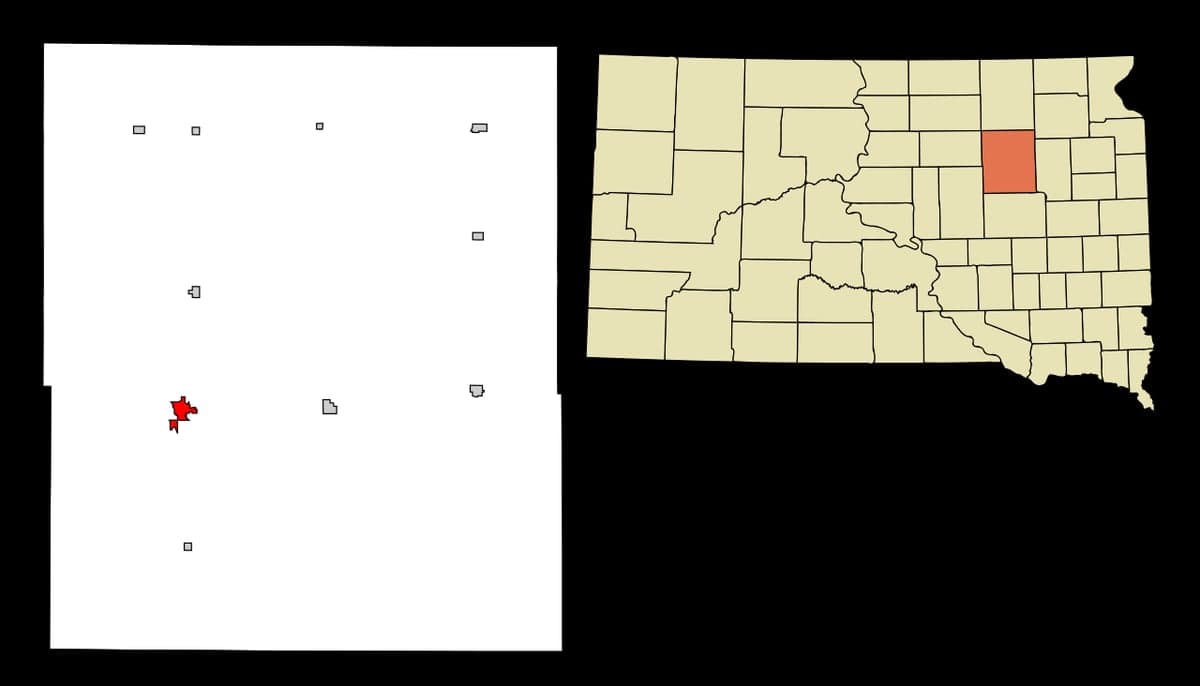
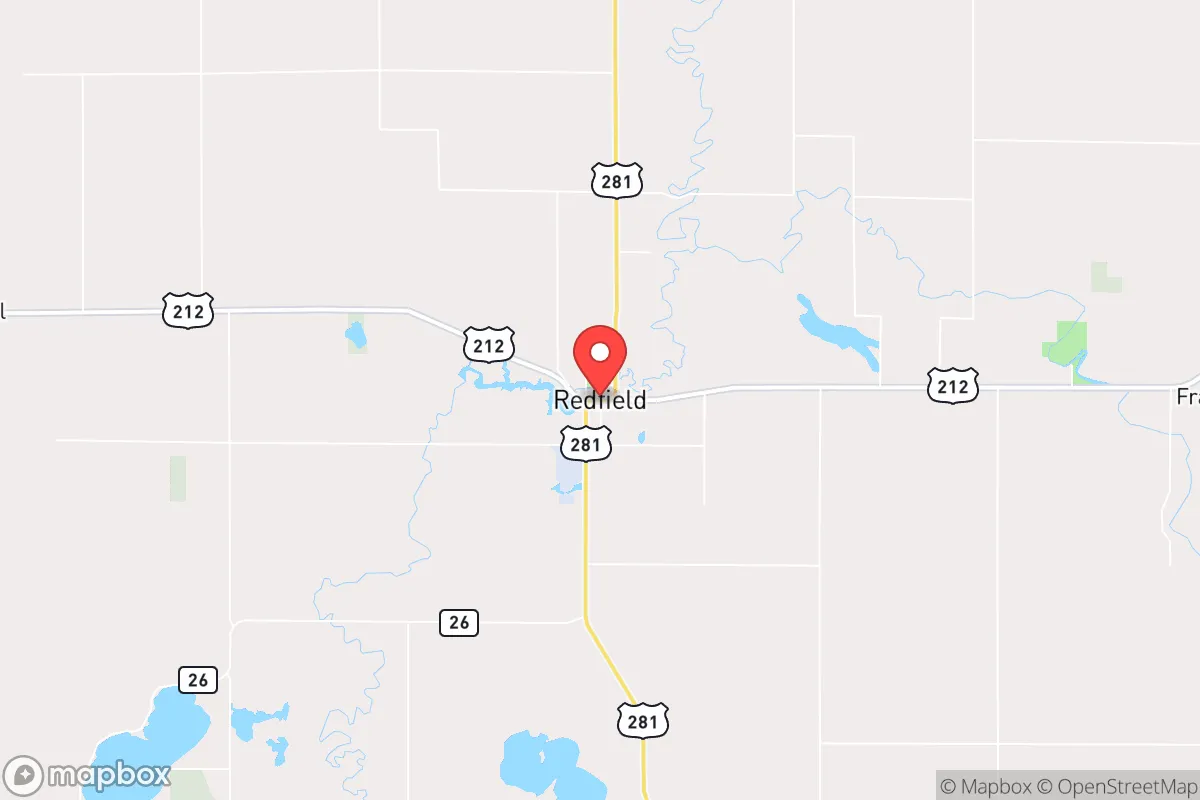
Photo: Wikipedia
Demographics of Redfield, SD
Affluence Level in Redfield, SD
A middle-class area roughly in line with national averages across income, home values, education, and employment.
People of Redfield, SD
The people of Redfield, South Dakota, today number 2,230, forming a predominantly white (92.2%) and native-born community with a small but notable Hispanic population (3.7%) and a foreign-born share of just 2.5%. The city’s identity is rooted in its agricultural and railroad heritage, with a density that feels small-town and family-oriented, where roughly 30% of adults hold a college degree. Distinctive markers include a strong sense of local pride centered on the Spink County Fair and a population that has remained remarkably stable in size and character over the past half-century.
How the city was settled and grew
Redfield was founded in 1880 as a railroad town on the Chicago, Milwaukee, St. Paul and Pacific line, drawing its first wave of settlers from the Upper Midwest—primarily German, Norwegian, and Swedish immigrants seeking farmland under the Homestead Act. The original plat centered on the Milwaukee Road depot, with the Old Town neighborhood (roughly bounded by 1st Street and 4th Avenue) developing as the commercial and residential core for these early homesteaders. By the 1890s, a second wave of German-Russian Mennonites arrived, drawn by cheap land and religious freedom; they settled in the South Side district, south of the railroad tracks, where many built modest frame houses and established the First Mennonite Church. The city’s growth peaked around 1910 with a population of 1,500, fueled by the expansion of the Redfield State Hospital and School (opened 190桔) and the arrival of the Chicago & North Western Railway. The Hospital Hill neighborhood, east of downtown, grew around the state institution, housing staff and their families in tidy bungalows. No significant land grants or colonial-era settlements preceded this railroad-era founding; Redfield is a genuine post-1880s prairie town.
Modern era (post-1965)
After the 1965 Immigration and Nationality Act, Redfield saw little direct impact from new immigration waves, as its economy—dominated by agriculture, the state hospital, and a few light manufacturers—did not attract the large-scale foreign-born populations seen in larger cities. The foreign-born share has hovered around 2.5% for decades, with most newcomers being domestic migrants from other parts of South Dakota or neighboring states. The West Side neighborhood, developed in the 1970s and 1980s along Highway 212, absorbed many of these in-movers, who built ranch-style homes on larger lots. The Hispanic population, now 3.7%, began growing slowly in the 1990s as a few families moved in to work at the turkey processing plant (Dakota Provisions) and in seasonal agriculture; they concentrated in the East End area near the industrial park, though no distinct ethnic enclave formed. The Black population remains negligible at 0.3%, and East/Southeast Asian and Indian-subcontinent populations are effectively zero. The city’s racial composition has remained overwhelmingly white, with the Hispanic share rising from roughly 1% in 1990 to its current level, a gradual shift driven by labor demand rather than chain migration.
The future
Redfield’s population is projected to remain stable or decline slightly over the next 10–20 years, as the city’s aging demographic (median age around 45) and limited job growth outside agriculture and healthcare constrain in-migration. The Hispanic community is likely to grow modestly, possibly reaching 5–6% by 2040, as younger families fill labor gaps in food processing and farming, but this growth will be gradual and assimilative rather than enclave-forming. The North Side neighborhood, where newer subdivisions have been built since 2000, may see the most new construction, attracting a mix of young families and retirees. The city is not tribalizing into distinct ethnic enclaves; rather, it is homogenizing further as the small non-white populations integrate into predominantly white neighborhoods. For a newcomer moving in now, Redfield offers a stable, slow-paced community where the population is unlikely to change dramatically in character, with a social fabric that remains deeply rooted in its agricultural and railroad past.
Bottom-line: Redfield is becoming a quieter, older version of itself—a place where demographic change is incremental and assimilation is the norm, not a source of tension. For someone moving in now, the city offers a predictable, family-oriented environment with a strong sense of local history, but little ethnic or cultural diversity beyond its small Hispanic community.

* Values derived from national, state, county, city and local statistics and may differ in a specific area. Last updated: 2026-04-19T06:54:07.000Z
Narrative content on this page is AI-generated and may contain mistakes. Verify any details that matter before acting on them.
ReloMaps may earn a commission from affiliate links at no extra cost to you.

