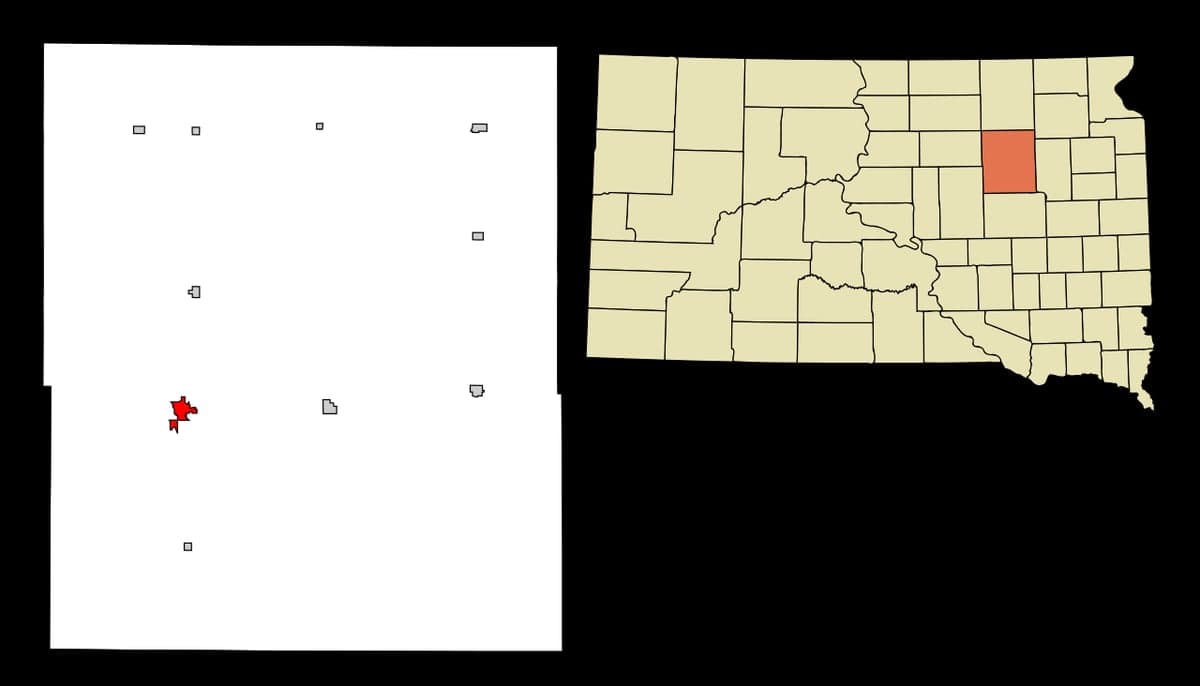
Photo: Wikipedia
Political ClimatePolitical Climate in Redfield, SD
District shown is the primary district for this city’s centroid. Cities may span multiple districts.
Inherited from parent state — no local data available.
Local Political AnalysisPolitical Analysis of Redfield, SD
Redfield, South Dakota, is about as reliably conservative as they come, with a Cook PVI of R+15 that tells you exactly where things stand politically. This isn't a purple area or a place where elections are nail-biters—it's a community where traditional values and limited government are the baseline, not the exception. Over the past decade, the political lean has only solidified, with local elections and county-level races consistently favoring candidates who prioritize personal responsibility, low taxes, and a hands-off approach from state and federal authorities. If you're looking for a place where the government stays out of your business and your neighbors share that sentiment, Redfield fits the bill.
How it compares
When you look at the surrounding towns, Redfield stands out as a conservative anchor in Spink County, but it's not alone. Head north to Aberdeen, and you'll find a slightly more moderate vibe, thanks to the university and a larger population that leans a bit more toward the center. Go south to Huron, and the politics are similar—solidly red, but with a bit more of a mixed bag in local races. The real contrast comes if you drive west to Pierre or east to Watertown; both are conservative, but Redfield feels more insulated from the progressive trends creeping into even small cities these days. The R+15 rating isn't just a number—it's a reflection of a community that hasn't been swayed by the coastal ideologies that seem to be seeping into other parts of the state. You won't find much talk of defunding the police or radical environmental policies here; instead, it's about keeping taxes low, protecting gun rights, and letting people live their lives without unnecessary interference.
What this means for residents
For the people who call Redfield home, this political climate translates into a daily life that feels free from the overreach you hear about in other parts of the country. Property taxes are manageable, zoning laws are minimal, and there's a general understanding that the government's job is to stay out of the way—not to micromanage how you run your farm, your business, or your household. You won't see mask mandates or lockdowns being enforced with a heavy hand here; the local leadership tends to trust residents to make their own decisions. That said, there's a growing concern among long-time residents about the direction of the state as a whole. With South Dakota's population growing and younger folks moving in from more progressive areas, there's a quiet worry that the next decade could bring more pressure for things like stricter environmental regulations or expanded government programs. For now, though, Redfield remains a place where personal freedoms are respected, and the political culture is one of "live and let live" as long as you're not asking for a handout or a new rule.
One thing that sets Redfield apart culturally is its strong sense of self-reliance. You won't find a lot of people looking to the government for solutions—they'd rather handle things themselves or through local churches and community groups. There's also a notable absence of the kind of partisan bickering that dominates national news; local politics here are more about practical issues like road maintenance and school funding than culture wars. But if you're paying attention, you can see the undercurrent of concern about where things are headed nationally. The feeling among many is that Redfield is a last bastion of common sense in a country that's losing its way, and they're determined to keep it that way. If you're thinking about moving here, just know that you'll be expected to pull your own weight and respect the unwritten rule that government overreach is the enemy—not a solution.

State Political ClimatePolitical Climate in South Dakota
State Political AnalysisPolitical Environment in the State
South Dakota is one of the most reliably conservative states in the nation, with a Republican trifecta that has held firm for decades and a statewide partisan lean of roughly +30 points in federal elections. The dominant coalition is a mix of rural traditionalists, libertarian-leaning ranchers, and a growing number of conservative transplants fleeing blue states, all united by a deep skepticism of federal overreach. Over the last 10-20 years, the state has shifted even further right, driven by rapid growth in the Black Hills region and a steady exodus of moderate Democrats from the legislature, leaving a political landscape where the real debate is between mainstream conservatives and the more populist, liberty-minded wing of the GOP.
Urban vs. rural divide
The political map breaks down along a clear urban-rural axis, but with a twist: South Dakota's "cities" are small by national standards and lean conservative themselves. Sioux Falls, the largest metro with about 200,000 people, is the state's economic engine and votes reliably Republican, though it has a small but vocal progressive minority centered around the university and healthcare sectors. Rapid City and the surrounding Pennington County area are even more conservative, driven by a strong military presence at Ellsworth Air Force Base and a libertarian ranching culture. The rural counties—Harding, Perkins, and Ziebach—are deep red, often voting 80%+ Republican. The only notable exception is Minnehaha County (Sioux Falls), which occasionally flips for a moderate Democrat in local races, but even there, the statewide GOP ticket wins comfortably. The Black Hills region, including Deadwood and Spearfish, is a mix of tourism-driven libertarianism and traditional conservatism, with a growing number of out-of-state retirees who moved specifically for the low taxes and gun-friendly laws.
Policy environment
South Dakota's policy environment is a textbook example of small-government conservatism. There is no state income tax, no corporate income tax, and no personal property tax on vehicles or business inventory. The sales tax is 4.5%, with local options pushing it to 6.5% in some cities, but the overall tax burden is among the lowest in the nation. The regulatory posture is aggressively pro-business: no state-level minimum wage above the federal $7.25, no paid family leave mandates, and a right-to-work law that keeps unions weak. Education policy is a mixed bag—the state has a robust school choice program through the "South Dakota Opportunity Scholarship" and a new Education Savings Account (ESA) program passed in 2024, but public school funding remains a perennial issue, with teacher salaries near the bottom nationally. Healthcare is dominated by Sanford Health and Avera, two large nonprofit systems, and the state has not expanded Medicaid under the ACA, a decision that has kept premiums higher but avoided the federal strings attached. Election laws are among the most secure in the country: voter ID is required, no-excuse absentee voting was repealed in 2023, and same-day registration is not allowed. The state also has a constitutional carry law for firearms, no permit needed for concealed carry, and a strong preemption statute that prevents local governments from enacting their own gun restrictions.
Trajectory & freedom
South Dakota is on a trajectory of expanding personal freedom, particularly in the areas of gun rights, parental rights, and medical autonomy. In 2023, Governor Kristi Noem signed a law banning gender transition procedures for minors, making South Dakota one of the first states to do so. The same year, the legislature passed a "Parents' Bill of Rights" that requires schools to notify parents of any curriculum related to sexuality or gender identity and prohibits schools from hiding a child's gender identity from parents. On the gun front, the state already had constitutional carry, but in 2024 it passed a "Second Amendment Sanctuary" resolution that prohibits state resources from being used to enforce any future federal gun bans. Property rights were strengthened with the passage of a "takings" law that requires the state to compensate landowners for any regulatory reduction in property value. The only area where freedom has arguably contracted is in the realm of COVID-era mandates—the state never imposed a mask mandate or lockdown, but some local school boards briefly required masks, leading to a backlash that resulted in a 2022 law banning mask mandates in schools. Overall, the trend is toward fewer restrictions, not more.
Civil unrest & political movements
South Dakota has seen remarkably little civil unrest compared to other states, but there have been notable flashpoints. The Dakota Access Pipeline protests in 2016-2017 were centered in North Dakota, but spillover activism occurred in Sioux Falls and Rapid City, with small but vocal groups of environmental activists and Native American rights advocates. More recently, the state has been a battleground for election integrity debates—in 2022, a ballot measure to legalize recreational marijuana was narrowly defeated after a contentious campaign, and there have been ongoing disputes over the security of mail-in voting. The South Dakota Freedom Caucus, a group of hardline conservatives in the legislature, has pushed for further restrictions on abortion (the state already has a near-total ban) and for a constitutional amendment to require a supermajority for any tax increase. Immigration politics are relatively quiet, as the state has a small foreign-born population and no sanctuary policies. The most visible political movement is the liberty-oriented wing of the GOP, which has successfully primaried moderate Republicans in recent cycles, particularly in the Rapid City area. A new resident would notice a general lack of street-level activism—no large protests, no encampments, and a strong cultural norm of minding your own business.
Projection
Over the next 5-10 years, South Dakota is likely to become even more conservative, driven by two demographic trends. First, the state is experiencing steady in-migration from blue states like California, Illinois, and Minnesota, with people specifically seeking lower taxes, less regulation, and a more traditional culture. These newcomers tend to be even more conservative than the native population, as they are self-selecting for freedom. Second, the Sioux Falls metro is growing rapidly, but it is not becoming more liberal—the new arrivals are largely families and remote workers who value the state's policies. The rural counties will continue to shrink, but their political weight will remain outsized due to the state's legislative apportionment. The biggest wild card is the Native American vote, which is heavily Democratic but has low turnout; any efforts to increase turnout on the reservations could shift some local races, but not the statewide balance. Expect further expansions of school choice, a possible elimination of the state property tax (currently being debated), and continued resistance to federal overreach on everything from environmental regulations to gun control. The state is on track to become a model of what a truly free society looks like in the 21st century.
For a new resident, the bottom line is this: South Dakota offers a political environment that is stable, predictable, and aligned with conservative values. You will not find the cultural battles or policy whiplash common in swing states. The trade-off is that the state is small, with limited urban amenities and a harsh winter climate, but if your priority is personal freedom, low taxes, and a government that stays out of your life, this is one of the best places in the country to put down roots. Just be prepared for a slower pace of life and a community where everyone knows your business—but respects your right to live it your way.
* Values derived from national, state, county, city and local statistics and may differ in a specific area. Last updated: 2026-04-19T06:54:07.000Z
Narrative content on this page is AI-generated and may contain mistakes. Verify any details that matter before acting on them.
ReloMaps may earn a commission from affiliate links at no extra cost to you.

