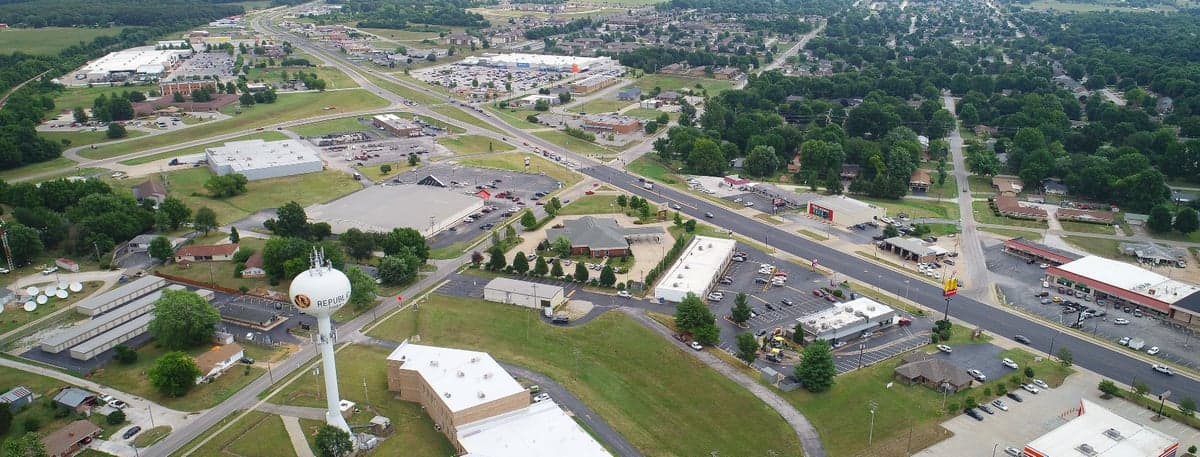
Photo: Wikipedia
Demographics of Republic, MO
Affluence Level in Republic, MO
A middle-class area roughly in line with national averages across income, home values, education, and employment.
People of Republic, MO
The people of Republic, Missouri, today form a predominantly white, family-oriented community of 19,233 residents, characterized by a strong sense of local identity and a notably low foreign-born population of just 1.5%. With 87.9% of residents identifying as white and 5.2% as Hispanic, the city is less diverse than the national average, yet it serves as a stable, growing bedroom community for Springfield. The population is marked by a moderate educational attainment level, with 27.5% holding a college degree, and a demographic profile that reflects decades of steady domestic in-migration rather than international immigration.
How the city was settled and grew
Republic was founded in 1871 as a railroad town along the Atlantic and Pacific Railroad line, drawing its first wave of settlers primarily from the rural Ozarks and the Upper South. These early residents were largely of English, Scots-Irish, and German ancestry, attracted by the promise of rail access for shipping timber, grain, and livestock. The original town site, centered around what is now the Republic Historic District along Main Street, was built by these families, who constructed simple frame houses and commercial buildings that still anchor the downtown. A second wave arrived in the early 20th century, driven by the expansion of fruit orchards and dairy farming in the surrounding countryside. These agricultural families settled in what became the North Side neighborhood, near the railroad depot, and established the town's early churches and schools. The population remained small—under 1,000 residents—through the 1940s, as Republic functioned primarily as a farm service center.
Modern era (post-1965)
The post-1965 era transformed Republic from a quiet farm town into a fast-growing suburban satellite of Springfield. The 1965 Hart-Cellar Act had minimal direct effect here—Republic's foreign-born population remains negligible at 1.5%—but the domestic migration patterns it indirectly spurred reshaped the city. The major driver was the expansion of U.S. Highway 60 and Interstate 44, which made Republic a convenient commuter option for Springfield's growing manufacturing and healthcare workforce. From the 1970s through the 1990s, families from Springfield and other parts of southwest Missouri moved into new subdivisions like Woodland Hills and Fox Hollow, attracted by lower taxes, larger lots, and a perceived safer environment. These subdivisions absorbed the bulk of the city's growth, which saw the population jump from roughly 2,000 in 1970 to over 10,000 by 2000. The Hispanic population, now 5.2%, began to grow in the 1990s and 2000s, largely through domestic relocation from other parts of Missouri and the Southwest, settling primarily in the Southwest Republic area near the high school. The Black population remains very small at 1.1%, and East/Southeast Asian residents account for another 1.1%, with no measurable Indian subcontinent population. These groups are dispersed across newer subdivisions rather than forming distinct ethnic enclaves.
The future
Republic's population trajectory points toward continued, moderate growth driven by domestic in-migration from within Missouri and neighboring states. The city is likely to remain overwhelmingly white and native-born, with the Hispanic share potentially rising to 8-10% over the next decade through continued domestic relocation and higher birth rates. The foreign-born share will likely stay below 3%, as the city lacks the industrial or service-sector magnets that attract international immigration. The population is not tribalizing into distinct ethnic enclaves; instead, it is homogenizing into a broad, family-oriented suburban identity. Newer developments like Hickory Hills and Prairie View Estates are attracting younger families from Springfield seeking affordable housing and good schools, while older neighborhoods like the Republic Historic District are seeing gradual reinvestment from empty-nesters and local professionals. The college-educated share, currently 27.5%, may rise slowly as remote work allows more professionals to choose Republic over Springfield, but the city will likely remain a predominantly blue-collar and middle-management bedroom community.
For someone moving in now, Republic is becoming a stable, culturally conservative suburb where the population is growing but not diversifying rapidly. The city offers a predictable, family-centric environment with low crime and strong schools, but little ethnic or cultural variety. New residents should expect a community that values self-reliance, local churches, and high school sports, and where the demographic story is one of steady, domestic-driven expansion rather than global influx.

* Values derived from national, state, county, city and local statistics and may differ in a specific area. Last updated: 2026-04-30T04:10:49.000Z
Narrative content on this page is AI-generated and may contain mistakes. Verify any details that matter before acting on them.
ReloMaps may earn a commission from affiliate links at no extra cost to you.

