Photo: Wikipedia
Demographics of Riverdale Park, MD
Affluence Level in Riverdale Park, MD
A middle-class area roughly in line with national averages across income, home values, education, and employment.
People of Riverdale Park, MD
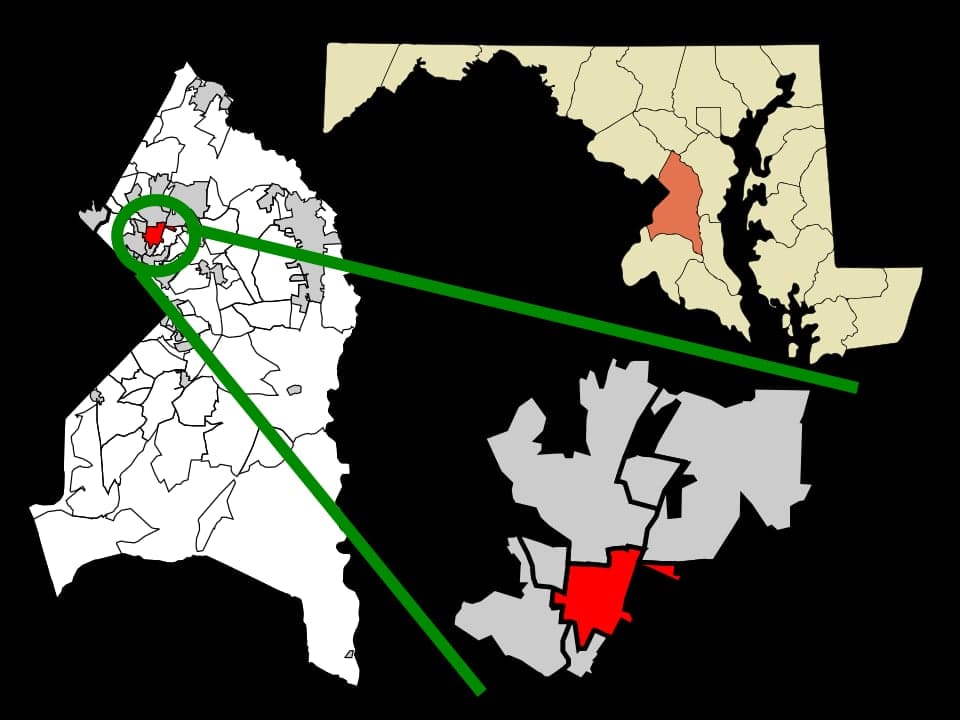
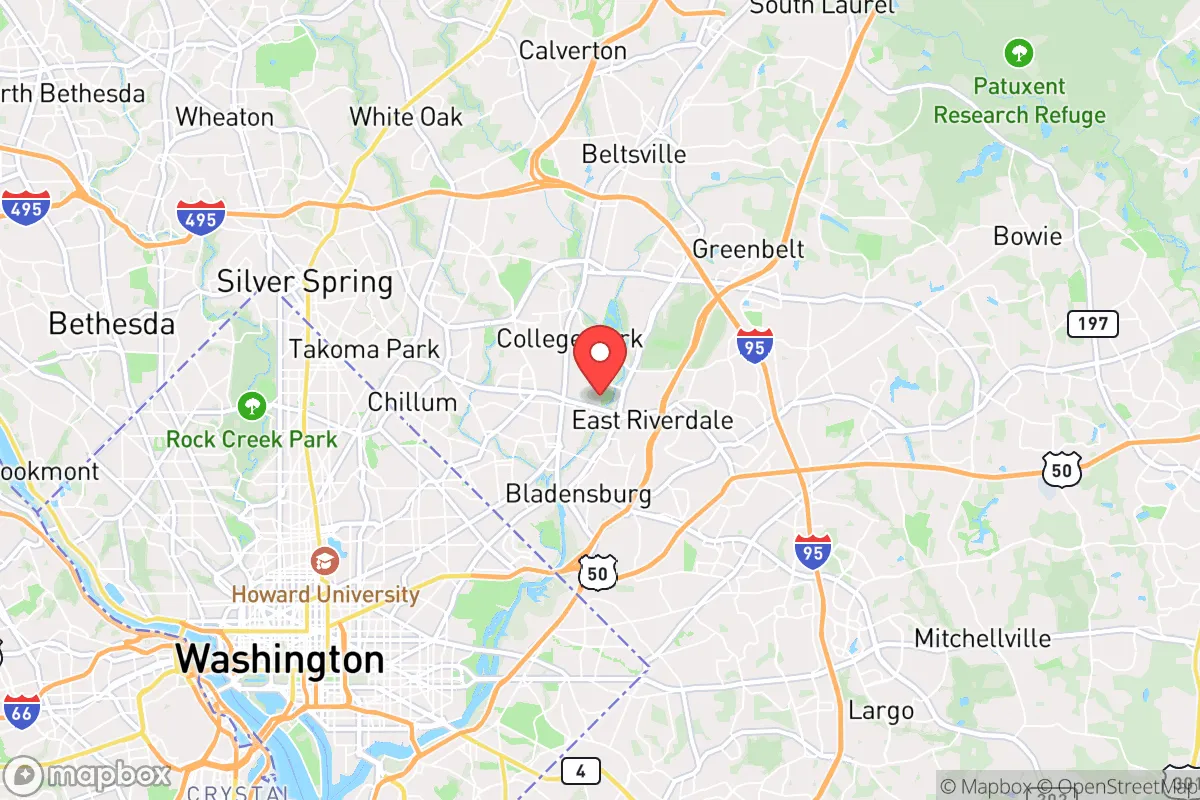
Today, Riverdale Park, Maryland is a densely settled, majority-Hispanic inner suburb of Washington, D.C., home to 7,249 residents. The city is defined by its high foreign-born population (27.3%) and a demographic profile that is 52.0% Hispanic, 21.9% Black, and 17.4% White, with small but notable East/Southeast Asian (2.6%) and Indian-subcontinent (0.6%) communities. Its character is that of a working-class, family-oriented enclave where Spanish is widely spoken and where immigrant roots remain close to the surface, even as the city sits just two miles from the U.S. Capitol.
How the city was settled and grew
Riverdale Park was not a colonial-era settlement. The area was originally part of a 17th-century land grant called "Beauvoir," but the city itself was platted in 1889 as a streetcar suburb along the Baltimore & Ohio Railroad. The earliest residents were middle-class white commuters drawn by the promise of country living within easy reach of Washington. The historic Riverdale Park Historic District, centered on the original grid of streets near the old B&O station, still contains the late-Victorian and early-20th-century homes these families built. A second wave arrived during the 1930s and 1940s, when the federal government expanded and workers sought affordable housing near the District line. This period saw the development of Kenilworth, a neighborhood of modest single-family homes just east of the town center, which absorbed many of these new government employees and their families.
Modern era (post-1965)
The 1965 Hart-Cellar Act fundamentally reshaped Riverdale Park. The city's proximity to low-skill employment in the District and its stock of aging, affordable rental housing drew successive waves of immigrants. The first major group was Central American, particularly Salvadoran and Guatemalan, who began arriving in the 1970s and 1980s fleeing civil wars. They concentrated in the Riverdale Gardens apartment complex and the surrounding blocks near the intersection of Kenilworth Avenue and Riverdale Road. By the 1990s, Mexican immigrants had also established a significant presence, settling in the West Riverdale area, a grid of small bungalows and duplexes west of the original historic district. At the same time, domestic Black families—many from Washington's historically Black neighborhoods like Shaw and Anacostia—moved into East Riverdale, a section of the city east of the railroad tracks, drawn by lower home prices and better schools. The result is a city where neighborhoods are not strictly segregated but do show clear ethnic clustering: the historic district remains predominantly White and older; Riverdale Gardens and West Riverdale are heavily Hispanic; and East Riverdale is majority Black. The Asian and Indian populations are too small to form distinct enclaves and are scattered across the city.
The future
Riverdale Park's population is likely to continue its Hispanic-majority trajectory. The Hispanic share has grown steadily since 2000, while the White share has fallen from over 40% to 17.4% today. The foreign-born rate of 27.3% suggests ongoing immigration, though the city is also seeing a second-generation effect: U.S.-born children of immigrants now make up a growing share of the school-age population. The Black population has been relatively stable since 2010, but out-migration of middle-class Black families to farther suburbs like Bowie and Waldorf is a slow countercurrent. The city is not homogenizing into a single ethnic bloc; rather, it is tribalizing into distinct, stable enclaves. The historic district is likely to remain a small, older White pocket, while the Hispanic neighborhoods will grow denser and more established. Gentrification pressure from nearby Hyattsville and College Park is real but muted, as Riverdale Park lacks a Metro station and its housing stock is dominated by older rentals. For a newcomer, the city offers a genuinely multicultural, working-class environment where Spanish is a practical second language and where the pace of change is gradual rather than disruptive.
Riverdale Park is becoming a stable, majority-Hispanic inner suburb with distinct ethnic neighborhoods, a high foreign-born share, and a family-oriented character. For a conservative-leaning mover, the city offers affordable housing, proximity to D.C., and a community where traditional family structures are common, but it also requires comfort with a dense, diverse, and heavily immigrant environment where English is not always the default language.

* Values derived from national, state, county, city and local statistics and may differ in a specific area. Last updated: 2026-04-22T02:38:24.000Z
Narrative content on this page is AI-generated and may contain mistakes. Verify any details that matter before acting on them.
ReloMaps may earn a commission from affiliate links at no extra cost to you.

