Photo: Wikipedia
Demographics of Riverton, WY
Affluence Level in Riverton, WY
A middle-class area roughly in line with national averages across income, home values, education, and employment.
People of Riverton, WY
The people of Riverton, Wyoming today number 10,803, forming a predominantly white (72.9%) community with a significant Hispanic minority (11.7%) and very small East/Southeast Asian (1.3%) and Black (0.8%) populations. The city is notably less diverse than the national average, with a foreign-born share of just 0.8% and a college attainment rate of 22.3%—below the state median. Riverton’s identity is rooted in its role as a regional service hub for central Wyoming’s agricultural and energy sectors, with a population that is older, more native-born, and more politically conservative than the U.S. as a whole.
How the city was settled and grew
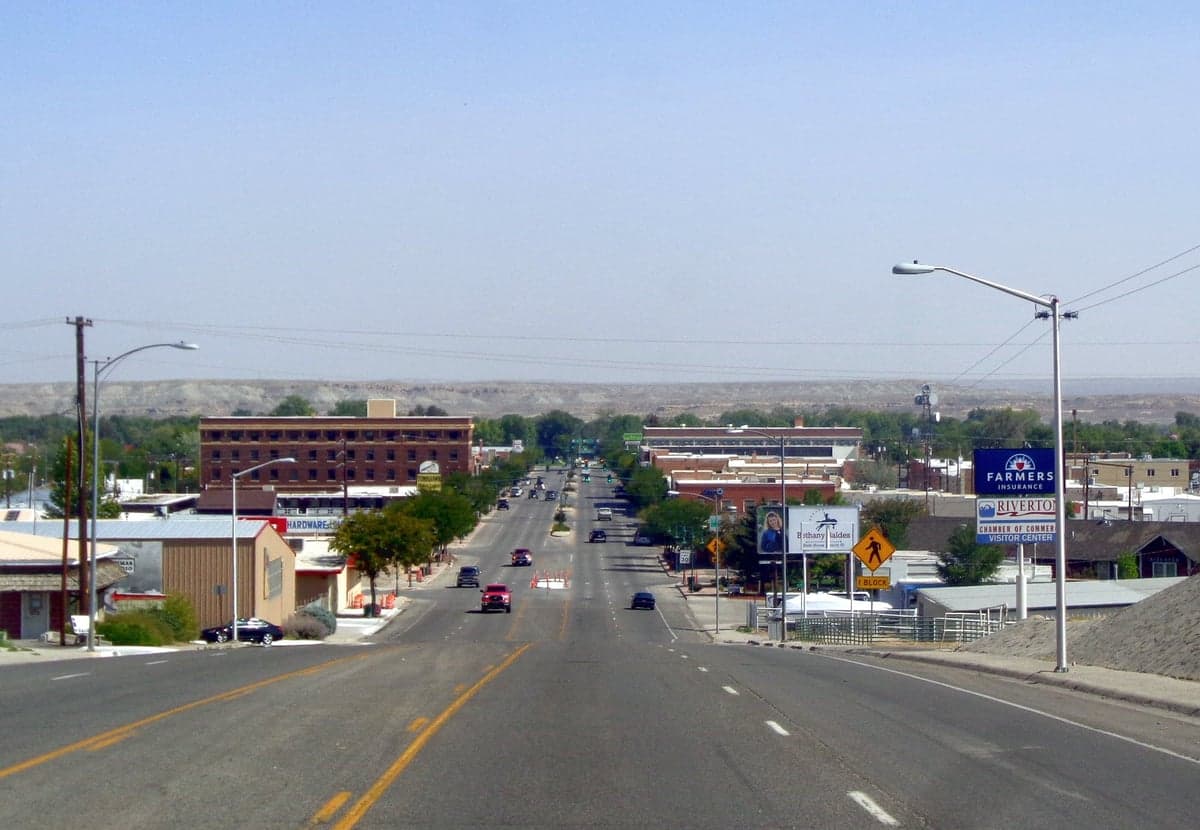
Riverton was founded in 1906 as a planned railroad town on the Wind River Indian Reservation, following a federal land cession that opened the area to non-Native settlement. The original population was overwhelmingly white, drawn by the promise of irrigated farming under the U.S. Reclamation Service’s Riverton Project, which diverted water from the Wind River. Early settlers—mostly homesteaders from the Midwest and Great Plains—built the core of the city around Main Street and the railroad depot, establishing a downtown of brick storefronts and grain elevators. A second wave arrived during the 1920s oil boom, when workers from Texas and Oklahoma settled in the West Riverton area, near the refineries and rail yards. The city’s growth stalled during the Dust Bowl and Great Depression, but a third wave of veterans and their families moved in after World War II, filling new subdivisions like Sunset Hills and North Park with modest ranch homes. By 1960, Riverton’s population had reached roughly 6,000, and the city was nearly entirely white, with a small number of Native American residents living in the adjacent reservation communities.
Modern era (post-1965)
After the 1965 Immigration and Nationality Act, Riverton saw almost no new immigration from outside the United States. The foreign-born share has remained below 1% for decades, and the city’s demographic changes have come almost entirely from domestic migration and natural increase. The most notable shift has been the growth of the Hispanic population, which rose from under 2% in 1990 to 11.7% today. This wave was driven by Mexican-American families moving from the Southwest for work in agriculture, construction, and the oil and gas fields. These households concentrated in the South Side neighborhood, south of the railroad tracks, and in the East Riverton area near the fairgrounds. Meanwhile, the white population has aged in place, with many younger white residents leaving for college or jobs in larger cities like Casper or Denver. The East/Southeast Asian community (1.3%) is small and largely composed of medical professionals and their families, many of whom live in the College Heights district near Central Wyoming College. The Black population (0.8%) is tiny and dispersed, with no distinct neighborhood concentration. The Indian subcontinent population is effectively zero.
The future
Riverton’s population is projected to remain flat or decline slightly over the next decade, as out-migration of young adults offsets any natural increase. The Hispanic share is likely to continue rising slowly, driven by higher birth rates and continued domestic migration from the Southwest, but the city will remain overwhelmingly white and native-born. There is no sign of the city tribalizing into distinct ethnic enclaves; instead, Hispanic families are gradually integrating into previously white neighborhoods like Sunset Hills and North Park, while the South Side remains the most diverse pocket. The East/Southeast Asian and Black populations are expected to stay very small, as Riverton lacks the economic pull or cultural infrastructure to attract significant numbers of new immigrants. The city’s low college attainment rate and limited job growth in white-collar sectors suggest it will continue to be a working-class, family-oriented community with a conservative political character.
For someone moving in now, Riverton offers a stable, low-diversity environment where the population is aging and slowly becoming more Hispanic. The city is not a destination for newcomers from abroad, and its future demographic trajectory points toward gradual homogenization rather than rapid diversification. A new resident should expect a community where most people have deep local roots, where change comes slowly, and where the social fabric remains shaped by the agricultural and energy economies that built the town a century ago.

* Values derived from national, state, county, city and local statistics and may differ in a specific area. Last updated: 2026-04-21T11:22:13.000Z
Narrative content on this page is AI-generated and may contain mistakes. Verify any details that matter before acting on them.
ReloMaps may earn a commission from affiliate links at no extra cost to you.

