 Popular
Photo: Wikipedia
Demographics of Rochester, NY
Affluence Level in Rochester, NY
A below-average socioeconomic profile. Incomes, home values, and educational attainment trail the U.S., with higher poverty and unemployment.
People of Rochester, NY
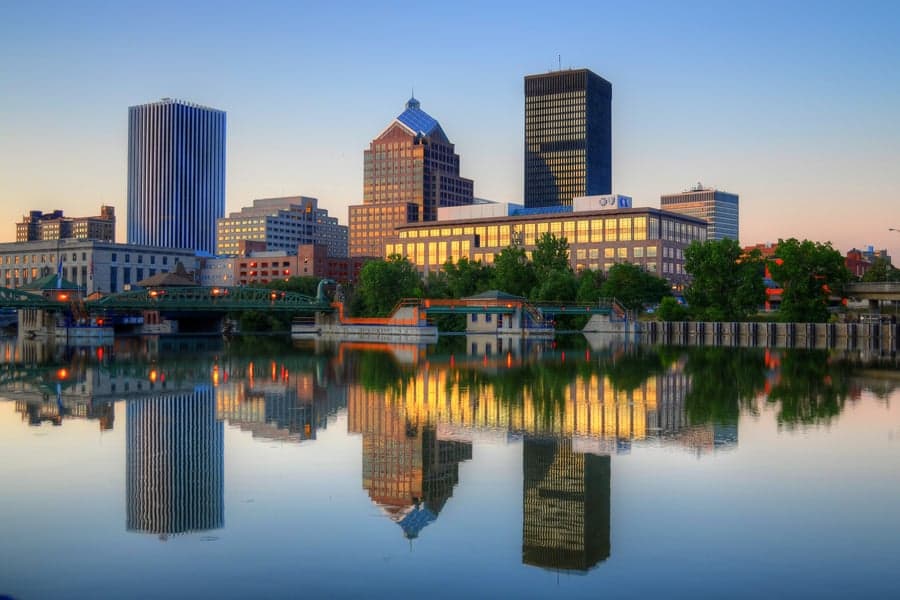
The people of Rochester, NY today number roughly 209,720, making it a mid-sized Great Lakes city with a notably diverse and historically layered population. The city is characterized by a near-even split between Black (35.7%) and White (36.0%) residents, a substantial Hispanic community (19.9%), and smaller but growing East/Southeast Asian (2.1%) and Indian-subcontinent (1.0%) populations. With a foreign-born share of just 4.0% and a college-educated rate of 29.9%, Rochester’s identity is rooted in its industrial past and the distinct ethnic enclaves that wave after wave of migration built — from German and Italian wards to Puerto Rican and Black neighborhoods shaped by the Great Migration and later suburban flight.
How the city was settled and grew
Rochester’s population history begins with the Erie Canal, completed in 1825, which turned a small flour-milling settlement into a boomtown. The canal drew waves of German and Irish immigrants in the mid-1800s, who settled in working-class neighborhoods like the Lyell-Otis area and the Plymouth-Exchange district, building the city’s early infrastructure. By the late 19th century, Italian and Polish immigrants arrived for jobs in the burgeoning garment and shoe industries, clustering in the North Clinton Avenue corridor and the Joseph Avenue area. The city’s industrial peak — driven by Kodak, Xerox, and Bausch & Lomb — attracted a second major wave: African Americans from the South during the Great Migration (roughly 1915–1970). They settled primarily in the Seventh Ward and the Marketview Heights area, building a vibrant Black middle class around the Clinton Avenue commercial strip. By 1950, Rochester’s population peaked at 332,488, with a heavily White, ethnic-European character and a growing Black minority.
Modern era (post-1965)
The post-1965 era reshaped Rochester’s population dramatically. The 1964 Rochester race riot, sparked by police brutality and economic exclusion, accelerated White flight to suburbs like Brighton, Pittsford, and Greece. Between 1970 and 2020, the city lost roughly 40% of its population. The Hispanic population grew rapidly from the 1970s onward, driven by Puerto Rican migration and later arrivals from the Dominican Republic and Central America. They concentrated in the Northeast quadrant, particularly around North Clinton Avenue and the Upper Falls Boulevard corridor, where bodegas and Spanish-language churches now anchor daily life. The Black population expanded its footprint into formerly White ethnic neighborhoods like Edgerton and Beechwood as older European-descended residents aged out or left. The East/Southeast Asian community (2.1%) is smaller and more dispersed, with a notable cluster of Vietnamese and Burmese refugees in the Rochester International District near the airport. The Indian-subcontinent population (1.0%) is largely professional, drawn by jobs at the University of Rochester and Rochester Institute of Technology, and tends to settle in the South Wedge and Park Avenue areas rather than forming a single ethnic enclave.
The future
Rochester’s population is projected to remain stable or decline slightly over the next decade, with the city’s 209,720 residents representing a slow bleed to suburbs and Sun Belt states. The Hispanic share (19.9%) is the fastest-growing segment, driven by both births and continued migration, and is expected to approach 25% by 2035, with the Northeast neighborhoods becoming increasingly Latino-dominant. The Black population (35.7%) is plateauing, as younger Black families often leave for Monroe County suburbs like Henrietta or Irondequoit. The White population (36.0%) continues to age in place, with many older residents in Browncroft and Maplewood neighborhoods, while younger Whites are drawn to the South Wedge and Park Avenue for walkable urbanism. The East/Southeast Asian and Indian-subcontinent communities are small but growing slowly, primarily through professional immigration tied to the region’s tech and medical sectors. The city is not homogenizing; rather, it is tribalizing into distinct enclaves — Hispanic northeast, Black central and northwest, White and mixed-race southeast — with limited cross-neighborhood mixing.
For someone moving to Rochester now, the city offers a deeply affordable, historically rich urban environment where neighborhood choice largely determines daily experience. The population is stable but aging, with growth concentrated in the Hispanic community and professional immigrants. The city’s future is one of modest diversity, persistent poverty in some wards, and a slow rebalancing as older White residents are replaced by younger, more diverse arrivals. It is not a boomtown, but a place where a newcomer can find a defined community — whether in the Latino corridors of North Clinton, the historic Black wards of the Seventh, or the revitalizing South Wedge — and build a life at a fraction of the cost of larger metros.

* Values derived from national, state, county, city and local statistics and may differ in a specific area. Last updated: 2026-05-01T23:58:20.000Z
Narrative content on this page is AI-generated and may contain mistakes. Verify any details that matter before acting on them.
ReloMaps may earn a commission from affiliate links at no extra cost to you.

