 Popular
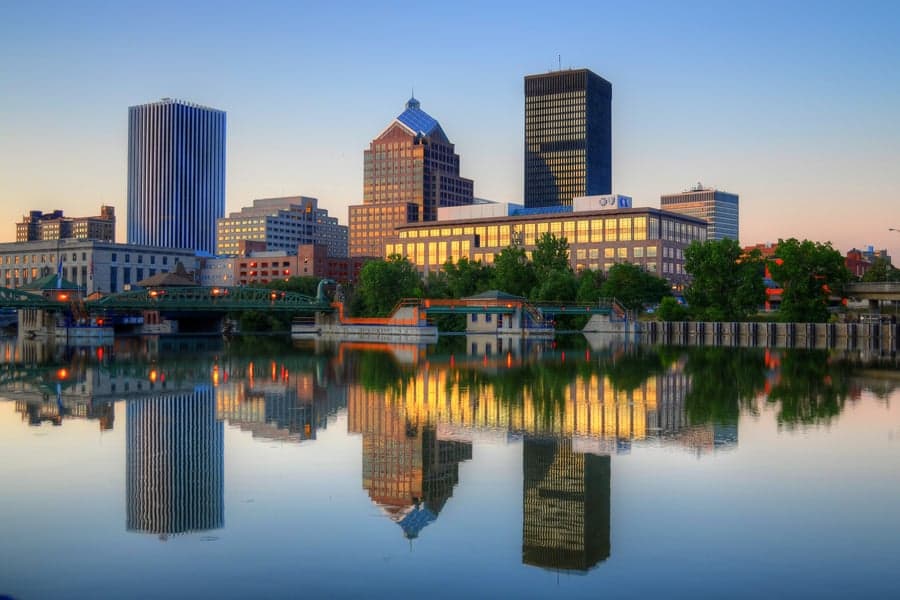
Photo: Wikipedia
Personal Sovereignty in Rochester, NY
Moderate friction. Expect trade-offs in some aspect of personal liberty and independence.
What does Personal Sovereignty tell us?
Personal Sovereignty measures your capacity for self-reliance and independence with minimal government friction. Higher scores mean fewer barriers between you and the way you want to live... but it assumes you have the space you need and good neighbors.
What does this tell us?
Personal Sovereignty measures your capacity for self-reliance and independence with minimal government friction. Higher scores mean fewer barriers between you and the way you want to live... but it assumes you have the space you need and good neighbors.
State Policy
Energy independence: Importer (12% of energy produced in-state)
Personal Liberty
Homesteading

Personal Liberty Analysis
For the strategic-minded individual or family evaluating Rochester, New York, as a relocation destination from a personal sovereignty standpoint, the picture is complex and demands careful scrutiny. While the region offers tangible advantages in terms of affordable land and access to fresh water—critical resources for any prepper or survivalist—it sits within a state government that has aggressively expanded its reach into nearly every facet of personal autonomy. The overarching reality is that New York State’s regulatory and fiscal environment imposes significant constraints on self-reliance, gun rights, and parental freedom, meaning that any move here requires a clear-eyed acceptance of these trade-offs. For those who prioritize maximum personal latitude above all else, Rochester presents a mixed bag: a relatively low-cost, resource-rich base of operations operating under a high-cost, high-control state apparatus.
Tax burden and regulatory posture in Monroe County
New York State’s tax burden is among the highest in the nation, and Rochester residents feel this acutely. The combined state and local income tax rates can push effective rates well above 8%, and property taxes in Monroe County are notoriously steep—often exceeding 3% of a home’s assessed value annually. This creates a persistent drain on disposable income that could otherwise fund personal preparedness, land purchases, or off-grid investments. The regulatory posture is equally dense: from strict building codes to complex environmental regulations governing everything from septic systems to wood-burning stoves, the state’s bureaucracy adds layers of cost and delay to any self-reliant project. For the homesteader or prepper, this means that even simple improvements—like adding a rainwater catchment system or a root cellar—may require permits and inspections that a more free-market state would not demand. The cumulative effect is a system that subtly but persistently discourages independent action, favoring instead a reliance on centralized utilities and government services.
Self-defense realities and New York gun law specifics
For anyone serious about the right to keep and bear arms, New York is one of the most restrictive states in the country, and Rochester is no exception. The state’s Concealed Carry Improvement Act (CCIA), passed in 2022, requires a “proper cause” showing for a concealed carry permit—a standard that, while technically shall-issue, still involves extensive background checks, character references, and a 16-hour training course. The law also bans the possession of firearms in a long list of “sensitive locations,” including public parks, libraries, and any private property where the owner hasn’t explicitly posted a sign allowing carry. This effectively criminalizes the routine carrying of a defensive firearm in many everyday settings. Furthermore, New York’s SAFE Act of 2013 restricts magazine capacities to 10 rounds and mandates a registry for certain semi-automatic rifles. For the survivalist, these laws mean that building a robust personal armory is not only expensive but legally fraught; a single misstep—like forgetting to renew a permit or carrying into a restricted zone—can result in felony charges. The practical takeaway: if self-defense is a non-negotiable priority, Rochester’s legal landscape is a significant liability, and one must be prepared to navigate a minefield of compliance.
Self-reliance and homesteading viability in the greater Rochester area
On the positive side, the land around Rochester offers genuine potential for self-sufficiency. Within a 30-minute drive of the city center, one can find rural lots of 1 to 5 acres at prices that are a fraction of those in the downstate suburbs or the West Coast. Zoning in towns like Mendon, Rush, or Wheatland is generally permissive toward small-scale agriculture, including keeping chickens, goats, or even a single cow, provided you meet setback requirements. The region’s fertile soil and reliable rainfall (averaging 35 inches per year) make gardening and food production viable without heavy irrigation. However, true off-grid living—meaning no connection to municipal water, sewer, or electric grids—is heavily restricted. Monroe County health departments typically require a drilled well and a septic system for any habitable dwelling, and solar panels must be grid-tied to comply with local building codes. Rainwater collection for potable use is generally prohibited. For the prepper seeking a fully independent compound, these constraints are a dealbreaker. The more realistic path is a “grid-tied with backup” approach: a home with a well, a septic system, a large garden, and a generator or battery bank for emergencies, all while remaining legally connected to the county infrastructure.
Personal liberties: parental rights, medical autonomy, speech, and property
New York State has been a leader in policies that many conservatives view as encroaching on parental rights and medical freedom. The state’s education system, for example, mandates comprehensive sex education and has policies that allow minors to consent to certain medical treatments—including mental health care and reproductive services—without parental notification. For parents who wish to opt their children out of specific curricula or maintain control over their medical decisions, the process can be adversarial and requires constant vigilance. Medical autonomy for adults is similarly constrained: New York’s vaccine mandates for healthcare workers and schoolchildren, along with its strict public health emergency powers, have demonstrated that the state is willing to compel medical interventions during declared crises. On free speech, while the First Amendment technically applies, the state’s hate crime laws and social media regulations create a chilling effect for those who express unpopular opinions, particularly on topics like immigration, gender, or public health. Property rights are also weaker than in many states: New York’s rent stabilization laws in Rochester limit what landlords can do with their own property, and the state’s expansive eminent domain powers have been used for private development projects. The overall message is clear: the state government views itself as the primary arbiter of your family’s health, education, and property decisions, leaving less room for individual discretion.
In the final analysis, Rochester, New York, offers a strategic paradox for the sovereignty-minded relocator. Its affordable land, abundant water, and agricultural potential provide a solid foundation for a self-reliant lifestyle—if you can navigate the state’s heavy regulatory and fiscal hand. Compared to a place like rural Texas or Idaho, where property taxes are lower, gun laws are permissive, and parental rights are legally protected, Rochester falls short on personal latitude. Compared to the coastal megacities like San Francisco or Boston, however, it offers a more attainable path to land ownership and a slower pace of life. The decision ultimately hinges on your tolerance for state oversight: if you are willing to trade some autonomy for the security of a low-cost, resource-rich base, Rochester can work. But if your vision of sovereignty includes minimal government interference in your home, your family, and your defense, you will find the Empire State’s grip too tight for comfort.

* Values derived from national, state, county, city and local statistics and may differ in a specific area. Last updated: 2026-05-01T23:58:20.000Z
Narrative content on this page is AI-generated and may contain mistakes. Verify any details that matter before acting on them.
ReloMaps may earn a commission from affiliate links at no extra cost to you.

