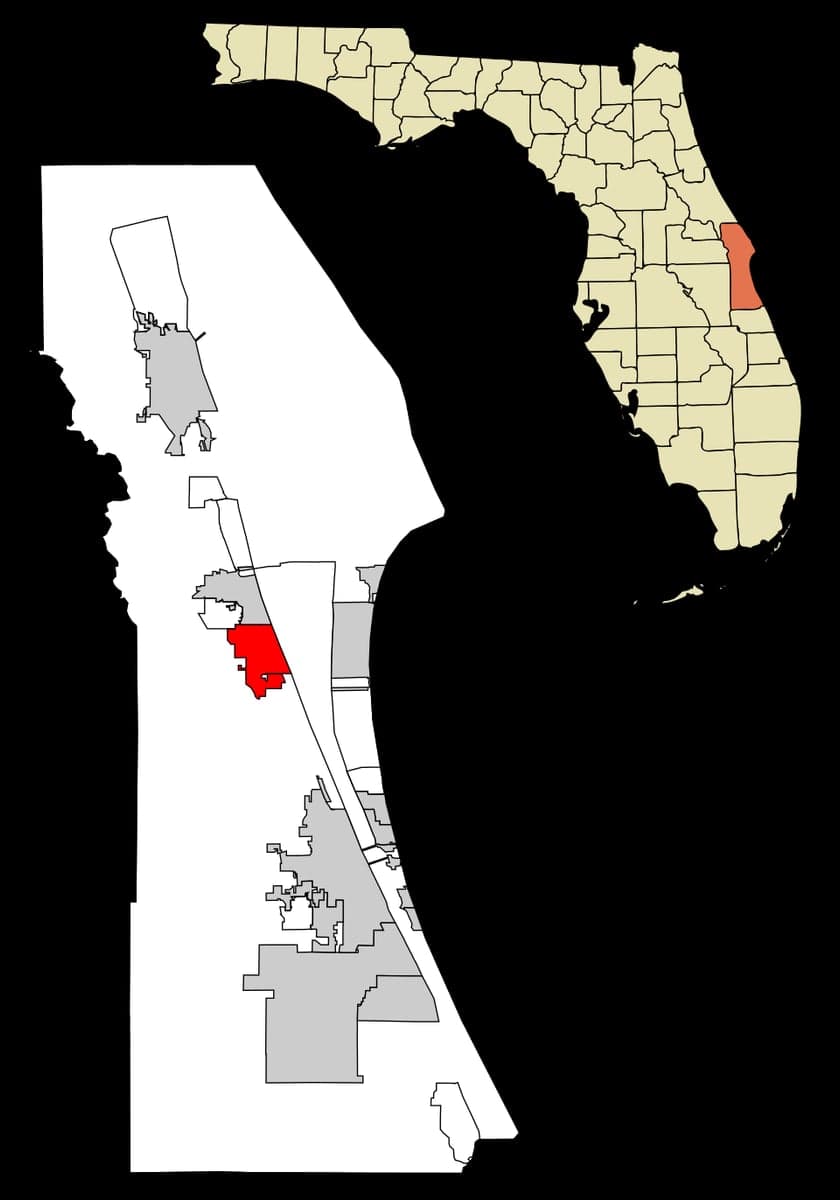
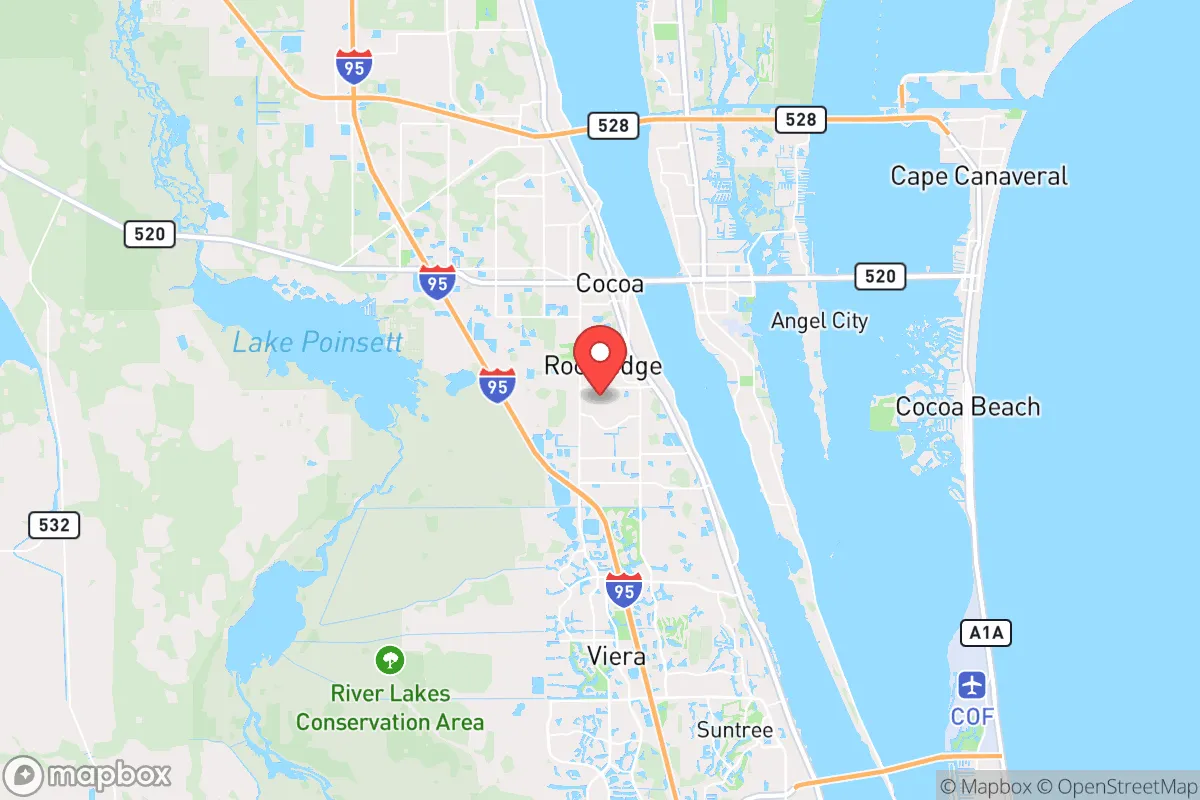
Photo: Wikipedia
Strategic Assessment of Rockledge, FL
Meaningful friction. Expect exposure to either population pressure, blast zones, or natural disaster risk. Consider buying a retreat property.
What does the Strategic Assessment tell us?
Our Strategic Assessment grades tactical survivability of an area. Major population centers, military targets, fallout zones, natural disasters, and border exposure all drive risk — lower exposure means a more defensible position in a crisis.
This is heavily inspired by Joel Skousen's Strategic Relocation book. Highly recommended you checkout the book ($)What does this tell us?
Our Strategic Assessment grades tactical survivability of an area. Major population centers, military targets, fallout zones, natural disasters, and border exposure all drive risk — lower exposure means a more defensible position in a crisis.
This is heavily inspired by Joel Skousen's Strategic Relocation book. Highly recommended you checkout the book ($)Strategic Pillars

Key Distances
Regional Safe Places
Below is our recommended "safe zones" in Florida and the surrounding area based on our strategic heuristics. For most people, it's unrealistic to live in a “safe zone” full-time due to work, family or other personal reasons. They tend to be more rural. However, many of these areas are perfect for second homes and retreat properties that double as a vacation home or even a short-term rental.

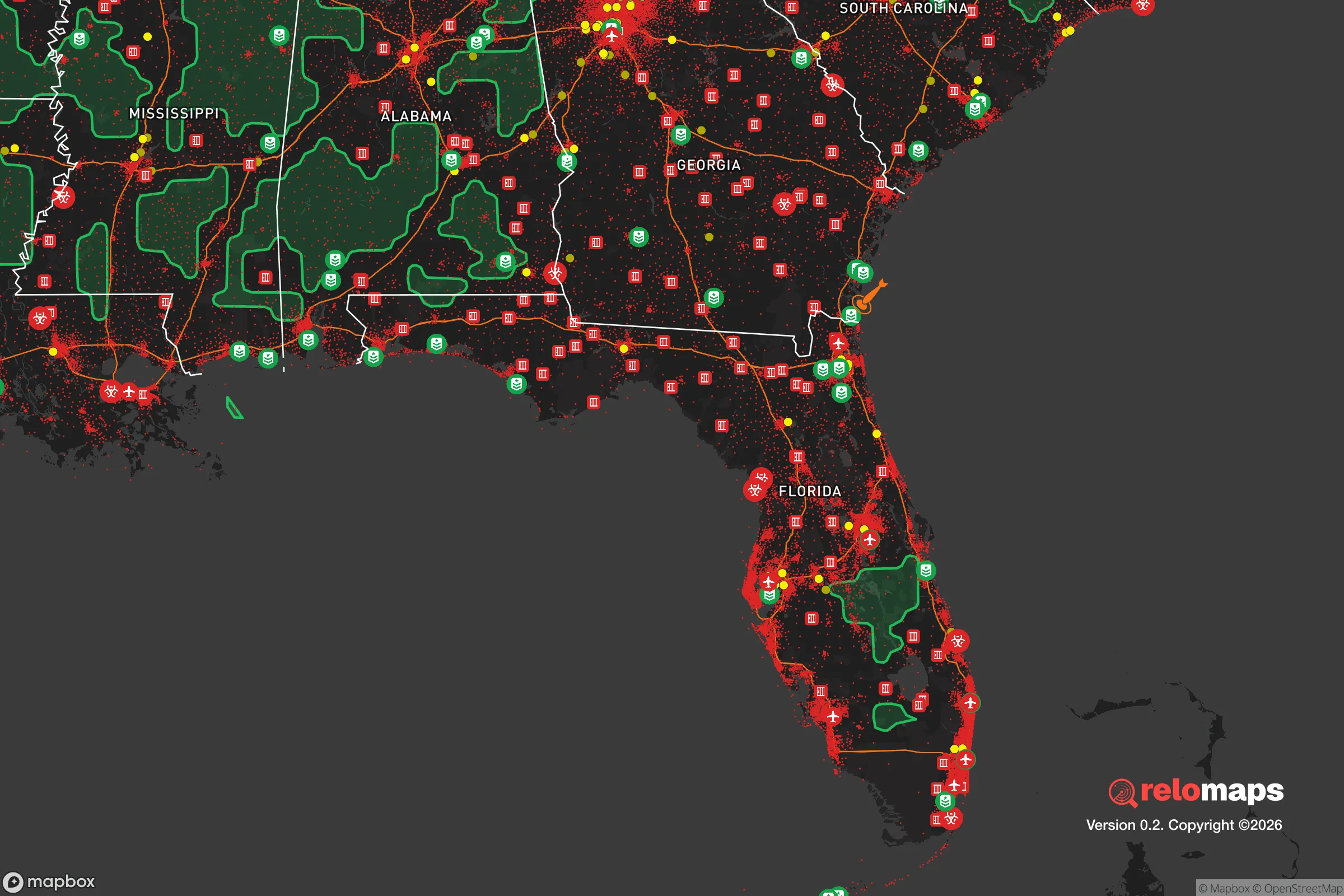


Important Note: For informational purposes only. This does not mean nothing bad ever happens in the green zones. Please use common sense. This is based on public data and modeled with AI. We tried to take a conservative approach but mistakes happen. We update this regularly as new information becomes available.
Solar Generator Recommendations
Backup power matters more here than in safer locations. We've picked three solar generators across budgets and capacity tiers — start with the budget unit if you only need a few essentials, or step up if you want to run a fridge and HVAC for days at a time.

Jackery Portable Power Station Explorer 300
Budget OptionPower on the Go: Weighing only 11 lbs, it's convenient to set up and store with book-sized foldable solar panels

BLUETTI Portable Power Station AC180
Designed for both indoor and outdoor scenarios, AC180 is highly capable as it has a robost capacity and continuous output power.

EF ECOFLOW DELTA Pro Ultra Power Station
Upgraded PickEcoFlow DELTA Pro Ultra is a whole-home energy system designed to grow with your family. Integrated with the Smart Home Panel 2, it scales to meet your evolving energy needs — keeping your home powered, intelligent, and secure through every stage of life.
We earn a commission, at no additional cost to you.
Strategic Assessment Analysis
Rockledge, Florida, offers a surprisingly strong strategic position for relocation when viewed through a resilience and preparedness lens, balancing proximity to vital infrastructure with a buffer from the most acute risks of the Space Coast. Its location on a barrier island-free stretch of the Intracoastal Waterway, combined with a modest elevation and a community ethos rooted in the space program, provides a foundation that is neither alarmist nor naive. For a single individual or family thinking seriously about disaster readiness and self-sufficiency, Rockledge presents a workable middle ground—close enough to major resources to be practical, yet far enough from the densest population centers and highest-risk zones to offer genuine strategic advantage.
Geographic position and natural advantages for self-sufficiency
Rockledge sits on the mainland side of the Indian River Lagoon, directly across from Merritt Island and the Kennedy Space Center. This position offers a critical natural advantage: it is not on a barrier island. Unlike Cocoa Beach or Melbourne Beach, Rockledge is not exposed to the full force of a hurricane storm surge from the Atlantic. The Indian River Lagoon provides a natural buffer, and the city's elevation—averaging 20 to 25 feet above sea level—places it well above the flood zones that plague coastal communities. The area's topography is gently rolling, with a mix of oak hammocks and pine flatwoods, which supports natural drainage and reduces the risk of standing water after heavy rains. The climate is humid subtropical, with a long growing season that allows for year-round food production—a key advantage for anyone pursuing self-sufficiency. The average last frost date is mid-February, and the first frost typically arrives in early December, giving a solid 10-month growing window for vegetables, citrus, and tropical fruits. The proximity to the St. Johns River, about 15 miles west, and the numerous freshwater springs in the region (like Blue Spring State Park) provides reliable backup water sources beyond municipal supplies. The area's natural resources—timber, game, and fish—are abundant, with the Indian River Lagoon itself being one of the most biodiverse estuaries in North America, offering year-round fishing for species like redfish, trout, and flounder.
Risks, exposures, and proximity to fallout-relevant landmarks
The most significant risk for Rockledge is its proximity to the Kennedy Space Center (KSC) and Cape Canaveral Space Force Station, located roughly 15 miles northeast. While these installations are economic engines, they also represent a potential target in a conflict scenario. A direct strike on KSC would likely produce a fallout plume that could affect Rockledge depending on wind direction—prevailing winds are from the east, which would carry fallout inland, but a shift to a westerly wind would push it directly over the city. The Patrick Space Force Base, about 10 miles south, adds another layer of risk. Beyond man-made threats, the primary natural risk is hurricanes. Rockledge is in a high-risk zone for storm surge from the Indian River Lagoon, though the surge heights are typically lower than on the ocean side. The city has experienced direct hits from hurricanes like Frances (2004) and Matthew (2016), which caused widespread tree damage and power outages but not catastrophic structural failure. Flooding is a concern in low-lying areas near the river, but the city's stormwater management system has been upgraded since 2017. The area is also in a moderate-risk zone for sinkholes, though these are less common than in central Florida. The proximity to the Atlantic Ocean also means a higher risk of tornadoes spawned by tropical systems, though these are typically weak (EF0-EF1). The biggest practical risk for a relocator is the vulnerability of the power grid: the area is served by Florida Power & Light, which has improved hardening since Hurricane Irma, but outages of 3-7 days are still common after major storms.
Practical resilience for a relocator: food, water, energy, and defensibility
Rockledge's practical resilience is a mixed bag, but the positives outweigh the negatives for a prepared individual. Food security is strong: the city has multiple farmers' markets (the Rockledge Farmers Market runs year-round on Saturdays), and the surrounding agricultural area produces citrus, strawberries, and vegetables. The proximity to the Indian River Lagoon and the Atlantic Ocean means fresh seafood is readily available, and the area has a strong network of community gardens and homesteading groups. Water security is moderate: the municipal water supply comes from the Floridan Aquifer, which is deep and well-protected, but a prolonged power outage would disrupt pumping. A well on your property is a significant advantage, and the water table is shallow enough (20-40 feet) that hand-pumping is feasible. Rainwater harvesting is also practical, with average annual rainfall of 52 inches. Energy resilience is improving: solar adoption is growing, and the area gets 240 sunny days per year, making solar panels a viable investment. However, net metering policies have become less favorable in Florida since 2022, so battery storage is essential. The city has a municipal electric utility, Rockledge Electric, which is more responsive than larger utilities but still vulnerable to storm damage. Defensibility is decent: Rockledge is a suburban city with a low crime rate (violent crime is about 60% of the national average), but it is not a gated community. The city's layout—a mix of older neighborhoods with mature trees and newer subdivisions—means there are natural chokepoints and good lines of sight. The proximity to the Space Coast Regional Airport (about 10 miles south) and the Port Canaveral (about 15 miles east) provides evacuation and resupply options. The local population is generally self-reliant, with a strong culture of preparedness rooted in the space industry's "mission assurance" mindset. The downside is that the area is not remote: it's a 45-minute drive to Orlando, and the I-95 corridor is a major evacuation route that can become clogged. For a relocator, the key is to choose a property with a well, solar panels, and a defensible layout—these are available but require active searching.
The overall strategic picture for Rockledge is one of calculated risk. It is not a bug-out location in the wilderness, nor is it a high-density urban center with acute vulnerabilities. It is a suburban community with strong natural resources, a resilient local economy, and a population that understands risk management. The proximity to KSC is a double-edged sword—it provides economic stability and a culture of preparedness, but it also introduces a man-made risk that cannot be ignored. For a family or individual willing to invest in on-site water and energy systems, and to maintain a reasonable stockpile of supplies, Rockledge offers a solid base of operations. The key is to avoid the flood zones near the river, secure a property with a well, and build relationships with the local homesteading and preparedness community. The area's biggest weakness is its reliance on the I-95 corridor for evacuation, but that is a trade-off for access to the resources of the Space Coast. For someone who wants to be close to civilization without being consumed by it, Rockledge is a defensible choice.

* Values derived from national, state, county, city and local statistics and may differ in a specific area. Last updated: 2026-08-19T14:45:03.000Z
Narrative content on this page is AI-generated and may contain mistakes. Verify any details that matter before acting on them.
ReloMaps may earn a commission from affiliate links at no extra cost to you.

