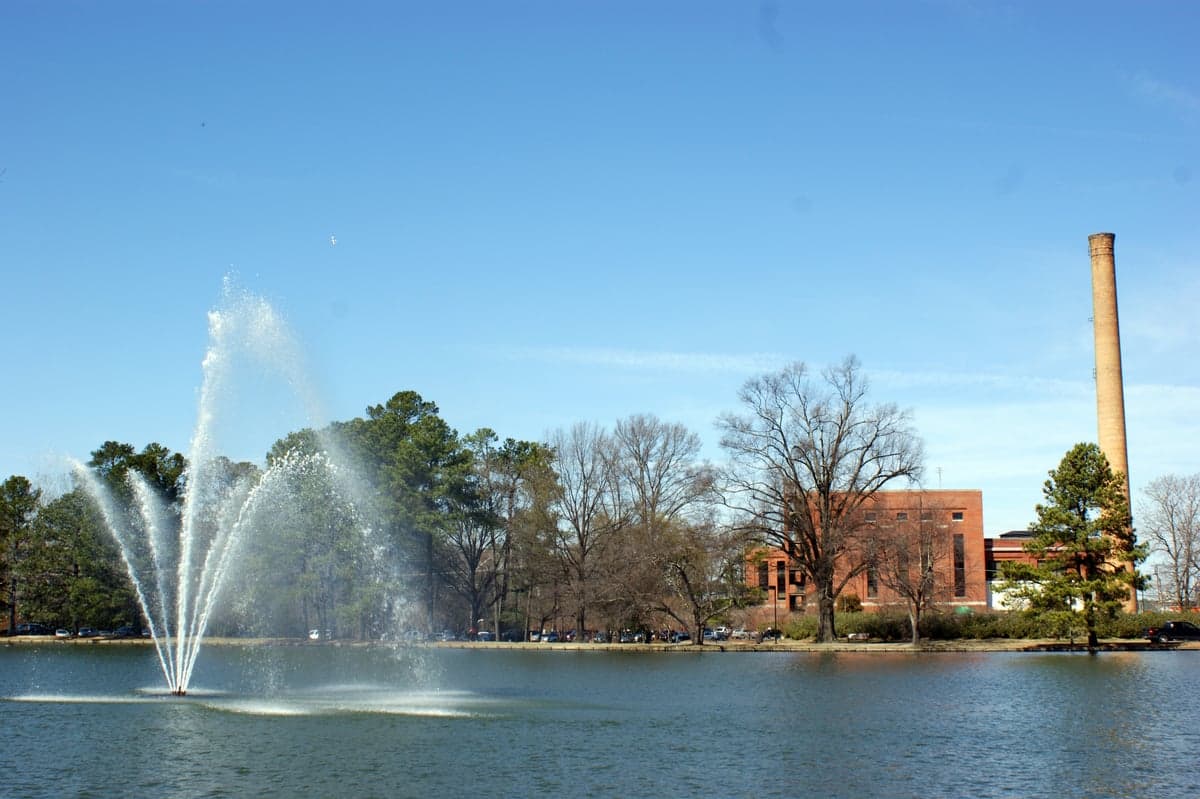
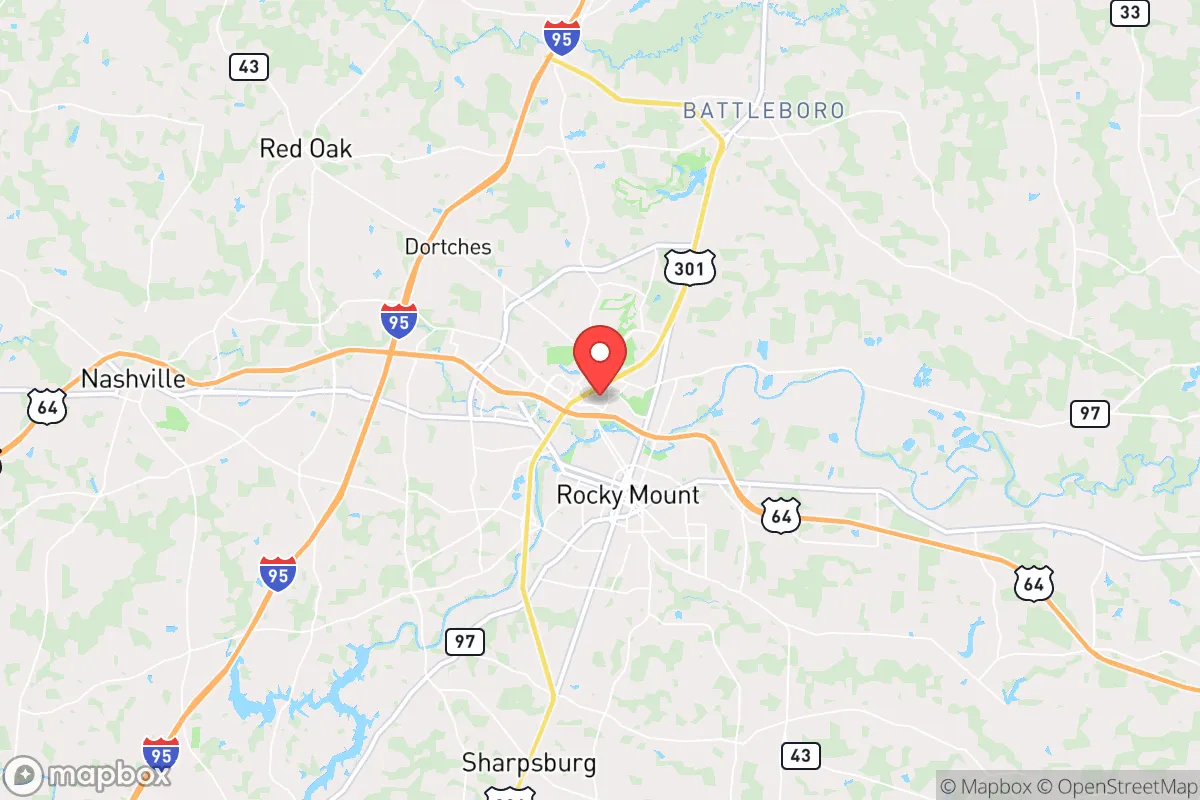
Photo: Wikipedia
Demographics of Rocky Mount, NC
Affluence Level in Rocky Mount, NC
A below-average socioeconomic profile. Incomes, home values, and educational attainment trail the U.S., with higher poverty and unemployment.
People of Rocky Mount, NC
The people of Rocky Mount, North Carolina, today form a predominantly Black (62.7%) and working-class city of 54,175 residents, with a small but established White minority (27.8%) and a modestly growing Hispanic population (3.8%). The city’s identity is shaped by its deep roots in the tobacco and textile industries, a legacy that has produced a tight-knit, community-oriented population with a notably low foreign-born share (1.5%) and a college attainment rate of 21.5%. Distinct neighborhoods still reflect the settlement patterns of the waves that built them, from the historic Black business corridor along Atlantic Avenue to the White working-class enclaves of the West End.
How the city was settled and grew
Rocky Mount’s population history begins with its founding as a railroad and river town in the early 19th century, but its real growth came after the Civil War with the rise of tobacco manufacturing. The Atlantic Coast Line Railroad established a major repair shop here in the 1880s, drawing a wave of White mechanics and laborers from rural eastern North Carolina who settled in the West End neighborhood, a grid of modest frame houses west of the tracks. Simultaneously, freedmen and their descendants moved into the city for tobacco-factory work, forming the core of the Brick City and South Rocky Mount neighborhoods—historically Black districts that became self-sufficient with their own schools, churches, and businesses. By 1900, the population was roughly 60% White and 40% Black, a ratio that held through the 1940s as textile mills (notably the Rocky Mount Mills) and a growing tobacco auction market drew additional rural migrants, both Black and White, from surrounding Nash and Edgecombe counties. The Belmont Lake area, originally a White middle-class suburb, emerged in the 1920s as streetcar lines extended eastward.
Modern era (post-1965)
The 1965 Hart-Cellar Act had minimal direct effect on Rocky Mount—the city’s foreign-born population remains just 1.5% today—but domestic migration reshaped the city dramatically. The mechanization of tobacco farming and the closure of textile mills in the 1970s and 1980s triggered White flight to newer subdivisions like Englewood and Hunter Hill, while Black residents consolidated in the older central neighborhoods. By 1990, the city had shifted from majority-White to majority-Black, a trend that accelerated through the 2000s as the White population aged and younger families left for Raleigh-Durham suburbs. The Hispanic population, though small at 3.8%, began growing in the 1990s, concentrated in the West Mount area near the old textile mills, where a handful of Mexican and Central American families found work in poultry processing and construction. East/Southeast Asian residents (0.4%) and Indian-subcontinent residents (0.7%) are tiny but present, largely professionals tied to the local hospital system and Nash Community College, living scattered across the newer subdivisions rather than in ethnic enclaves.
The future
Rocky Mount’s population is projected to remain stable or decline slightly over the next decade, with the Black majority likely holding steady as the White population continues to age out and the Hispanic share slowly rises. The city is not homogenizing into a single identity; rather, it is tribalizing along historic lines—the Brick City and South Rocky Mount neighborhoods remain overwhelmingly Black and lower-income, while the West End and Englewood are more mixed but still majority-White. The foreign-born population shows no signs of rapid growth: the 1.5% share is among the lowest in North Carolina’s urban areas, and the small Hispanic community is assimilating into the broader working class rather than forming a distinct enclave. The Indian and East/Southeast Asian populations are too small to drive neighborhood change. The biggest demographic shift may be internal: a slow out-migration of college-educated Black residents to the Triangle region, leaving an older, poorer population behind.
For someone moving to Rocky Mount now, the city offers a deeply rooted, predominantly Black community with a strong sense of place but limited demographic dynamism. The population is stable, not growing, and the low foreign-born share means little cultural change from immigration. New arrivals will find a city where neighborhood identity still matters—where the legacy of tobacco and railroads is visible in the housing stock and the social fabric—and where the future looks more like a continuation of the present than a transformation.

* Values derived from national, state, county, city and local statistics and may differ in a specific area. Last updated: 2026-05-03T20:28:24.000Z
Narrative content on this page is AI-generated and may contain mistakes. Verify any details that matter before acting on them.
ReloMaps may earn a commission from affiliate links at no extra cost to you.

