Photo: Wikipedia
Find The Best Places To Live
in Raleigh
PRO TIP! You can paste a Zillow or Redfin link to get info on that property.
What It's Like Living in Raleigh, NC
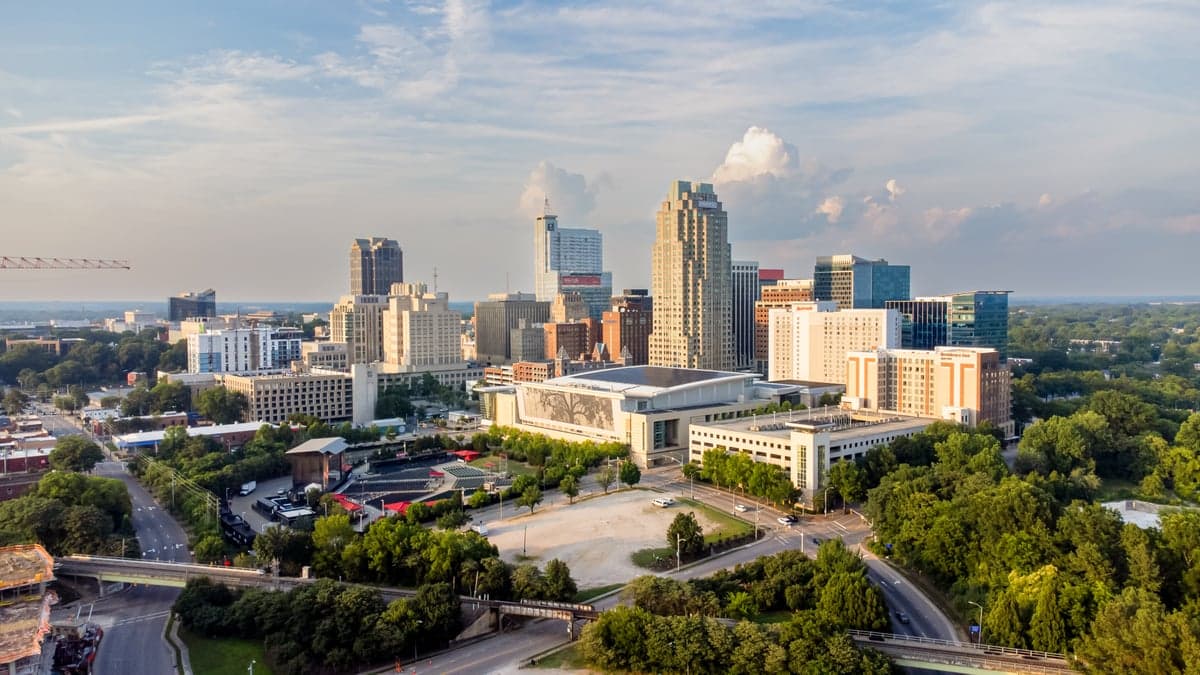
Raleigh has a way of sneaking up on you. It’s not trying to be the loudest city in the South, but it’s got a steady, confident hum—part college town, part state capital, part tech hub. You’ll find people here who moved for a job at SAS or Lenovo and stayed because they accidentally fell in love with the pace: fast enough to keep things interesting, slow enough to still say hello to your neighbor at the farmers market.
Daily Rhythm: What People Actually Do
Most days in Raleigh start with coffee from a spot like Larry’s Beans or Jubala, then a commute that’s manageable by big-city standards—average drive time hovers around 25 minutes, though the 440 Beltline can test your patience at 5 p.m. Work dominates the week for the many professionals here, but evenings are for patios. Transfer Co. Food Hall and Morgan Street Food Hall are the default “what’s for dinner?” answer for young singles and couples, while families gravitate toward Player’s Retreat (a 70-year-old institution near NC State) or the sprawling North Hills development, which mixes shopping, apartments, and a greenway. Weekends split between the State Farmers Market (don’t skip the boiled peanuts) and the Neuse River Greenway Trail, a 28-mile paved path that runs through hardwood forest and feels a world away from the office parks.
Sports & Community: More Than Just College Ball
You can’t live here without absorbing some of the NC State energy. Wolfpack basketball and football are the closest thing Raleigh has to a civic religion—game days at Carter-Finley Stadium turn the entire western side of town into a sea of red and white. But the city also supports its own minor-league quirks: the Carolina Hurricanes (NHL) have a devoted, surprisingly loud fanbase at PNC Arena, and the Durham Bulls (Triple-A baseball) are a 20-minute drive away. High school football is serious business, especially at Wake Forest High School and Millbrook, where Friday night games draw crowds that rival some small colleges. For a city its size, Raleigh punches above its weight in sports culture—it’s not just something to watch on TV, it’s something you do.
What’s There to Do: Festivals, Parks, and the Quirky Stuff
Raleigh’s social calendar is packed with events that feel both polished and unpretentious. Hopscotch Music Festival takes over downtown every September with indie bands spilling out of clubs and parking lots. Artsplosure in spring turns Fayetteville Street into an open-air gallery. And NC State Fair in October is a non-negotiable tradition—fried everything, livestock barns, and the kind of crowd that reminds you this is still the South. For quieter weekends, William B. Umstead State Park offers 5,500 acres of hiking and fishing right inside the Beltline, and Pullen Park has a historic carousel that’s been spinning since 1911. The cultural quirk you’ll notice fast: Raleighites are proud of their “City of Oaks” nickname, and they will point out the old-growth trees along Blount Street like they’re showing off family heirlooms.
Pros and Cons of Living Here
What longtime residents love: The job market is genuinely strong—median household income is $82,424, well above the national average, and the presence of IBM, Cisco, and Red Hat means you can build a career without leaving town. The median age of 34.7 keeps the city feeling energetic, and 52.9% of adults hold a bachelor’s degree or higher, so conversations at bars and dinner parties tend to be substantive. The schools—especially Wake County Public Schools—are a major draw for parents, with magnet programs and year-round options that give families real choices.
What frustrates people: The cost of living index sits at 129 (29% above the national average), and median home values have climbed to $377,800, pushing first-time buyers toward suburbs like Clayton or Knightdale. Traffic on Capital Boulevard and Glenwood Avenue during rush hour is genuinely annoying—not Atlanta bad, but bad enough that locals plan errands around it. The violent crime rate of 391.4 per 100,000 is higher than the national average, and while most of it concentrates in specific areas, it’s a stat that gives some newcomers pause. Summers are humid and long—June through September feel like breathing through a wet towel—but the flip side is mild winters where you can grill outside in January.
Raleigh works best for people who want a city with real economic opportunity and a social scene that doesn’t require a costume. It’s not a place for nightlife purists (bars close by 2 a.m., and the club scene is thin), but it’s excellent for anyone who values a strong job market, good schools, and a community that still feels like it’s figuring itself out in a good way. The kind of person who fits here is someone who’s ambitious but not in a hurry—who wants a nice house with a yard, a job that challenges them, and a Saturday morning that starts with a run on the greenway and ends with a beer on a patio. That’s Raleigh in a nutshell: it’s a place that rewards showing up and putting down roots.

Similar mid-size cities to Raleigh
* Values derived from national, state, county, city and local statistics and may differ in a specific area. Last updated: 2026-10-10T16:28:47.000Z
Narrative content on this page is AI-generated and may contain mistakes. Verify any details that matter before acting on them.
ReloMaps may earn a commission from affiliate links at no extra cost to you.

