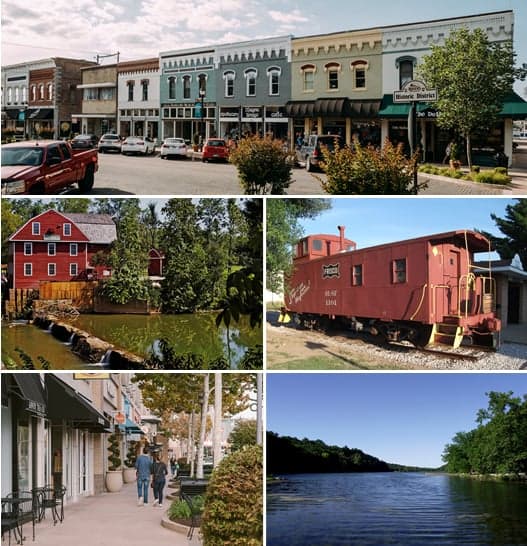
Photo: Wikipedia
Demographics of Rogers, AR
Affluence Level in Rogers, AR
A middle-class area roughly in line with national averages across income, home values, education, and employment.
People of Rogers, AR
The people of Rogers, Arkansas, in 2026 form a fast-growing, majority-minority city of 71,411 where a white population (51.0%) shares the landscape with a substantial Hispanic community (32.8%) and smaller East/Southeast Asian (1.9%), Black (1.2%), and Indian-subcontinent (0.8%) groups. The city’s identity is shaped by its role as a corporate hub for Walmart and Tyson Foods, a magnet for both domestic professionals and immigrant labor, and a place where distinct neighborhoods reflect successive waves of settlement. With a foreign-born population of 12.7% and a college-educated rate of 33.8%, Rogers is neither a homogeneous small town nor a fully assimilated melting pot—it is a layered, economically stratified community where newcomers often cluster by origin and income.
How the city was settled and grew
Rogers was founded in 1881 as a railroad town along the St. Louis–San Francisco Railway, named after a railroad official. The original population was overwhelmingly white, drawn by the promise of land in the Ozark foothills and the timber and fruit industries. Early settlers built homes in what is now the Historic Downtown Rogers district, a walkable grid of Victorian-era houses and brick commercial buildings that still anchors the city’s identity. By the early 1900s, a small number of Italian and German immigrants arrived to work in the apple orchards and railroad yards, settling in the Frisco Springs neighborhood near the tracks. The city remained a modest agricultural and railroad center—population under 5,000—until the mid-20th century, when the rise of Walmart in nearby Bentonville (1962) and Tyson Foods in Springdale began pulling in white-collar workers and plant laborers. No significant non-white population existed before 1965; the city was effectively all-white through the 1950 census.
Modern era (post-1965)
The 1965 Hart-Cellar Act opened the door for new immigration, but Rogers’ modern demographic shift began in earnest in the 1980s and 1990s, driven by the meatpacking and poultry industries. Tyson Foods recruited heavily from Mexico and Central America, and later from the Marshall Islands and Southeast Asia, to staff its processing plants. These workers settled in the Southwest Rogers corridor along Arkansas 94 and Hudson Road, areas that today have the highest Hispanic and East/Southeast Asian concentrations. The Hispanic share of the population rose from under 5% in 1990 to 32.8% by 2020, making Rogers one of the most heavily Hispanic cities in the Ozarks. Meanwhile, Walmart’s corporate expansion drew educated white and Asian professionals to newer subdivisions in Pinnacle Hills and Scottsdale Center, affluent master-planned areas with large homes and top-rated schools. The Indian-subcontinent community, though small at 0.8%, is concentrated in these same professional neighborhoods, often working in IT, logistics, or retail management. The Black population has remained low (1.2%), reflecting the broader Ozarks pattern of limited African American in-migration. The city’s foreign-born share (12.7%) is nearly double the national average, and the white share has dropped from 85% in 1990 to 51.0% today, driven by both Hispanic growth and white out-migration to exurban areas like Benton County’s unincorporated west side.
The future
Rogers is likely to continue its trajectory toward a white-minority, Hispanic-plurality city over the next 10–20 years. The Hispanic population is young (median age roughly 26 vs. 40 for whites) and has high birth rates, while white in-migration is slowing as the Pinnacle Hills area nears build-out. The city is not homogenizing—it is tribalizing into distinct enclaves: Pinnacle Hills remains overwhelmingly white and Asian professional, Southwest Rogers is heavily Hispanic and working-class, and Historic Downtown is gentrifying with a mix of white professionals and Hispanic small-business owners. The East/Southeast Asian community (1.9%) is small but stable, anchored by Marshallese and Filipino families in the Hudson Road area. The Indian-subcontinent population (0.8%) is growing slowly, tied to corporate relocations. No single group is assimilating rapidly; Spanish-language media, ethnic grocery stores, and bilingual signage are common in the southwest, while English-dominant professional culture prevails in the north. The city’s school district has seen a majority-Hispanic student body since 2018, a trend that will reshape the workforce and housing market over the next decade.
For someone moving to Rogers now, the city offers a clear choice: the affluent, largely white and Asian Pinnacle Hills corridor with top schools and corporate jobs, or the more diverse, lower-cost southwest neighborhoods where Spanish is the lingua franca and community life centers on churches and family networks. The city is becoming a two-track community—one professional and English-dominant, one working-class and Spanish-dominant—with limited mixing between them. That reality is neither good nor bad, but it is the demographic landscape a newcomer will navigate.

* Values derived from national, state, county, city and local statistics and may differ in a specific area. Last updated: 2026-04-30T02:20:07.000Z
Narrative content on this page is AI-generated and may contain mistakes. Verify any details that matter before acting on them.
ReloMaps may earn a commission from affiliate links at no extra cost to you.

