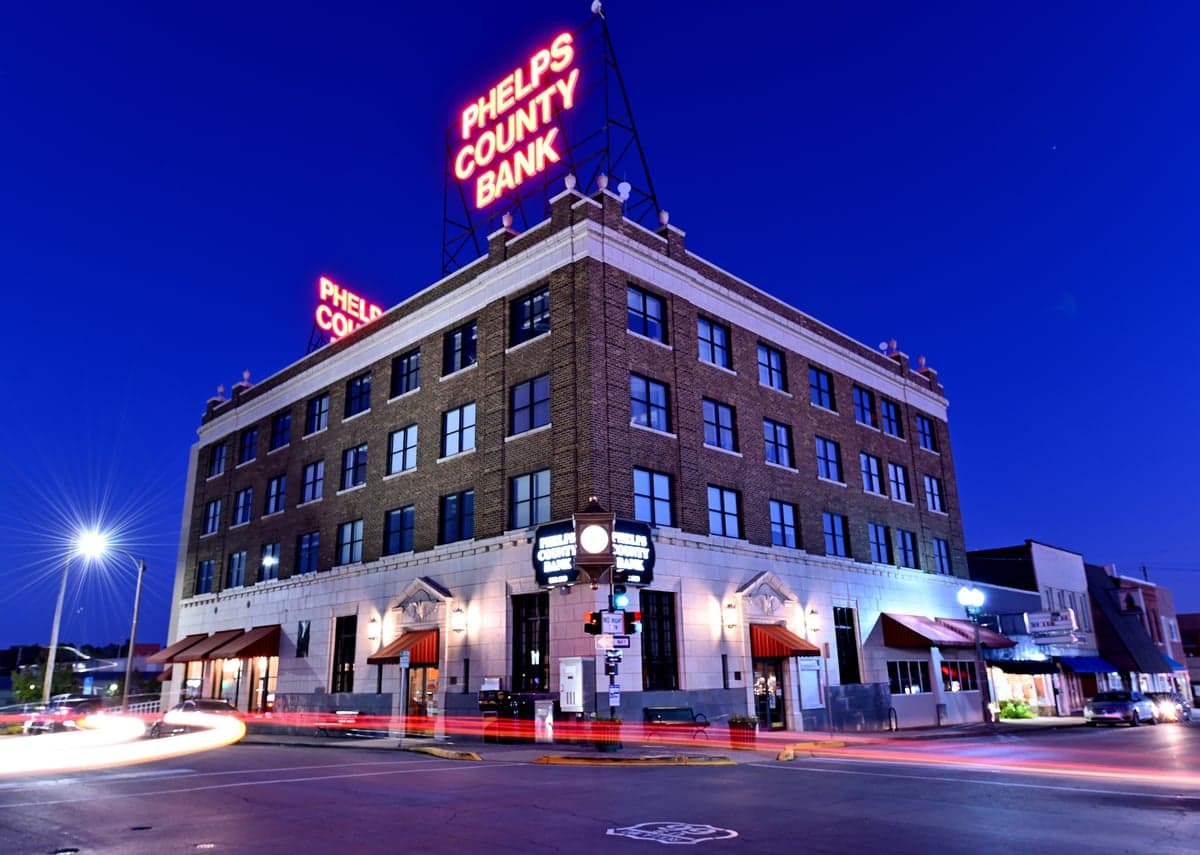
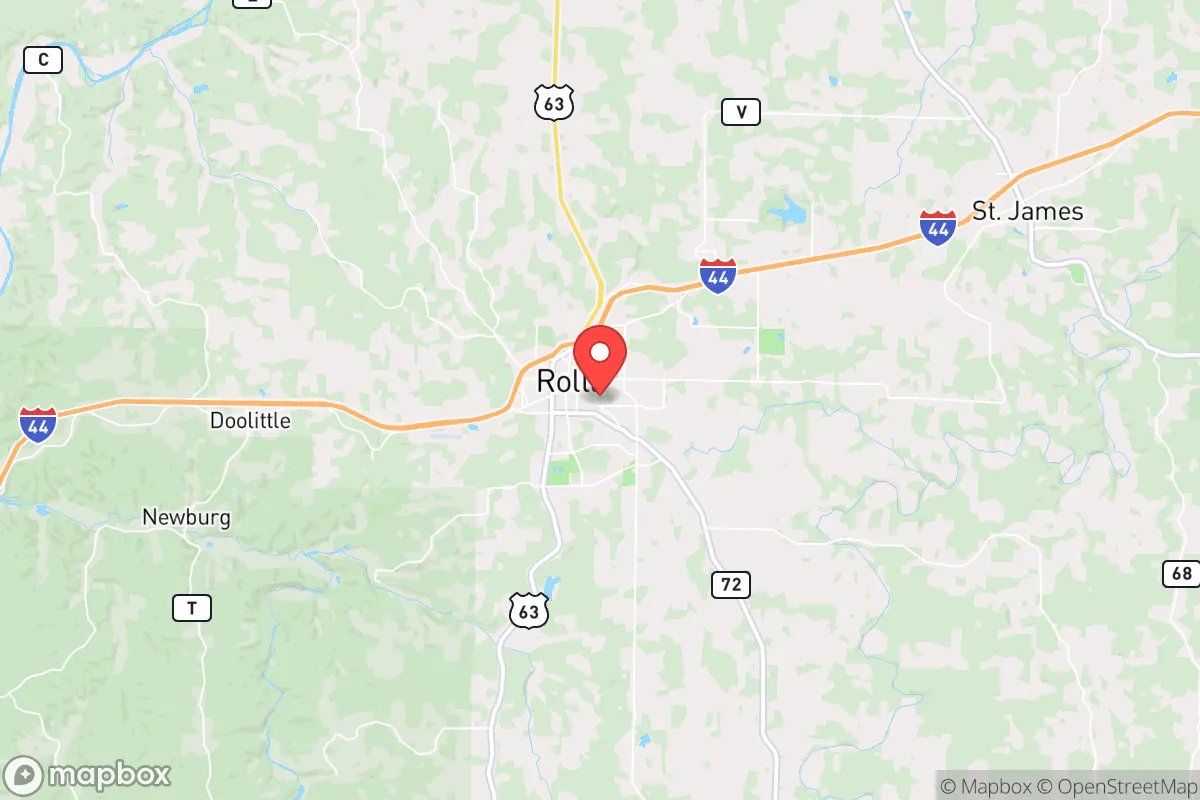
Photo: Wikipedia
Demographics of Rolla, MO
Affluence Level in Rolla, MO
A below-average socioeconomic profile. Incomes, home values, and educational attainment trail the U.S., with higher poverty and unemployment.
People of Rolla, MO
The people of Rolla, Missouri, today number 20,144, forming a compact, college-educated community that is significantly whiter (81.8%) than the national average, with a notable and growing East/Southeast Asian presence (4.5%) anchored by Missouri University of Science and Technology (Missouri S&T). The city’s character is shaped by a blend of long-standing Ozarks-rooted families, university faculty and students, and a small but stable professional class drawn by engineering and defense-sector jobs. Rolla feels more like a tight-knit, midwestern college town than a typical rural Missouri county seat, with a foreign-born population of 5.7% that is concentrated in specific neighborhoods near campus.
How the city was settled and grew
Rolla was founded in 1857 as a railroad town on the St. Louis-San Francisco Railway, with the first wave of settlers being Anglo-American farmers and merchants from Kentucky, Tennessee, and the Upper South who followed the rail corridor into the Ozarks. The discovery of rich iron ore deposits in the surrounding hills drew a second wave of miners and smelter workers in the 1870s–1890s, many of whom were German and Irish immigrants who settled in what is now Old Rolla, the historic core around 8th Street and Pine Street. The establishment of the Missouri School of Mines (now Missouri S&T) in 1870 brought a third wave: faculty and their families, mostly from the Northeast and Midwest, who built homes in the University Heights neighborhood north of campus. By 1900, Rolla was a small but stable town of roughly 3,000, overwhelmingly native-born white, with a tiny Black population (under 2%) working as domestic servants and railroad laborers, concentrated along the rail tracks in the South Rolla area near the depot.
Modern era (post-1965)
The post-1965 period brought two major demographic shifts. First, the expansion of Missouri S&T into a national engineering and defense-research hub—fueled by Cold War contracts and later by the Rolla National Laboratory (now the U.S. Geological Survey’s Midcontinent Geospatial Science Center)—drew a wave of domestic in-migration from across the Midwest and Northeast. These new arrivals, mostly white professionals, settled in the Greenbriar subdivision and the Bishop Avenue corridor, areas of newer single-family homes built from the 1970s through the 1990s. Second, the university’s graduate programs began recruiting internationally, particularly from East and Southeast Asia. By 2020, Rolla’s East/Southeast Asian population reached 4.5%, with most families living in apartments and condos near campus in the Honey Creek area and along 10th Street. The Indian-subcontinent population (1.5%) is smaller and more dispersed, with many faculty and graduate students renting in the same campus-adjacent zones. The Black population (3.5%) has remained stable since the 1970s, with families concentrated in the East Rolla neighborhood around Highway 63. The Hispanic share (3.7%) grew modestly after 2000, driven by construction and service-sector jobs, with no single ethnic enclave forming.
The future
Rolla’s population is likely to continue its slow, steady growth—projected at roughly 0.5–1% annually—driven almost entirely by Missouri S&T’s enrollment and the spin-off tech and defense employers (e.g., the U.S. Army’s nearby Fort Leonard Wood and the Brewer Science technology park). The white share will gradually decline as the university’s international recruitment expands, particularly from East/Southeast Asia, which could reach 6–7% by 2035. The Indian-subcontinent population may grow slightly but will remain a small fraction of the Asian cohort. The Black and Hispanic shares are expected to plateau or grow very slowly, as Rolla lacks the industrial or agricultural draw that attracts larger minority populations in other Missouri towns. The city is not tribalizing into distinct ethnic enclaves; rather, it is homogenizing around a university-town identity, with most newcomers—regardless of origin—settling in the same campus-adjacent neighborhoods. The biggest wildcard is whether Missouri S&T can maintain its research funding and enrollment in a shifting higher-education landscape; a contraction would likely freeze population growth and accelerate out-migration of younger professionals.
For someone moving in now, Rolla is becoming a whiter-than-average, college-town community where the population is slowly diversifying at the top (graduate students and faculty) while the base remains solidly native-born and midwestern. The practical effect is a stable, safe, and education-focused environment with limited ethnic or cultural friction—but also limited diversity beyond the university bubble. New residents should expect a town where the university sets the tone, the neighborhoods are quiet and family-oriented, and the demographic future depends almost entirely on the fortunes of one institution.

* Values derived from national, state, county, city and local statistics and may differ in a specific area. Last updated: 2026-04-29T20:55:56.000Z
Narrative content on this page is AI-generated and may contain mistakes. Verify any details that matter before acting on them.
ReloMaps may earn a commission from affiliate links at no extra cost to you.

