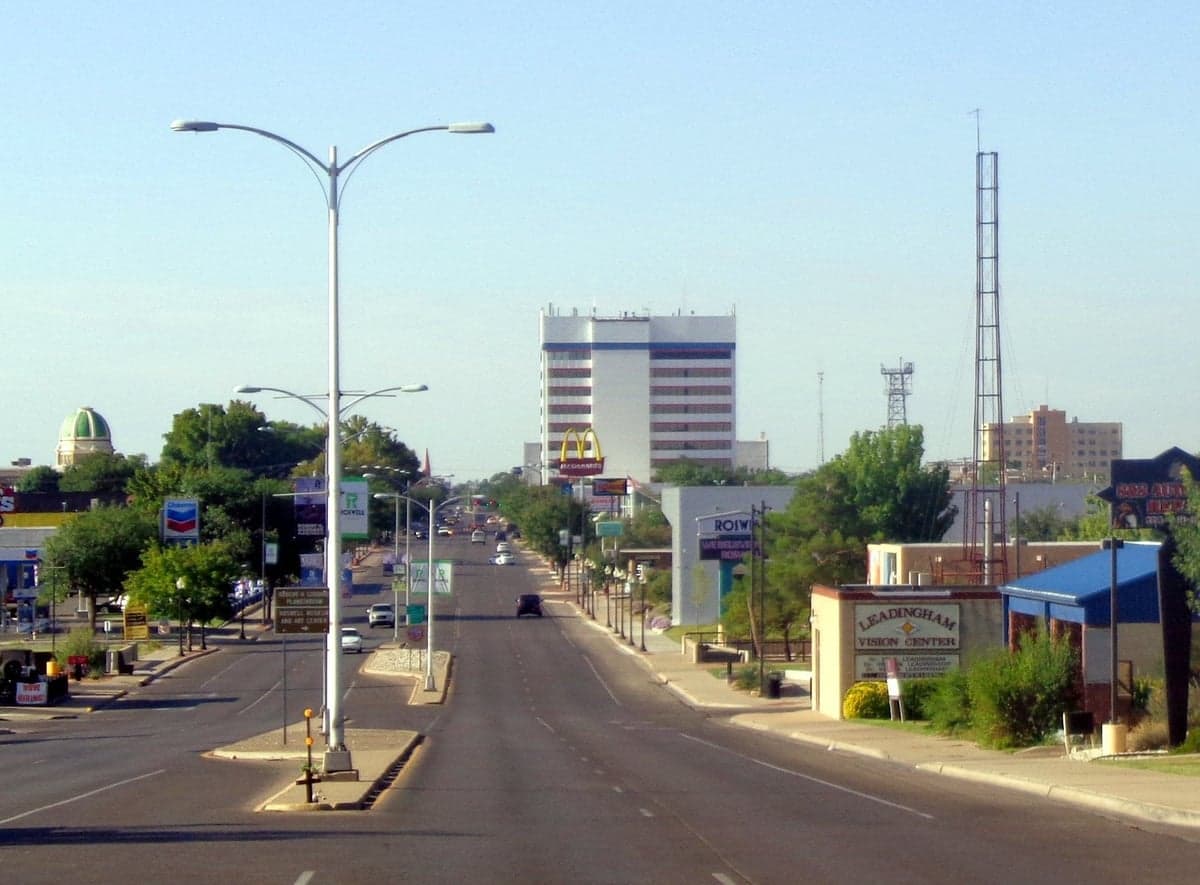
Photo: Wikipedia
Demographics of Roswell, NM
Affluence Level in Roswell, NM
A below-average socioeconomic profile. Incomes, home values, and educational attainment trail the U.S., with higher poverty and unemployment.
People of Roswell, NM
The people of Roswell, New Mexico, today form a predominantly Hispanic (61.1%) and white (33.6%) community of 47,823, with a small but established foreign-born population of 5.8%. The city is notably less college-educated than the national average, with only 19.6% holding a bachelor’s degree or higher, reflecting its roots in agriculture, manufacturing, and the military. Roswell’s identity is a blend of deep Hispanic heritage, a white Anglo ranching and military tradition, and a small but visible East/Southeast Asian community (1.0%) tied to the local dairy industry. The city remains a regional hub for southeastern New Mexico, with a population that is younger and more family-oriented than the state average.
How the city was settled and grew
Roswell was founded in 1869 as a trading post on the Pecos River, but its first major population wave came in the 1890s with the arrival of the railroad and the expansion of irrigated agriculture. The original Anglo settlers were ranchers and farmers from Texas and the Midwest, who established the North Spring River area as the city’s first residential core. By the early 1900s, Hispanic families from the surrounding Hispanos villages of northern New Mexico and southern Colorado moved in for farm and railroad work, settling in what became Barrio Viejo (Old Neighborhood) south of downtown. A second wave arrived during the 1940s and 1950s with the establishment of Walker Air Force Base, which brought military personnel and their families from across the country, many of whom settled in the East Side near the base. The base’s closure in 1967 triggered a population decline, but the city rebounded through the 1970s and 1980s as dairy farming expanded, drawing a small but steady stream of East/Southeast Asian immigrants, particularly from Vietnam and the Philippines, who clustered in the Southeast Heights near the dairy plants.
Modern era (post-1965)
After the 1965 Immigration and Nationality Act, Roswell’s Hispanic population grew steadily through both domestic migration from Texas and Mexico and natural increase, while the white population declined in relative share. The West Side, developed from the 1980s onward, became the primary destination for upwardly mobile Hispanic families moving out of Barrio Viejo, while the North Side (near the airport and industrial parks) attracted a mix of white and Hispanic residents employed in manufacturing and logistics. The East/Southeast Asian community, though small at 1.0%, remains concentrated in the Southeast Heights and has maintained its presence through chain migration from the dairy industry. The Indian subcontinent population (0.4%) is tiny and largely tied to professional roles at the local hospital and Eastern New Mexico University-Roswell, with no distinct neighborhood enclave. The Black population (1.7%) is dispersed, with no historic neighborhood concentration, reflecting the absence of a large-scale migration from the South or urban centers. The foreign-born share of 5.8% is below the national average, and most immigrants are Hispanic (primarily from Mexico) or East/Southeast Asian, with very few from the Middle East or South Asia.
The future
Roswell’s population is slowly homogenizing into a majority-Hispanic city, with the white share projected to continue declining as older Anglo residents age out and younger Hispanic families have higher birth rates. The Hispanic population is not tribalizing into distinct enclaves; rather, it is spreading across the West Side and newer subdivisions on the Southwest Perimeter, while Barrio Viejo remains a lower-income, older Hispanic core. The East/Southeast Asian community is stable but not growing, as the dairy industry mechanizes and younger generations leave for larger cities. The Indian and Black populations are too small to drive neighborhood change. The city’s low college attainment rate (19.6%) and reliance on agriculture, manufacturing, and the prison system (the Roswell Correctional Facility) suggest that future growth will be modest and driven by natural increase rather than in-migration. The next 10-20 years will likely see Roswell become more uniformly Hispanic, with a smaller white minority and a persistent but static East/Southeast Asian presence.
For someone moving in now, Roswell is becoming a predominantly Hispanic, working-class city with a stable population and limited economic diversification. The city offers affordable housing and a family-oriented atmosphere, but the low education levels and narrow job base mean that professional opportunities are scarce. New residents should expect a community where Hispanic culture is dominant, English is universal, and the small-town feel is reinforced by the city’s isolation in the high plains of southeastern New Mexico.

* Values derived from national, state, county, city and local statistics and may differ in a specific area. Last updated: 2026-05-01T06:11:45.000Z
Narrative content on this page is AI-generated and may contain mistakes. Verify any details that matter before acting on them.
ReloMaps may earn a commission from affiliate links at no extra cost to you.

