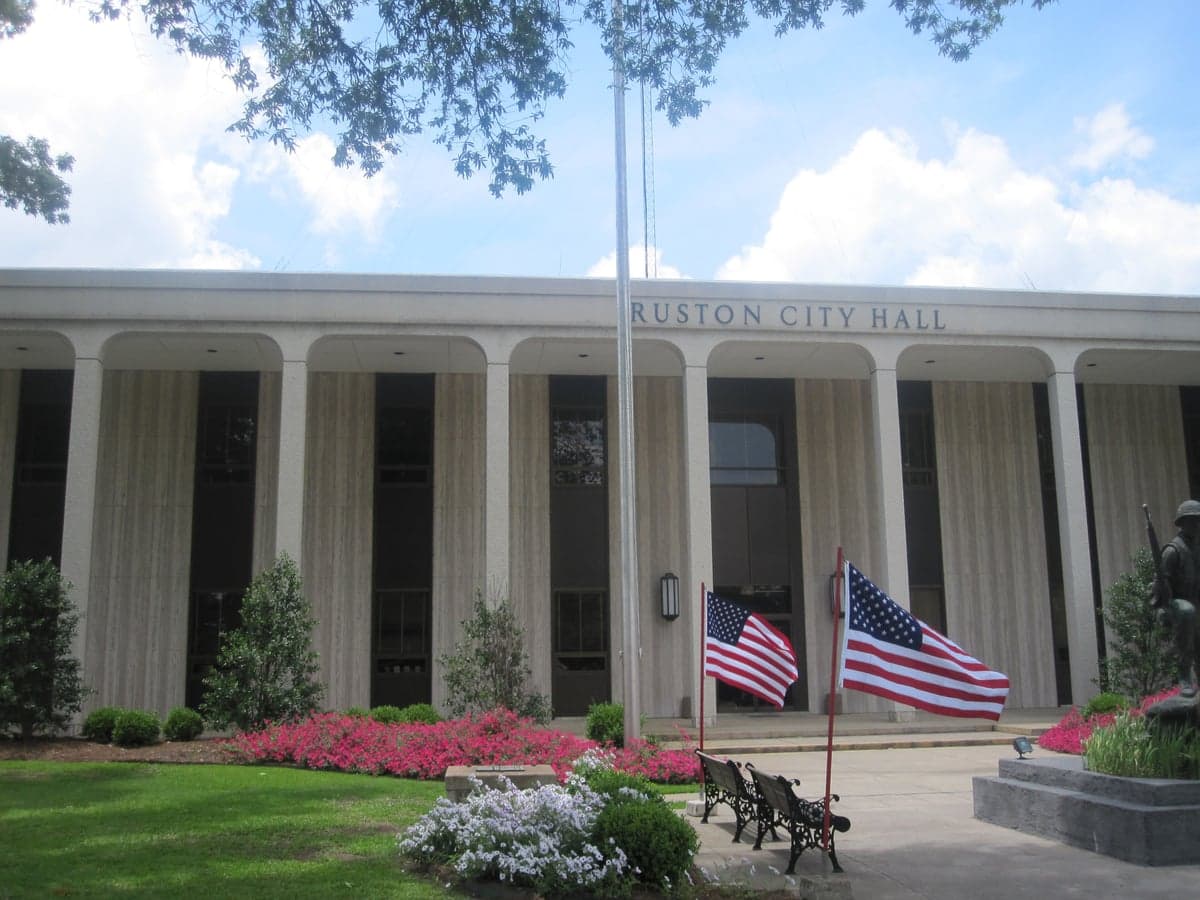
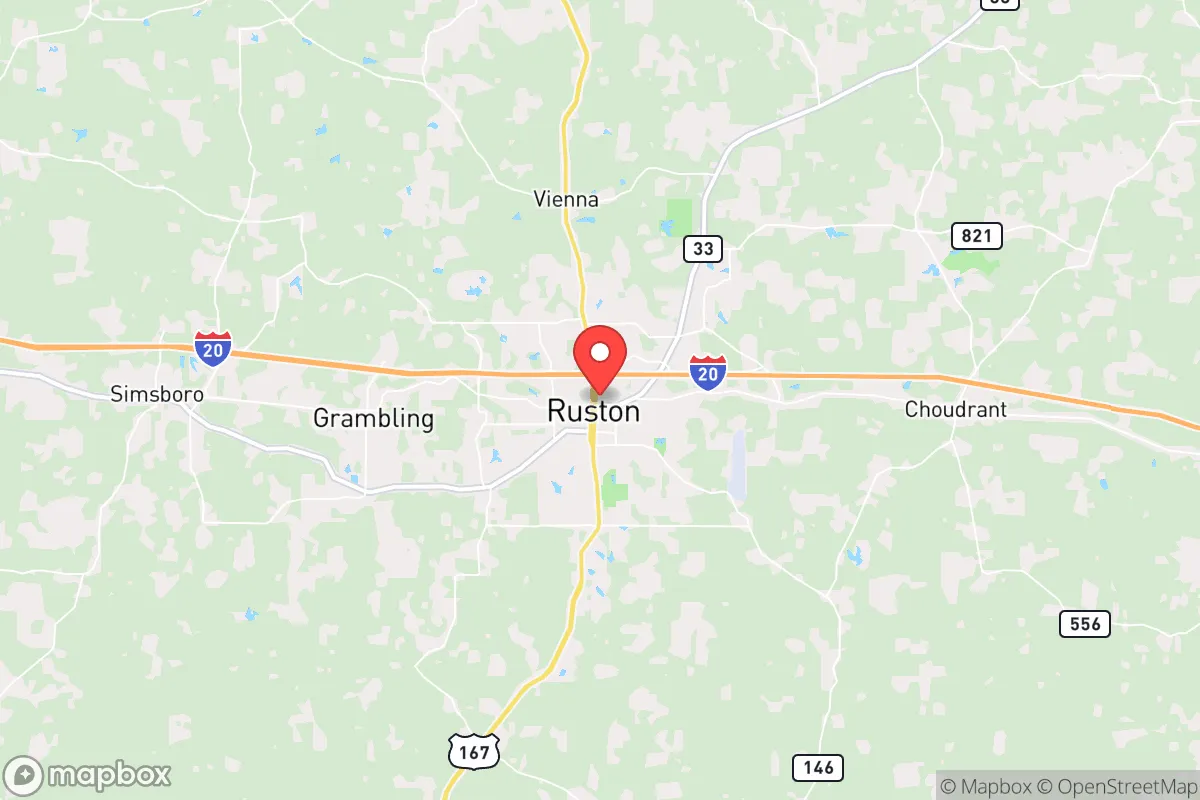
Photo: Wikipedia
Personal Sovereignty in Ruston, LA
Strong independent fundamentals that actively favor personal liberty and low regulation.
What does Personal Sovereignty tell us?
Personal Sovereignty measures your capacity for self-reliance and independence with minimal government friction. Higher scores mean fewer barriers between you and the way you want to live... but it assumes you have the space you need and good neighbors.
What does this tell us?
Personal Sovereignty measures your capacity for self-reliance and independence with minimal government friction. Higher scores mean fewer barriers between you and the way you want to live... but it assumes you have the space you need and good neighbors.
State Policy
Energy independence: Net exporter (280% of energy produced in-state)
Personal Liberty
Homesteading

Personal Liberty Analysis
For the liberty-minded individual or family evaluating Ruston, Louisiana, as a relocation destination, the personal sovereignty environment is defined by a state-level commitment to limited government that stands in stark contrast to the coastal regulatory states many are fleeing. Louisiana’s legal framework generally presumes individual competence over government paternalism, and Ruston, as a mid-sized college town in Lincoln Parish, reflects this ethos with a lower tax burden, permissive gun laws, and a regulatory climate that still allows for meaningful self-reliance. However, the presence of Louisiana Tech University and its associated progressive administrative influence introduces some friction points, particularly around local ordinances and zoning, that a strategic relocation requires careful navigation.
Tax burden and regulatory posture for individuals and families
Louisiana’s tax structure is a net positive for those seeking to keep more of their own earnings. The state levies a flat personal income tax rate of 3% on all taxable income after a standard deduction, a rate that has been trending downward and is among the lowest in the South. There is no state-level property tax on vehicles or business inventory, and the homestead exemption shields the first $75,000 of assessed value on a primary residence from parish property taxes. In Ruston, the combined millage rate for Lincoln Parish and the city typically falls between 100 and 120 mills, meaning a $200,000 home with the exemption applied would owe roughly $1,500 to $1,800 annually in property taxes—far less than in Texas or most Western states. Sales tax is the main bite: Ruston’s combined rate is 9.45% (state 4.45% + parish 5%), which is high but typical for Louisiana. On the regulatory side, Louisiana is a right-to-work state with no state-level occupational licensing for many trades, and the state’s business climate is ranked in the top 15 nationally for ease of starting a new enterprise. For a prepper or homesteader, this means fewer bureaucratic hurdles for side businesses like welding, small-scale food production, or handyman services. The state also has no franchise tax on small LLCs, and annual report fees are minimal. The primary regulatory concern is the Louisiana Department of Environmental Quality, which can be intrusive for larger land-use projects, but for a standard residential homestead, the permitting process is straightforward and local.
Self-defense rights and specific gun laws in Ruston
Louisiana is a constitutional carry state, meaning any law-abiding adult 18 or older can carry a concealed firearm without a permit. This right is codified in state statute and cannot be preempted by local ordinances—Ruston city council cannot ban carry in city parks or on public streets. The state also has a strong Castle Doctrine and Stand Your Ground law, with no duty to retreat in any place where a person has a legal right to be. For the survivalist, this is critical: your home, vehicle, and occupied temporary shelter (like a camper or tent) are all covered by the presumption of reasonable force against unlawful intrusion. Magazine capacity is unrestricted, and there is no state-level assault weapons ban. The only notable restriction is a 10-day waiting period for handgun purchases from a licensed dealer, though private sales between individuals remain unregulated. Ruston itself has a relatively low violent crime rate for a city its size (roughly 400 per 100,000, below the national average), but the surrounding rural areas of Lincoln Parish see even less. The local sheriff’s office is generally pro-Second Amendment, and there are multiple gun shops and ranges within a 20-minute drive, including the Ruston Gun Club. For those concerned about government overreach, Louisiana also has a Second Amendment Sanctuary statute that prohibits state and local resources from being used to enforce federal gun laws deemed unconstitutional—a layer of legal protection that matters if federal restrictions tighten.
Self-reliance and homesteading viability in the area
Ruston’s position in the piney woods of north Louisiana offers genuine potential for self-reliance, but the specifics depend heavily on whether you are inside city limits or in the unincorporated parish. Inside Ruston, residential lots in established neighborhoods average 0.25 to 0.5 acres, and city zoning restricts keeping livestock—chickens are allowed with a permit, but goats, pigs, or cattle are not. The city also enforces noise ordinances that could complicate generator use or shooting on your own property. The real opportunity lies in the surrounding rural areas of Lincoln Parish, where land is affordable and zoning is minimal. A 5- to 10-acre parcel within a 15-minute drive of downtown Ruston can be purchased for $8,000 to $15,000 per acre, and many of these properties have no HOA or restrictive covenants. Off-grid feasibility is high: well water is accessible at depths of 100-200 feet, and the cost to drill a well runs $5,000 to $8,000. Septic systems are standard, and solar panel installation is legal and common, though net metering with the local utility (Entergy) is limited to systems under 25 kW. The growing season is long (March through November), and the soil is sandy loam that drains well for gardening. For the prepper, the biggest limitation is the lack of natural water features on most small parcels—creeks are not guaranteed—so rainwater catchment is a practical necessity. The local agricultural extension office at Louisiana Tech offers soil testing and canning workshops, which is a useful resource for those new to homesteading.
Personal liberties: parental rights, medical autonomy, speech, and property
Louisiana has been a battleground for parental rights, and the current legal landscape is favorable. The state passed the Parents’ Bill of Rights in 2024, which explicitly affirms that parents have the fundamental right to direct the upbringing, education, and healthcare of their children. This includes the right to opt out of any school curriculum or activity without penalty, and the right to access all educational and medical records. In Ruston, the Lincoln Parish School Board has generally complied with these statutes, though parents should be aware that Louisiana Tech’s on-campus K-12 lab school operates under university policies that may be more progressive. Medical autonomy is mixed: Louisiana has strict laws against COVID-19 vaccine mandates for state employees and students, and it prohibits mask mandates in public schools. However, the state has not passed broad medical freedom legislation covering experimental treatments or off-label drug use. For property rights, Louisiana is a “code Napoleon” state, which means property laws differ from common-law states—primarily in how mineral rights and servitudes (easements) are handled. For a homesteader, this means you must be careful to verify that mineral rights are included in the deed, as they are often severed and owned by oil companies. Speech protections are robust: Louisiana has no hate speech laws that criminalize political or religious expression, and the state’s public universities, including Louisiana Tech, are bound by the First Amendment, though the campus “free speech zones” have been challenged by student groups. The overall property rights environment is strong, with no state-level red flag law and a recent law prohibiting local governments from restricting short-term rentals on private property.
Compared to the Pacific Northwest, the Northeast, or even Colorado, Ruston offers a significantly higher degree of personal sovereignty for the liberty-minded individual. The combination of constitutional carry, low property taxes, minimal zoning in rural areas, and strong parental rights creates a legal environment where a family can live largely unbothered by government intrusion. The trade-offs are real: the sales tax is high, the summer heat and humidity are oppressive, and the local economy is tied to a university that occasionally pushes progressive policies. But for those who prioritize the freedom to keep and bear arms, to educate their children as they see fit, and to build a self-reliant homestead without a stack of permits, Ruston and its surrounding parish represent one of the more defensible positions in the lower 48. The key is to buy land outside city limits, verify your mineral rights, and understand that while the state government is generally on your side, the local city council may not always be. With that awareness, Ruston can serve as a solid base for a life of genuine autonomy.

* Values derived from national, state, county, city and local statistics and may differ in a specific area. Last updated: 2026-05-01T04:21:09.000Z
Narrative content on this page is AI-generated and may contain mistakes. Verify any details that matter before acting on them.
ReloMaps may earn a commission from affiliate links at no extra cost to you.

