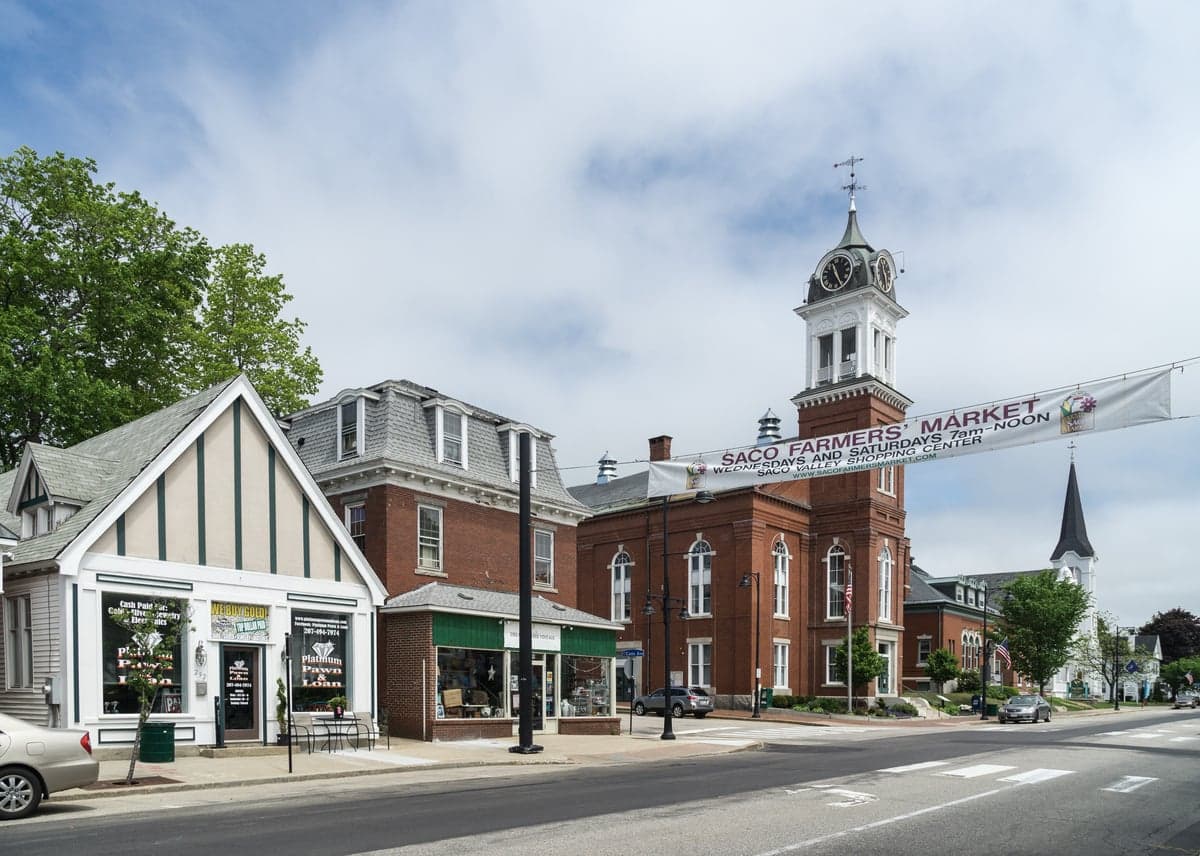
Photo: Wikipedia
Demographics of Saco, ME
Affluence Level in Saco, ME
A middle-class area roughly in line with national averages across income, home values, education, and employment.
People of Saco, ME
The people of Saco, Maine, today number 20,636, forming a predominantly white (85.4%) and well-educated (40.5% college degree) community that blends historic New England stock with a modest but growing diversity. The city’s character is shaped by its dual identity: a former mill town with deep Franco-American and Irish roots, now increasingly a bedroom suburb for Portland and a magnet for families seeking lower taxes and good schools. Saco is denser than its rural neighbors but less crowded than Portland, with a distinctive civic pride rooted in its preserved downtown and riverfront.
How the city was settled and grew
Saco’s original European settlers were English Puritans from the Massachusetts Bay Colony, who arrived in the 1630s and established a farming and fishing community along the Saco River. The town was formally incorporated in 1762, but its population exploded in the 19th century with the rise of textile mills powered by the Saco River’s falls. Irish immigrants fleeing the Great Famine (1845–1852) built the mills and settled in the working-class Pepperell Park and Factory Island neighborhoods, where their descendants still form a visible cultural presence. French Canadians from Quebec followed from the 1860s through the 1890s, drawn by mill jobs, and concentrated in the North Saco area near the Biddeford line, creating a tight-knit Franco-American enclave centered on St. Joseph’s Church. By 1900, Saco was a classic New England mill city, with a population that was overwhelmingly white, Catholic, and working-class.
Modern era (post-1965)
The post-1965 era brought gradual demographic change. The Immigration and Nationality Act of 1965 opened doors to non-European immigrants, but Saco’s foreign-born population remains low at just 3.3% — far below the national average. The city’s growth since the 1970s has been driven primarily by domestic in-migration: families and professionals from southern Maine and Massachusetts seeking affordable housing and good schools. This wave settled in newer subdivisions like Boothby Hills and Hills Beach, where single-family homes on larger lots replaced farmland. The Hispanic population (3.9%) and Black population (2.9%) are small but growing, with most Hispanic residents concentrated in the Downtown Saco area near the schools and social services, while Black families are scattered across the city with no single dominant enclave. East/Southeast Asian residents (1.2%) are primarily professionals in tech and healthcare, living in the West Saco neighborhoods near the Maine Turnpike. The Indian subcontinent population (0.1%) is negligible. The city’s white share has declined from roughly 95% in 1990 to 85.4% today, a shift driven more by domestic out-migration of older white residents to Florida and New Hampshire than by rapid minority in-migration.
The future
Saco’s population is slowly diversifying, but the pace is moderate. The foreign-born share (3.3%) is unlikely to spike dramatically given the city’s high housing costs (median home value ~$350,000) and limited rental stock. The Hispanic and Black populations are growing organically through births and secondary migration from larger cities like Portland and Boston, but they remain small and geographically dispersed rather than forming distinct ethnic enclaves. The East/Southeast Asian community is stable, tied to the University of New England’s medical programs and nearby tech employers. The most significant demographic trend is the aging of the Franco-American and Irish core: many younger residents leave for Portland or Boston after college, while retirees stay. Over the next 10–20 years, Saco will likely become slightly more diverse but remain a predominantly white, middle-class suburb with a strong sense of local identity. The city is not tribalizing into ethnic neighborhoods; instead, it is homogenizing around a shared civic culture, with newcomers — whether from Massachusetts or from abroad — assimilating into the existing social fabric.
For someone moving in now, Saco offers a stable, safe, and well-run community where the population is slowly becoming more diverse but remains overwhelmingly white and native-born. The city’s future is one of gradual, managed growth — not rapid transformation — making it a predictable choice for families and conservatives who value continuity over change. The key trade-off is affordability relative to Portland versus limited ethnic and cultural diversity.

* Values derived from national, state, county, city and local statistics and may differ in a specific area. Last updated: 2026-05-02T00:21:56.000Z
Narrative content on this page is AI-generated and may contain mistakes. Verify any details that matter before acting on them.
ReloMaps may earn a commission from affiliate links at no extra cost to you.

